
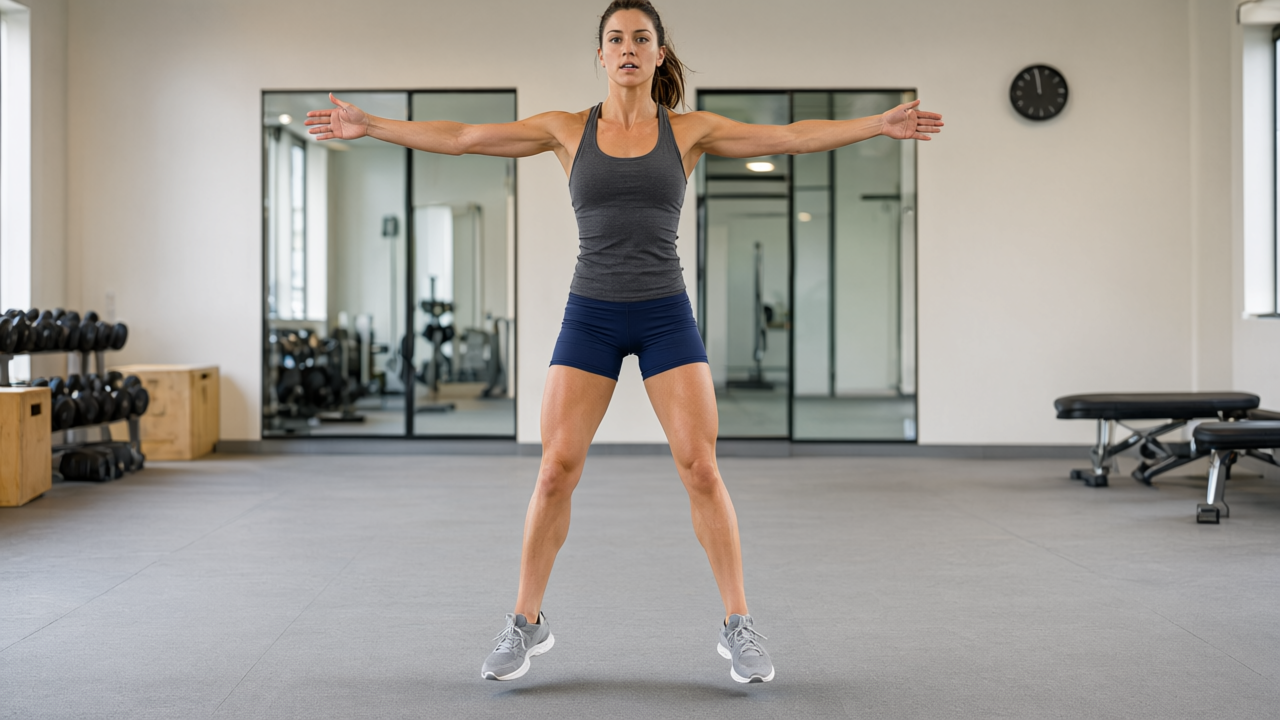
Jumping Jacks
jumping-jacks
Ten cuidado con
- modify · Acute knee injury — Repeated landing impact loads the patellofemoral joint with every rep. Swap to step-out jacks: tap one foot out to the side at a time instead of jumping, keeping the arms and pace identical so the heart-rate work stays.
- modify · Pregnancy — Jumping and rapid position changes are poorly tolerated as balance shifts. Use step-out jacks at a pace where conversation stays possible, and stop if you feel any abdominal doming or pelvic pressure.
When I guide you through jumping jacks, I want you to feel light, rhythmic, and fully coordinated. Good reps flow like a steady heartbeat, where your breath matches your movement and your joints absorb impact smoothly. Focus on maintaining a tall spine, soft knees, and controlled arm swings. You should finish feeling energized, not exhausted, with a gentle warmth spreading through your shoulders and lower body.
Si eres nuevo en esto
Jumping jacks are a fantastic entry point into rhythmic cardio, but landing mechanics matter more than speed. Keep your knees tracking over your second toe and let them bend naturally on impact. If you feel sharp pain in your ankles, knees, or lower back, pause immediately and switch to step-out jacks until your joints adapt. You will know you are pushing too hard when your breathing becomes ragged or your shoulders start hiking toward your ears. Avoid letting your feet slap the floor loudly; a quiet landing means your muscles, not your joints, are absorbing force. Common compensations include overarching your lower back when your core fatigues or swinging your arms too wide past your shoulders. Stay light on your toes, keep your gaze forward, and prioritize smooth transitions over raw speed. Consistency will build your endurance safely.
Ir más allá
To make jumping jacks genuinely demanding, manipulate your pace rather than simply adding duration. Try a two-second pause at the wide landing position to increase time under tension in the calves and hip abductors, or alternate between thirty seconds of rapid turnover and thirty seconds of slow, deliberate reps. Harder here means sustaining that quiet midfoot landing while you push the speed or extend the set well beyond ninety seconds. Once you can handle four-minute continuous sets without your rhythm degrading, progress to seal jacks, where you add a forward hinge and clap behind your back to challenge coordination and posterior chain endurance. For variation, try half jacks, keeping the arms below shoulder height to isolate lower-body speed, or cross jacks, crossing one foot in front of the other on each return to introduce a rotational demand through the hips and ankles.
Errores comunes
Most practitioners rush the tempo and sacrifice joint alignment, which quickly turns a fluid movement into a jarring impact. The most frequent error is locking the knees straight upon landing, transferring shock directly into the joints instead of letting the calves and quads absorb it. Many also allow their core to collapse, causing the lower back to arch excessively as fatigue sets in. Another common issue is overextending the arm swing, which creates unnecessary tension in the upper traps and disrupts your natural breathing rhythm. Finally, landing with a heavy, flat-footed slap instead of rolling through the midfoot kills your momentum and accelerates fatigue.
Rutina
- Sets
- 3
- Reps
- 15-20
- Rest
- 60s
- RPE
- 3
- Per set
- ~90s
- Frecuencia
- 3-4x/week
Increase your working duration by fifteen seconds each week while maintaining a crisp, quiet landing.
Cues
Músculos
- Calves
- Quadriceps
- Glutes
- Abs
- Shoulders
- Cardiovascular
Equipo
- Bodyweight
- 1
Stand tall with your feet together, arms resting at your sides, and shoulders relaxed.
- 2
Inhale deeply as you push through the balls of your feet to jump upward.
- 3
Simultaneously sweep your arms out to shoulder height while spreading your legs wider than your hips.
- 4
Land softly with knees slightly bent and toes pointing forward to cushion the impact.
- 5
Exhale smoothly as you immediately spring back to the starting position, bringing arms down and feet together.
- 6
Maintain a steady, rhythmic pace and keep your core gently engaged throughout each repetition.
- 7
Reset your posture after the set, rolling your shoulders and taking three deep breaths to recover.