
Wall Hip Hinge
wall-hip-hinge
Achten Sie auf
- caution · Herniated disc — A disc that is angry usually objects to the spine rounding while the hips stop moving — which is what happens when you reach for the wall with your hips instead of keeping them stacked. Keep the back completely flat as written and stop at the light touch. If flexion is symptomatic today, take the hip movement from Glute Bridge, which trains the same end position with no spinal flexion, and Bird Dog for the brace. Numbness, tingling or weakness down a leg is a clinician's question, not a range adjustment.
- modify · Acute lower back injury — Hinging requires the lumbar spine to hold still while the hips move, and a back that is currently reactive will often take over the movement instead — the wall never gets touched, or you reach it by arching. Take a smaller range and let the hands rest on the thighs for support. If hinge patterns aggravate it, substitute Glute Bridge, which trains the same hip extension with the spine fully supported on the floor, and come back to the hinge once walking hinged is comfortable.
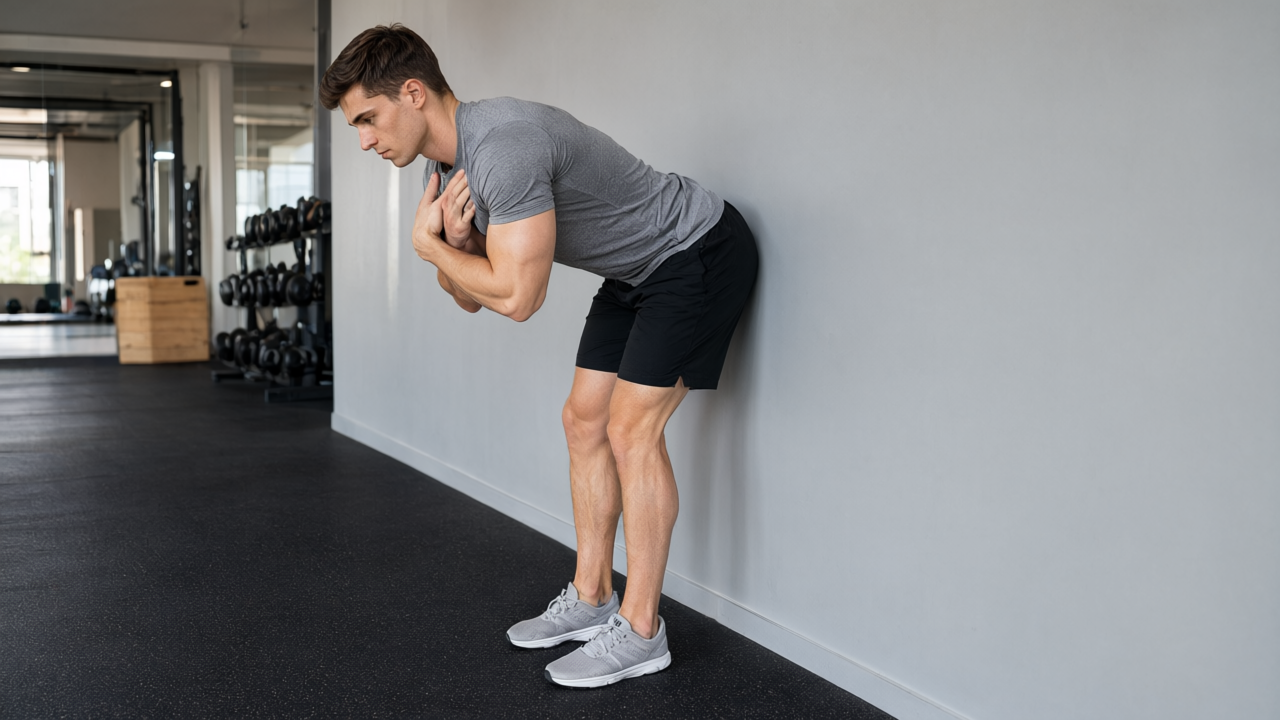
When I cue you into the Wall Hip Hinge, I am teaching your body to move from the hips rather than the knees or lower back. You stand facing away from a wall and push your hips back until they touch it, keeping your spine flat and shins vertical. This drill builds the exact pattern you need before loading any deadlift variation.
Wenn Sie neu dabei sind
The first time you try this, your instinct will be to squat by bending your knees forward rather than pushing your hips back. If your shins tilt past your toes, you have lost the hinge. Reset, soften the knees only slightly, and think about closing the gap between your ribs and pelvis at the back while opening it at the front. Another common error is rounding the lower back as you reach for the wall. Keep your chest proud and imagine balancing a glass of water on your upper back. You should feel a gentle stretch through your hamstrings and tension in your glutes at the deepest point. If you feel pinching in your lower back, you have gone too far or rounded your spine. Stop immediately, step closer to the wall, and reduce your depth. Practise this daily during your warm-up until the movement feels entirely natural and automatic before adding external load.
Mehr erfahren
Once you can touch the wall comfortably from a full foot length away, increase the distance by small increments each session to deepen the hamstring stretch under control. Use a slow tempo: three seconds hinging back, a one-second pause with your glutes resting lightly on the wall, and two seconds driving forward. Perform two sets of ten to fifteen repetitions as part of your warm-up. When you can hinge smoothly from two foot lengths away with a perfectly flat back and vertical shins, progress to a bodyweight single-leg Romanian deadlift to challenge your balance and unilateral stability. Alternatively, hold a light kettlebell in a goblet position to add anterior load, which forces your core to work harder to maintain spinal neutrality throughout the hinge pattern.
Häufige Fehler
Bending the knees excessively turns the hinge into a squat, shifting the effort to the quadriceps and removing the hamstring stretch. Keep the knee angle fixed after the initial softening. Rounding the lower back to reach the wall places shear force on the lumbar spine. Maintain a long, neutral spine from your tailbone to the crown of your head throughout. Leaning the shins forward means your centre of gravity has shifted incorrectly; anchor your weight evenly across your whole foot and keep the shins vertical. Finally, bouncing off the wall uses momentum rather than muscular control. Touch the wall softly, pause briefly, and drive the hips forward using only your glutes.
Routine
- Sets
- 2
- Reps
- 10–15 reps
- Rest
- 30s
- Tempo
- 3-1-2-0
- RPE
- 3
- Per set
- ~60s
- Häufigkeit
- 4
Increase distance from wall by small increments each session
Cues
Muskeln
- Glutes
- Hamstrings
- Lower back
- Abs
Geräte
- Bodyweight
- 1
Stand facing away from a wall with your feet hip-width apart, roughly one foot length in front of it.
- 2
Place your hands on your hips or cross them over your chest, keeping your spine tall and neutral.
- 3
Soften your knees slightly without bending them further; your shins must stay perfectly vertical throughout.
- 4
Inhale, then push your hips straight back towards the wall, letting your torso tip forward as one rigid unit.
- 5
Continue hinging until your glutes lightly touch the wall behind you, maintaining a completely flat back.
- 6
Exhale and squeeze your glutes to drive your hips forward, returning to a tall standing position.
- 7
Step one or two centimetres further from the wall and repeat the hinge for the next repetition.