
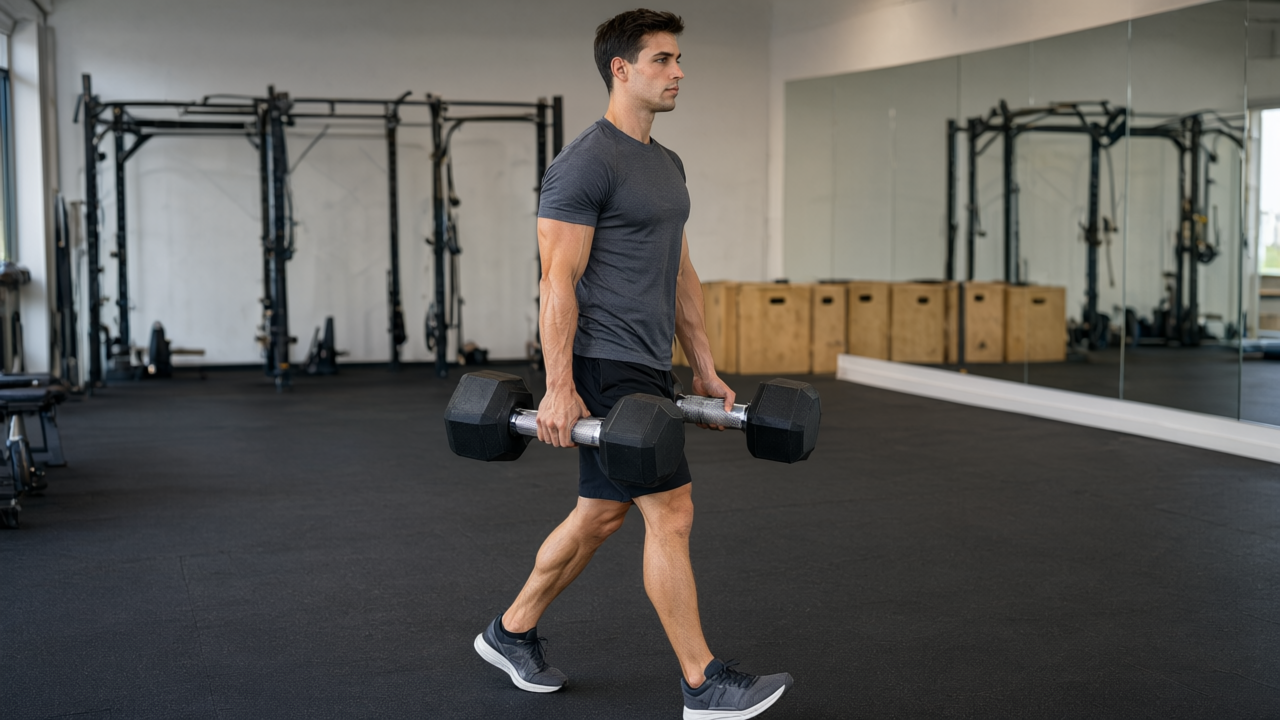
Thick Bar Farmer's Carry
thick-bar-farmer-s-carry
Achten Sie auf
- caution · Shoulder impingement — The loaded carry can aggravate shoulder impingement if posture breaks down. Focus on maintaining shoulder retraction or substitute with a lighter load.
A farmer's carry performed with a thick bar, fat grips, or a specialized thick-handled implement. The increased diameter forces the forearm flexors to work harder to maintain grip closure throughout the walk. This is a genuine progression from standard farmer's carries — the thicker the grip, the more the forearm must work to prevent the implement from slipping. The movement also trains core stability, postural endurance, and total-body tension under load.
Wenn Sie neu dabei sind
Master a standard farmer's carry with a normal barbell or dumbbell first. The thick grip significantly increases the demand on the forearms — most people find they can carry 30-50% less weight with a thick grip compared to a standard grip. Start lighter than you think you need.
Mehr erfahren
Walk at a deliberate, even pace rather than rushing. A three-second pause mid-stride every ten metres forces your forearms to re-engage fully and exposes any grip asymmetry. For pure grip endurance, carry for sixty seconds or more; for maximal forearm recruitment under heavy load, keep the distance to thirty metres but use heavier dumbbells. Add weight only when you complete all three sets with a closed hand and steady posture throughout. Once thick-handled dumbbells no longer challenge your grip at your heaviest available pair, move on to the plate pinch hold, which removes the cylindrical shape entirely and demands a different type of crushing strength. To vary the stimulus without changing equipment, try carrying one dumbbell at a time in a suitcase position, which shifts the demand heavily onto your obliques while still taxing the working hand, or walk slowly uphill to increase time under tension without adding load.
Häufige Fehler
Letting the shoulders round forward or the chest collapse as the grip fatigues — this compromises posture and shifts load from the forearms to the upper back in a way that can cause injury. Also: taking short, choppy steps instead of maintaining a normal walking gait. The carry should look like controlled walking, not a shuffle.
Routine
- Sets
- 3
- Reps
- 30-60m distance or 30-60s time
- Rest
- 120s
- Tempo
- steady walk
- RPE
- 8
- Häufigkeit
- 1-2
Increase weight by 2.5-5kg, or extend distance/time by 10m/10s
Cues
Leichter, schwerer, alternativ
Muskeln
- Forearms
- Upper back
- Shoulders
Geräte
- Dumbbells
- 1
Attach fat grips to a pair of dumbbells or use a thick-handled implement. Load the desired weight.
- 2
Stand between the implements and hinge at the hips to grip them, keeping your chest up and back flat.
- 3
Drive through your heels to stand upright, arms straight at your sides, shoulders pulled back and down, core braced.
- 4
Walk forward with steady, controlled steps for the prescribed distance or time. Maintain upright posture throughout.
- 5
At the end of the set, hinge at the hips to lower the implements to the ground under control.