
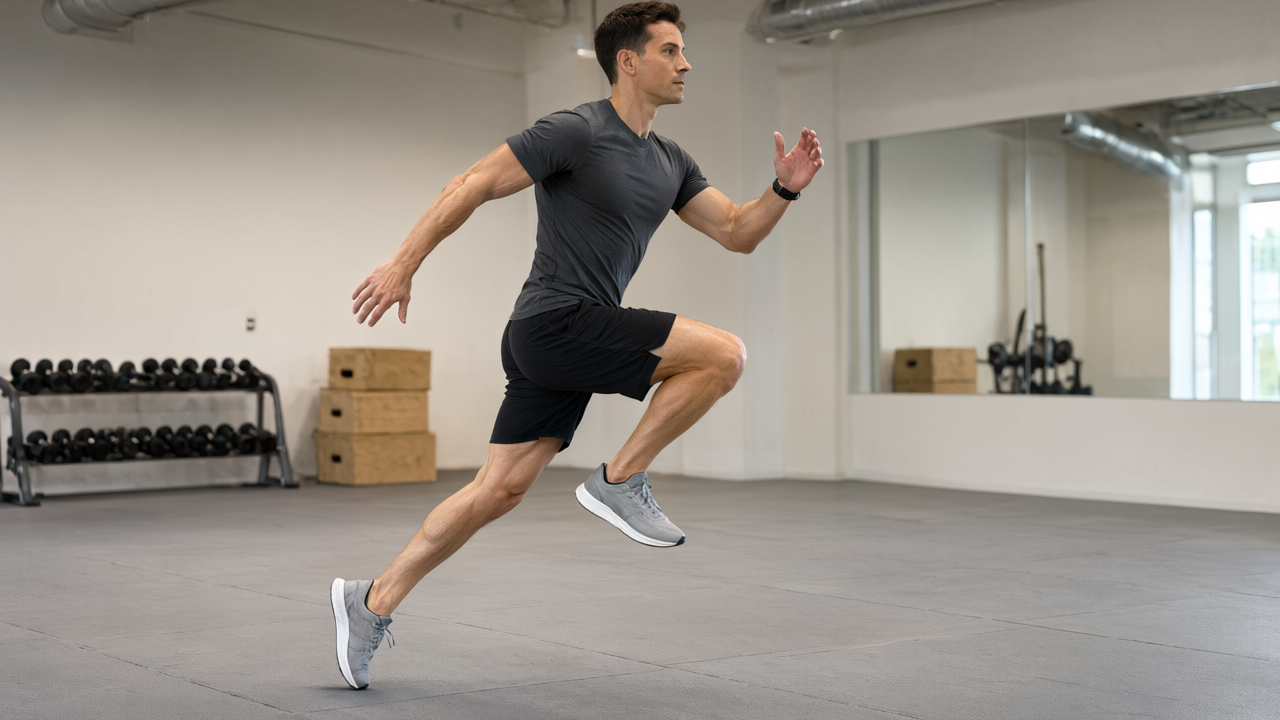
Skater Jumps
skater-jumps
When you execute these well, you feel like a pendulum of controlled momentum. Each bound launches from a stable, single-leg anchor, and your landing melts into the next rep with a quiet, springy rhythm. Focus on driving through your working foot, keeping your chest tall, and letting your arms swing naturally to counterbalance. You should feel the burn in your outer hips and quads, not your joints.
Wenn Sie neu dabei sind
Start with a modest lateral range; quality of landing matters far more than distance. Keep your core braced and your chest lifted to prevent your spine from collapsing forward. If you feel sharp pain in your knees or ankles, stop immediately and regress to a low-impact side step. True muscular fatigue will feel like a heavy, burning pump in your glutes and outer thighs, not joint instability. Avoid letting your landing knee cave inward or your torso twist excessively. Instead, track your knee directly over your second toe and let your arms act as natural counterweights. Breathe rhythmically with each push and land. Remember, this is a skill of control disguised as a jump. Master the quiet, spring-like landing before chasing speed or distance, and your lateral power will build safely and steadily.
Mehr erfahren
To extract more from skater jumps, manipulate your tempo deliberately. Spend two to three seconds stabilising on the landing leg before launching into the next bound; this pause under tension builds lateral stiffness and control. The push-off itself should be rapid and forceful. Stick to sets of eight to twelve reps at an RPE of 8, resting ninety seconds between efforts. Making this harder means increasing your lateral distance per bound or adding a light resistance band around your thighs to challenge hip abduction throughout the flight phase. When you can cover maximum comfortable distance with silent landings and no wasted movement across all three sets, progress to single-leg continuous hops in one direction before switching. For variation, try pausing for a full three seconds on each landing to eliminate the stretch reflex entirely, forcing pure concentric power on every jump.
Häufige Fehler
Most lifters sacrifice stability for distance, which turns a powerful plyometric into a joint-pounding crash. Letting the landing knee collapse inward places dangerous shear stress on the patella and medial ligaments. Another frequent error is over-rotating the torso, which bleeds lateral momentum and forces the lower back to absorb the impact instead of the legs. Many also hold their breath through the entire sequence, causing premature fatigue and a rigid, choppy rhythm. Finally, landing with straight legs or on flat feet bypasses the body’s natural shock absorbers. Focus on a quiet, bent-knee touchdown with a neutral spine and controlled exhalation to keep the movement efficient.
Routine
- Sets
- 3
- Reps
- 8-12
- Rest
- 90s
- RPE
- 8
- Per set
- ~60s
- Häufigkeit
- 2-3x/week
Increase lateral distance, add a light resistance band around the thighs, or transition to single-leg continuous hops.
Cues
Muskeln
- Glutes
- Quadriceps
- Abductors
- Calves
- Hamstrings
- Obliques
Geräte
- Bodyweight
- 1
Stand tall with feet hip-width apart, knees soft, and arms relaxed at your sides.
- 2
Shift your weight onto your right foot, hinge slightly at the hips, and exhale as you drive laterally off your right leg.
- 3
Swing your left arm forward and right arm back to counterbalance while propelling yourself sideways.
- 4
Land softly on your left foot, bending the knee and hip to absorb impact while keeping your torso upright.
- 5
Inhale as you immediately load the left leg, then exhale and push off to leap back to the right side.
- 6
Repeat the lateral bounds continuously, maintaining a steady, rhythmic cadence for the prescribed repetitions.
- 7
Finish your final rep, land with both feet, and step into a neutral stance to reset your breathing.