
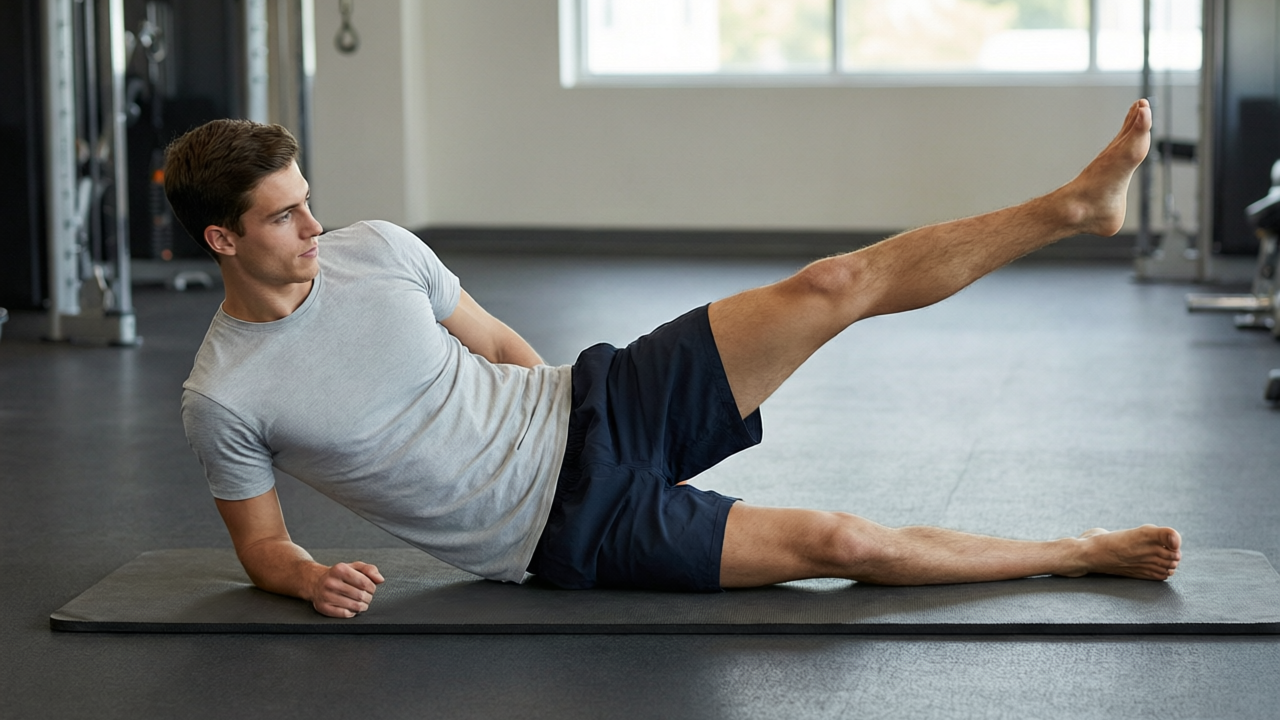
Side Kick Series
side-kick-series
When you execute this series well, you’ll feel a clean, rhythmic sweep through your outer hips and a steady, braced core that never wavers. I want you to focus on lengthening through the working leg while your torso stays anchored to the floor. Each kick should feel controlled, fluid, and powered from your center, leaving your shoulders relaxed and your breath moving smoothly through every transition.
Wenn Sie neu dabei sind
Focus on keeping your ribcage stacked directly over your pelvis throughout every repetition. As a beginner, you will feel a deep burn along the outer thigh and a subtle tremor in your core as the stabilizers wake up. That sensation is normal and signals proper engagement. Stop immediately if you feel sharp joint pain in the hip or lower back, or if your pelvis begins to rock with each kick. A common compensation is letting the working leg drag the torso into a backward roll; instead, imagine your spine is glued to the floor and only the leg moves. Keep your shoulders relaxed away from your ears and maintain a steady breathing rhythm. If fatigue compromises your alignment, reduce the range of motion or pause to reset. Mastery here comes from precision, not height or speed, so honor the smaller, controlled movements until your neuromuscular system builds the necessary endurance.
Mehr erfahren
To deepen the challenge, extend your tempo to a four-count lowering phase on every return, pausing for two seconds at full extension to eliminate momentum and force the abductors to stabilise under load. The standard eight to twelve repetitions build endurance, but if you can complete three sets without your pelvis shifting, introduce a light ankle weight or increase the count to fifteen. Harder here means greater time under tension and stricter leverage, not speed; keeping both legs hovering off the mat throughout the entire sequence dramatically increases core demand. Once the weighted series feels steady, progress to small continuous circles in both directions, which removes the pause between reps entirely. You might also explore performing the sequence with your supporting forearm lifted so only your head and bottom hip contact the mat, demanding far more lateral stability. Alternatively, the standing side kick series transfers this exact pattern upright, challenging your balance against gravity rather than the floor.
Häufige Fehler
Most practitioners sacrifice spinal alignment by allowing their pelvis to tilt backward as the leg sweeps, which shifts the workload away from the glutes and strains the lumbar spine. Another frequent error is gripping the shoulders toward the ears, creating unnecessary tension that disrupts the fluidity of the movement. Many also rush the tempo, turning the controlled Pilates flow into a ballistic kick that bypasses core engagement entirely. Finally, letting the working knee collapse inward during the lift phase compromises hip joint tracking and reduces abductor activation. Prioritize a neutral spine, relaxed shoulders, and deliberate pacing to ensure the muscles work exactly as intended.
Routine
- Sets
- 3
- Reps
- 8-12
- Rest
- 90s
- Tempo
- 2-0-2-0
- RPE
- 4
- Per set
- ~90s
- Häufigkeit
- 2-3x/week
Increase the number of repetitions per sequence or add a light ankle weight to challenge hip stability and control.
Cues
Muskeln
- Abductors
- Glutes
- Obliques
- Abs
Geräte
- Mat
- 1
Lie on your right side on the mat with your legs stacked, head resting on your bottom arm and your top hand planted lightly on the floor in front of your chest.
- 2
Draw your navel toward your spine, lengthen your neck, and lift both legs slightly off the mat to engage your core.
- 3
Inhale as you sweep your top leg forward in a smooth, controlled arc, keeping the movement driven from your hip socket.
- 4
Exhale as you draw the leg back, squeezing the outer glute and abductor without letting your torso roll backward.
- 5
Inhale to lift the top leg toward the ceiling, then exhale to lower it back to the starting height with control.
- 6
Inhale to sweep the leg forward again, then exhale to circle it backward in a wide, fluid half-circle.
- 7
Inhale as you bend the working knee, then exhale to press the foot away and straighten the leg fully before returning.
- 8
Lower both legs to rest on the mat, shake out the hips, and repeat the entire sequence on your left side.