
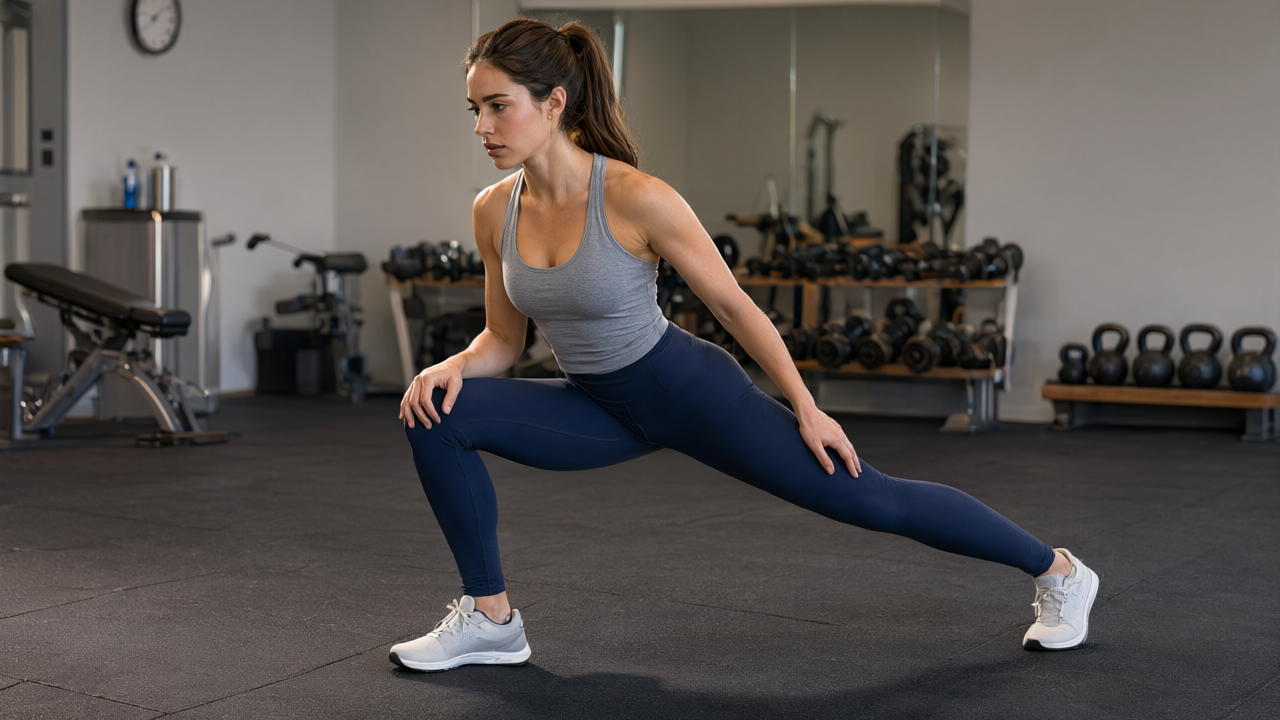
Lateral Lunge
lateral-lunge
Achten Sie auf
- caution · Vertigo / balance disorder — This is a deep single-leg stance with a lateral weight shift, and the recovery back to centre is where a wobbly ankle rolls. Take a narrower step, keep both hands free to find a wall, and do it beside a support you can touch. If balance is the limit rather than the inner thigh, substitute Wall Sit, which trains the same leg without any transition.
- modify · Acute knee injury — The side step puts the knee in front of the hip and loads it bent, and the depth people chase is past where the joint stays quiet. Keep the knee tracking over the second toe as written, stop at the depth where you feel the inner thigh and glute working rather than the knee, and shorten the step. If the knee is the sensation, substitute Glute Bridge, which loads the hip with the knee in a safe fixed bend and no shear.
- modify · Acute lower back injury — Hinging forward to counterbalance a wide side lunge loads the lumbar spine asymmetrically, which is a worse deal than a symmetrical hinge at the same effort. Keep the torso as upright as your ankle range allows and brace before you step; if you have to pitch forward to stay balanced, the step is too wide. Substitute Bodyweight Squat with the feet planted straight in front of you, or Glute Bridge, and work back to the lateral pattern once an upright torso is sustainable.
When I coach this movement, I want you to feel a deep, controlled stretch along your inner thigh while your planted side stays completely anchored. Good reps should feel smooth and rhythmic, like a pendulum swinging with purpose. You’ll notice a satisfying burn building in your glutes and quads, while your knees track comfortably over your toes. Breathe steadily, own that lateral range, and let each rep build grounded, athletic confidence.
Wenn Sie neu dabei sind
Start with a shorter step than you think you need, focusing entirely on keeping your chest lifted and your weight centered over your midfoot. If your heel lifts off the ground or your knee caves inward, shorten your stance immediately. True failure in this movement feels like a sharp pinch in the knee joint or a sudden loss of balance, not just muscular fatigue. Stop the set the moment your form breaks down, your lower back rounds, or you feel joint discomfort. Beginners often compensate by leaning their torso too far forward or letting the trailing knee bend slightly, which steals tension from the working leg and shifts stress to the spine. Keep your trailing leg locked out and hinge strictly from the hips. Practice slowly in front of a mirror, counting a full three seconds down and one second up. Trust that even a shallow range of motion builds excellent foundational strength, and your mobility will naturally expand as your nervous system adapts. You are training control first; depth follows.
Mehr erfahren
To make this movement genuinely challenging without external load, extend the eccentric phase to four or five seconds and add a two-second pause at maximum depth. That pause eliminates any elastic rebound from your adductors, forcing you to generate pure concentric strength to return to standing. Sets of eight to twelve per side remain ideal for building tissue tolerance, but if you can complete twelve controlled reps with a full pause and still feel fresh, it is time to progress. Your next step is holding a dumbbell or kettlebell at the chest in a goblet position, which shifts your centre of mass forward and demands more from your quads and core. Alternatively, try the Cossack squat, where both feet stay planted wide throughout and you sink deeper into each side sequentially. For variation, performing the lateral lunge on a slight deficit under the working foot increases the stretch on the adductors and challenges your end-range stability further.
Häufige Fehler
Most lifters rush the descent, allowing gravity to dictate the tempo and sacrificing joint control. The second most frequent error is letting the working knee drift inward past the midline of the foot, which places unnecessary shear force on the knee ligaments. Many also round their thoracic spine and collapse their chest forward, turning a lower-body strength builder into a lower-back strain. Another common flaw is keeping the trailing leg slightly bent, which robs the movement of its intended hip and adductor tension. Finally, stepping too far out before building adequate mobility forces a deep, uncontrolled drop that compromises stability and makes the return phase impossible to execute cleanly.
Routine
- Sets
- 3
- Reps
- 8-12
- Rest
- 90s
- Tempo
- 2-0-2-0
- RPE
- 7
- Per set
- ~90s
- Häufigkeit
- 2-3x/week
Add load by holding dumbbells or a kettlebell at the chest, or increase depth and slow the eccentric phase for greater time under tension.
Cues
Muskeln
- Quadriceps
- Glutes
- Adductors
- Abductors
- Abs
Geräte
- Bodyweight
- 1
Stand tall with feet together and arms relaxed at the sides.
- 2
Plant feet shoulder-width apart with toes pointing slightly outward.
- 3
Engage the core and maintain a neutral spine.
- 4
Inhale while shifting weight onto the right foot and stepping directly out to the right side.
- 5
Keep the left leg completely straight and the left foot flat on the floor.
- 6
Push the hips back and bend the right knee, ensuring it tracks directly over the right toes.
- 7
Lower the hips until the right thigh reaches a comfortable depth or becomes parallel to the floor.
- 8
Exhale while pressing firmly through the entire right foot to initiate the return.
- 9
Pull the right foot back toward the center until both feet meet shoulder-width apart.
- 10
Reset posture to a tall standing position before repeating on the left side.