
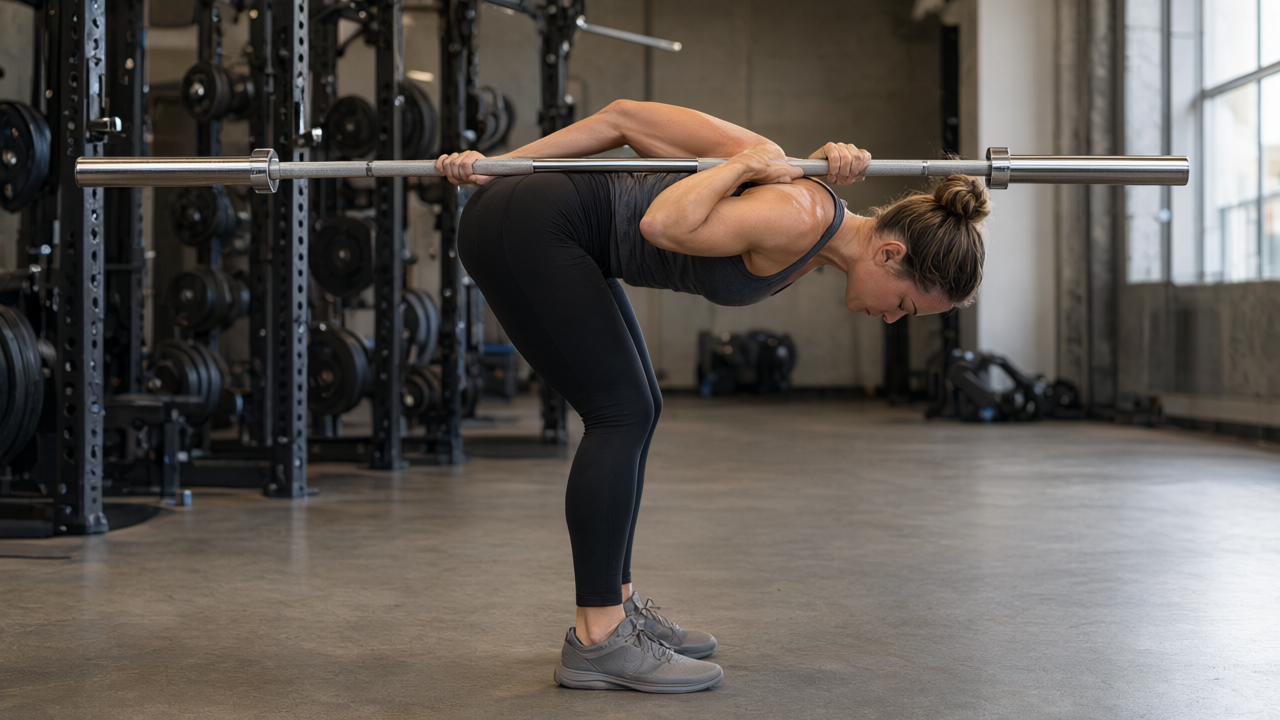
Good Morning
good-morning
Achten Sie auf
- avoid · Osteoporosis — Axial loading combined with forward spinal flexion significantly increases vertebral fracture risk. Instead, use supported hip hinge variations or machine-based leg curls to target the hamstrings.
- avoid · Acute lower back injury — The long lever arm places extreme shear force on the lumbar spine during the hinge. Instead, perform glute bridges to train hip extension without loading the lower back.
- avoid · Herniated disc — Forward flexion under axial load drives compressive forces directly into the intervertebral discs. Instead, use bird-dogs or cable pull-throughs to strengthen the posterior chain safely.
- avoid · Pregnancy — Deep bracing against a heavy barbell increases intra-abdominal pressure and restricts diaphragm movement. Instead, perform bodyweight hip hinges or banded good mornings with minimal load.
When I load the bar across my shoulders and begin to hinge, a proper rep feels like a smooth, deliberate unfolding from the hips. I feel a deep, steady stretch along my hamstrings and glutes, never a sharp pull in my lower back. The weight moves with my torso in one solid line, controlled and quiet. Each rep should leave my posterior chain humming with tension, proving I’ve mastered the hinge without rushing or compromising my spine.
Wenn Sie neu dabei sind
When you are first learning this pattern, leave your ego at the door and use a light bar or even just the empty shaft. Focus entirely on hinging at the hips rather than bending at the waist. Imagine a straight rod running through your spine; it must not flex, extend, or twist. If your lower back begins to ache or round, you have exceeded your current mobility or loaded the bar too heavily. Stop immediately when form degrades, as spinal shear is not worth the extra reps. Beginners often compensate by bending the knees into a squat or letting the bar slide down the back, both of which defeat the purpose of the exercise. Keep a slight, constant knee bend throughout, lock your gaze a few feet ahead, and move with deliberate control. Trust the stretch in your hamstrings and build confidence slowly. You will quickly discover how much power lives in your posterior chain when you respect the mechanics.
Mehr erfahren
Slow the lowering phase to three or four seconds to maximise hamstring tension, then drive up with intent. A two-second pause at the bottom removes momentum and forces your spinal erectors to work harder under load. The 8–12 rep range builds tissue tolerance, but dropping to sets of 5–8 with a heavier barbell develops raw hip extension strength. Add weight only when every rep in your target range finishes with a flat back and full glute contraction; if your lower back tightens before your hamstrings fatigue, stay put. Once you handle heavy loads for 3 sets of 8 without form breaking down, progress to the stiff-legged deadlift or the barbell Romanian deadlift, which challenge the same hinge under greater absolute loading. For variation, try the seated good morning to isolate the upper back and remove leg drive, or use a safety squat bar to shift the centre of mass forward and increase thoracic demand.
Häufige Fehler
Most lifters sabotage this movement by treating it like a squat, bending their knees excessively as they descend instead of pushing the hips backward. Another frequent error is allowing the thoracic spine to collapse or the lumbar curve to reverse, which shifts dangerous compressive forces directly onto the intervertebral discs rather than the target musculature. Many also rush the tempo, using momentum to bounce out of the bottom position, which completely eliminates the eccentric tension required for true posterior chain development. Finally, placing the barbell too low on the traps or gripping it too tightly can pull the shoulders forward and break your rigid spinal alignment before the first rep even begins.
Routine
- Sets
- 3
- Reps
- 8-12
- Rest
- 90s
- Tempo
- 2-0-2-0
- RPE
- 7
- Per set
- ~120s
- Häufigkeit
- 2-3x/week
Increase barbell load by 5 lbs once you complete all sets at the top of the rep range with controlled form and full range of motion.
Cues
Muskeln
- Hamstrings
- Glutes
- Lower back
- Abs
- Upper back
- Traps
Geräte
- Barbell
- 1
Rest a barbell across the upper traps and secure it with an overhand grip.
- 2
Plant feet shoulder-width apart with toes angled slightly outward.
- 3
Brace the core, pull the shoulder blades together, and lock the spine in a neutral position.
- 4
Inhale deeply to stabilize the torso, then push the hips straight backward to initiate the hinge.
- 5
Lower the chest until a firm stretch develops in the hamstrings while keeping the knees softly bent.
- 6
Pause briefly at the bottom to verify the barbell remains close to the body and the back stays flat.
- 7
Exhale steadily while driving the hips forward to return to the starting upright position.
- 8
Contract the glutes firmly at the top to lock out the hips without arching the lower back.
- 9
Reset posture, take a controlled breath, and prepare for the next repetition.