
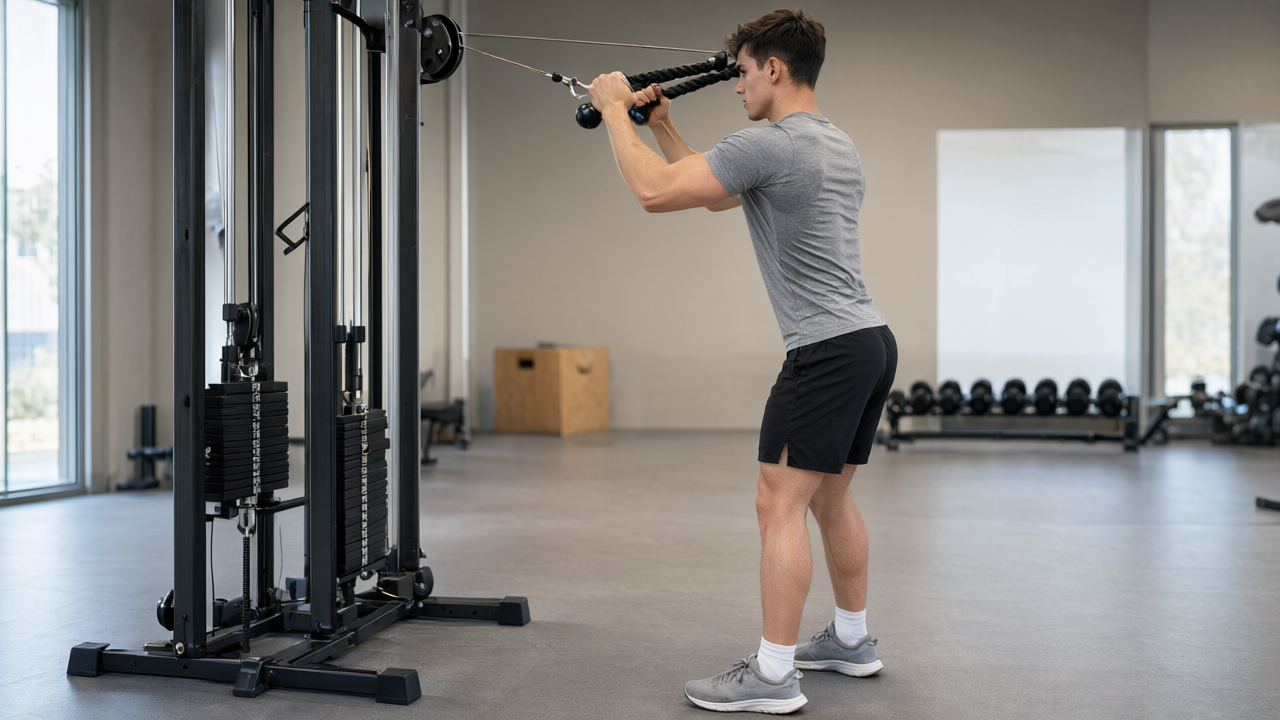
Face Pull
face-pull
Achten Sie auf
- avoid · Rotator cuff tear — The rope pulls the hands apart as the arm externally rotates under cable tension, which is the exact job a torn cuff cannot do reliably. Avoid it while the shoulder is healing. Substitute Table Inverted Row at a high body angle, where the arm finishes beside the ribs and nothing is rotated under load, or Chest-Supported Row with the same restriction. Anything that produces pain down the outside of the arm or a moment of weakness needs assessing, not programming around.
- caution · Uncontrolled hypertension — A sustained pull with the head near the rope and a hard exhale at the top invites a breath-hold, and this exercise is usually loaded lighter than it feels, so people take it to genuine failure — which is where the pressure spike happens. Keep the breath moving, stop well short of failure, and avoid until cleared. Substitute Bodyweight Squat or Wall Slides at easy effort. Stop on headache or spots in your vision.
- caution · Shoulder impingement — Driving the elbows high into external rotation is the point of the exercise and also what pinches an irritable shoulder, so lower the target: pull toward the chest rather than the forehead, keep the elbows below shoulder height, and lighten the load until the pull is boring. If it still catches, substitute Table Inverted Row with a high body angle, which trains the same rear shoulder and mid-back with the arm finishing beside the ribcage.
- modify · Acute lower back injury — Standing, people arch the lumbar spine and lean back to heave the weight, which turns a shoulder exercise into a loaded extension the back did not agree to. Take the load down, brace before the pull, and work half-kneeling or seated with the chest tall so the torso cannot join in. If the arch returns as the set gets hard, the set is over. Substitute Chest-Supported Row, which trains the same mid-back with the torso carried by the bench.
A cable pull that finishes at the face rather than the ribs, so the rear shoulder, external rotators and mid-back work through a range a normal row never reaches. A rope attachment is the best choice, because its two free ends let the hands travel past each other at the finish and complete the external rotation; a straight or V-bar handle trains the same pattern with the hands fixed apart, which is still useful if that is what the gym has. Light load, high control, the elbows leading.
Wenn Sie neu dabei sind
Start lighter than feels reasonable — this movement rewards control and punishes load, and a plate that forces you to row will teach the wrong pattern. Focus on leading with the elbows and squeezing the shoulder blades, not yanking with the hands. If your neck tenses, your traps shrug toward your ears, or your lower back arches, you are compensating; drop the weight a notch. Failure should feel like deep fatigue in the back of the shoulders, not sharp joint pain or strain at the elbow, and sharp pain means the set is finished. Stop the set when the hands can no longer finish beside your ears with the torso still quiet. Breathe out on the pull, in on the return, and let only the arms and shoulder girdle move. Do a few slow practice sets before worrying about progress, and expect the posture change to show up long before the load does.
Mehr erfahren
Extend the pause at full contraction to two or three seconds and actively spread the ends apart to maximise external rotation. Keep the lowering phase deliberate; a three-second return holds tension where it matters. Twelve to fifteen reps suits this for hypertrophy and shoulder health, dropping to eight to ten with slightly more resistance for the rotator cuff without losing form. Add load only when every rep in your top set finishes with a full squeeze and zero torso sway. Once the standard pull is owned, raise the pulley above head height to lengthen the range through which the lower traps and external rotators work, or move to a half-kneeling stance to remove subtle hip drive. Both use the same setup and expose weaknesses standing hides.
Häufige Fehler
Loading too much is the usual one, and it turns this into a heavy row: the elbows drop, the shoulders roll inward, and the lower back hyperextends to manufacture the missing force. Pulling too low toward the chest rather than the face shifts the work out of the rear shoulder and into the lats, so the exercise keeps its name and loses its point. Rushing the return lets the stack crash and deletes the half of the rep the rotator cuff was meant to get. Holding the breath or shrugging the traps toward the ears builds neck tension instead of upper-back strength and breaks scapular rhythm. Each fixes the same way: less load, torso braced, a slow tempo, and the elbows leading so external rotation finishes rather than being skipped.
Routine
- Sets
- 3
- Reps
- 12-15
- Rest
- 60s
- Tempo
- 2-1-2-0
- RPE
- 7
- Per set
- ~90s
- Häufigkeit
- 2-3x/week
Increase cable resistance once you can complete the top of the rep range with strict form and full rear delt contraction.
Cues
Muskeln
- Shoulders
- Upper back
- Traps
- Biceps
- Abs
Geräte
- Cable machine
- 1
Attach a handle to a cable pulley positioned at upper chest or forehead height.
- 2
Grasp it with your palms facing inward, hands roughly shoulder-width apart.
- 3
Step backward until the cable is taut and your arms are fully extended in front of your chest.
- 4
Plant your feet shoulder-width apart with a slight bend in your knees.
- 5
Brace your abdomen and pull your shoulder blades down away from your ears.
- 6
Exhale as you pull the handle directly toward your face.
- 7
Drive your elbows up and out so your hands finish beside your ears, no lower than your nose.
- 8
Hold the contracted position briefly, then let the hands travel a little past each other if the attachment allows.
- 9
Inhale as you slowly reverse the motion and fully extend your arms back to the start.
- 10
Step forward to slacken the cable before detaching the handle.