
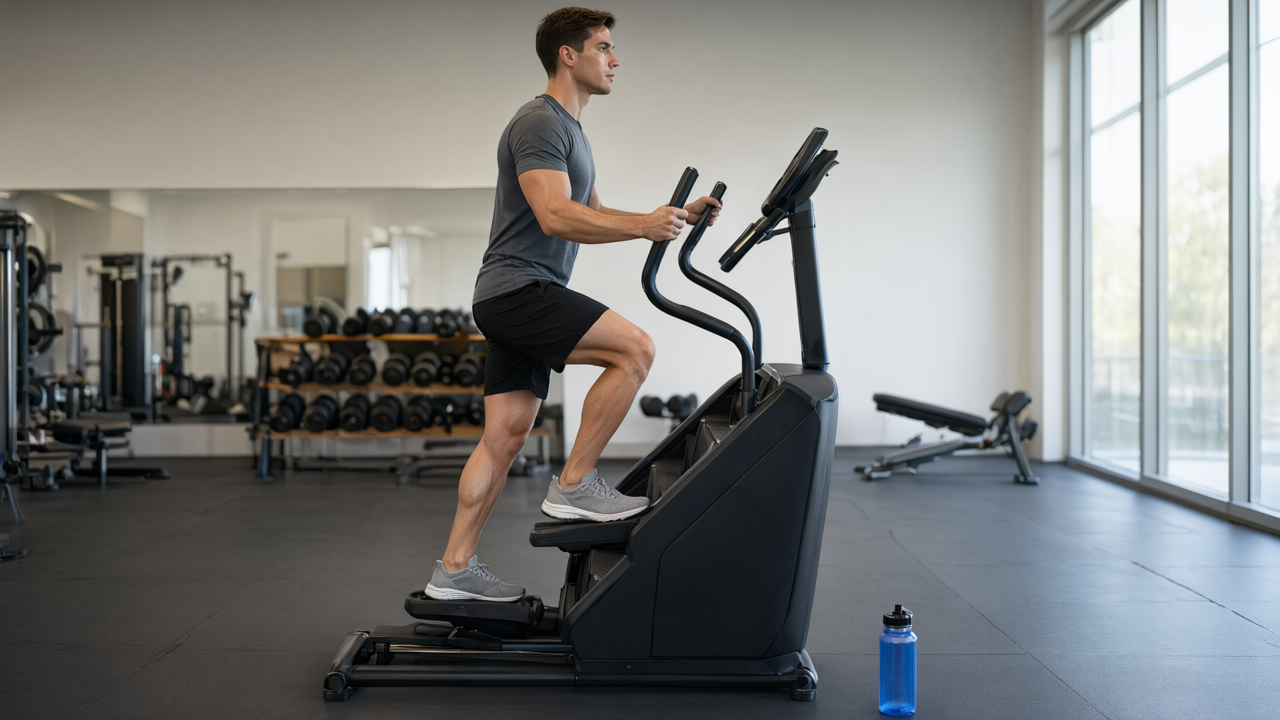
Stair Climber
stair-climber
Cẩn thận khi
- avoid · Vertigo / balance disorder — Moving steps under a person whose balance is unreliable is a fall onto the machine. Do not use it unsupported; hold both rails throughout with a spotter nearby, or use a recumbent exercise bike where the torso is supported the whole time.
- avoid · Cardiac condition (un-cleared) — The climb is continuous and hard to slow down quickly, and the machine will keep stepping with you once it is started. Do not use it until a physician has cleared aerobic work; walking on level ground lets the person set their own pace and stop instantly.
- caution · Uncontrolled hypertension — Sustained stepping raises blood pressure steadily and people often brace and grip the rails hard without noticing. Keep it conversational, breathe continuously through the work, and never max out effort on the day.
- modify · Acute knee injury — Continuous loaded knee bending aggravates an acutely sore knee. Lighten the load by resting more weight on the rails, stop short of full pedal depression, and keep sessions under ten minutes. Cycling on the exercise bike takes the same cardio without the bodyweight repetition.
- modify · Acute lower back injury — The upright stepping posture tires the trunk, and the lower back then takes the lean the legs should be doing. Hold the rails, stay tall, and cut the session short before that happens. Cycling or the Wall Hip Hinge train the same engine with the spine supported.
A powered staircase that keeps rising under you: continuous, low-impact stepping that trains the glutes, quadriceps and calves through a full stair-climbing stride while holding the heart rate up for as long as you want it held. The machine sets the pace, which is the point and the drawback — no balance skill, no terrain, but also no downhill to punish the knees. It is the cardio option when running is out: same breathless work, no impact spikes.
Nếu bạn mới bắt đầu
First time on it, expect the steps to feel like they are moving faster than you are: that is the machine's speed, not your fitness, and the fix is to slow it down until you can step without chasing. Start at the lowest resistance for three or four minutes before you decide how hard the session is. Hands rest on the rails for balance only — if you are pushing your weight into them, the legs are no longer doing the work and the heart rate reading is a lie. It should feel like a steady climb you could keep going, breathing hard but able to speak a sentence; a burning, pump-heavy thigh that forces you onto your toes means the stride is too short. Stop when form breaks down into leaning and bouncing, not when the timer says so, and step off only after the machine has fully stopped.
Vươn xa hơn
Harder means more resistance per step, not faster feet: a deliberate drive through the whole foot into a full pedal depression is what loads the glutes, while scrambling at low resistance just teaches a bouncy stride. Work 20–30 minutes steady for aerobic conditioning in the talking-but-laboured range, or 8–12 minutes at a high resistance for muscular endurance in the legs. Add one resistance step or two minutes only when the current session finishes without the cadence sagging. Pause a full second at the bottom of each stroke to remove momentum and make the legs start every step from a dead stop; lighten the hands to one fingertip when you want the trunk to earn its share. Progress to one-sided emphasis — drive harder through one leg for 60 seconds, then switch — which is where an asymmetry shows up. Do not walk backwards on a powered stair climber: the steps rise where you cannot see them coming, and it is a fall with no training benefit worth the risk.
Những lỗi thường gặp
Most users immediately sabotage their effort by leaning heavily on the handrails, which shifts the workload away from the legs and artificially lowers the cardiovascular demand. Another frequent error is taking shallow, rapid steps that bounce off the pedals, creating unnecessary impact on the knees and disrupting the natural stride cycle. Many also neglect their posture, allowing the shoulders to round forward and the lower back to overarch as fatigue sets in. Finally, holding the breath during intense intervals restricts oxygen delivery and causes premature exhaustion. Correcting these habits means lightening your grip, committing to full pedal depression, maintaining a tall chest, and pairing every step with deliberate, rhythmic breathing.
Lịch trình
- Sets
- 1
- Reps
- 20-30 minutes
- Rest
- 0s
- RPE
- 7
- Per set
- ~300s
- Tần suất
- 3-4x/week
Gradually increase session duration by 2-5 minutes or raise the machine resistance level by one step weekly.
Cues
Cơ bắp
- Glutes
- Quadriceps
- Cardiovascular
- Calves
- Hamstrings
Thiết bị
- Stair climber
- 1
Step onto the stair climber pedals and grip the side handles lightly for balance.
- 2
Stand tall with shoulders back, core braced, and knees softly bent.
- 3
Press the start button and select a low resistance setting.
- 4
Begin stepping slowly, focusing on keeping your weight centered over your midfoot.
- 5
Inhale as the front foot lifts and the opposite pedal descends.
- 6
Exhale as you press firmly through the entire foot to fully depress the pedal without locking the knee.
- 7
Maintain a steady, controlled pace while keeping your chest lifted and avoiding forward leaning on the rails.
- 8
Step off the stair climber carefully when finished, release the handles, and take three slow, deep breaths to recover.