
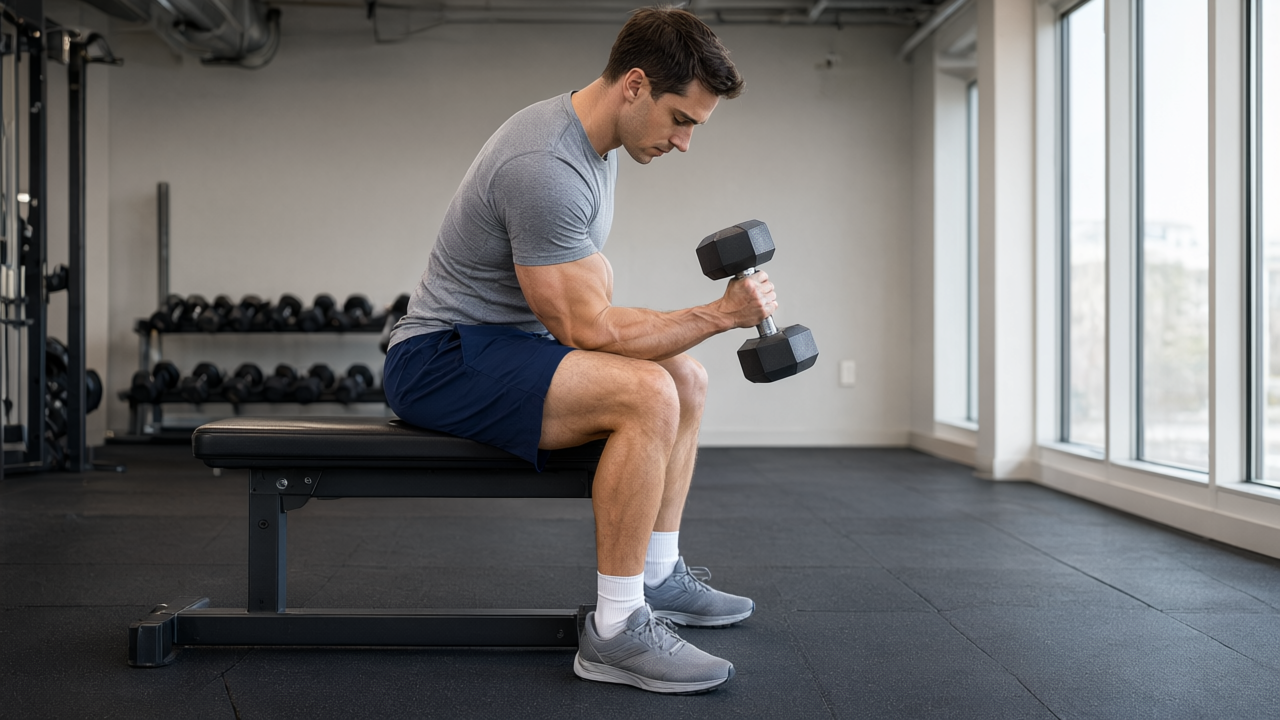
Reverse Wrist Curl
reverse-wrist-curl
Cẩn thận khi
- caution · Rotator cuff tear — Reaching forward to rest the arm on a bench places sustained tension on a compromised rotator cuff. Instead, perform the movement with the forearm braced on your thigh to minimize shoulder demand.
- caution · Shoulder impingement — Resting the forearm on a bench can force the shoulder into internal rotation and elevation, aggravating impinged tissues. Instead, support the forearm on your own thigh to keep the shoulder in a neutral, relaxed position.
A dumbbell held with a pronated (overhand) grip, forearm resting on a bench or thigh, wrist hanging off the edge. The wrist extends — lifting the back of the hand upward against resistance. This isolates the wrist and finger extensors (extensor carpi radialis, extensor carpi ulnaris, extensor digitorum), the muscles on the top of the forearm that are almost entirely neglected by standard curling and gripping work.
Nếu bạn mới bắt đầu
Start with a very light dumbbell — 2-4kg is enough for most beginners. The muscles being trained are small, and ego-loading this movement is the fastest way to develop wrist pain rather than wrist strength. The forearm should be fully supported; only the hand moves.
Vươn xa hơn
Slow the lowering phase to three or four seconds, letting the dumbbell roll into your fingers at the bottom for a full stretch before lifting. A one-second pause at the top of each rep removes momentum and forces the extensors to work harder under tension. Stick to sets of 12–15 for endurance and joint resilience, or drop to 8–10 with slightly heavier dumbbells when you want more strength stimulus. Add weight in 1kg increments only once every set feels controlled at an RPE of 7; if your wrist aches rather than burns, stay put. When 3 sets of 15 with a brief top pause feel manageable, progress by performing the movement standing, holding the dumbbells behind your back with straight arms to change the line of pull. Alternatively, try the barbell version using both hands simultaneously, which lets you load the extensors more evenly and handle slightly more weight.
Những lỗi thường gặp
Letting the forearm lift off the bench or thigh during the movement — this recruits the bicep and shoulder instead of isolating the extensors. Also: using momentum by jerking the weight up rather than controlling it through the full range. The wrist should move slowly in both directions.
Lịch trình
- Sets
- 3
- Reps
- 12-15
- Rest
- 60s
- Tempo
- 1-1-2
- RPE
- 7
- Tần suất
- 2-3
Increase weight by 1-2kg once you can complete all sets at the top of the rep range with control
Cues
Cơ bắp
- Forearms
Thiết bị
- Bench
- Dumbbells
- 1
Sit on a bench and rest your right forearm on your right thigh, palm facing down, with your wrist hanging just past your knee. Hold a dumbbell with a pronated (overhand) grip.
- 2
Let your wrist flex downward, allowing the dumbbell to roll toward your fingers — this is the starting position.
- 3
Keeping your forearm stationary against your thigh, extend your wrist upward, lifting the back of your hand toward the ceiling.
- 4
Hold the top position for one second, then slowly lower the dumbbell back to the start over two seconds.
- 5
Complete all reps on one arm before switching.