
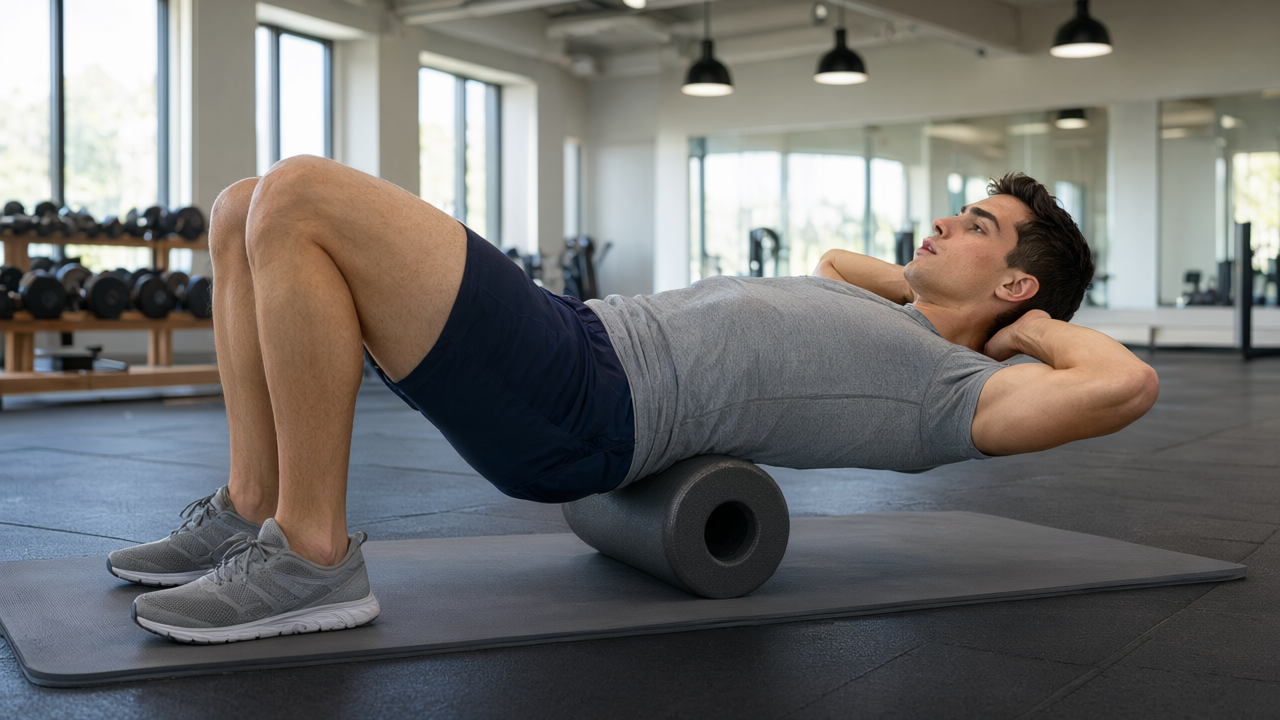
Foam Roll Upper Back
foam-roll-upper-back
Cẩn thận khi
- avoid · Herniated disc — Spinal extension over the foam roller can increase disc pressure in the thoracic region. Instead, perform supine pelvic tilts on the mat to mobilise the spine gently.
- caution · Osteoporosis — Direct pressure on a fragile thoracic spine may risk vertebral compression fractures. Instead, perform gentle seated thoracic rotations without external load.
When I cue you into this movement, I want you to think of it as a gentle reset for your thoracic spine. You will lie on the foam roller and slowly roll between your shoulder blades and upper shoulders. This opens stiffness from desk work or pressing patterns. It is not about force; it is about letting gravity and your breath do the work.
Nếu bạn mới bắt đầu
The first time you try this, you will likely roll too fast or wander onto your lower back or neck. Both areas lack the bony structure to handle direct pressure safely. Keep the movement strictly between the bottom of your shoulder blades and the top of your shoulders. Another common error is letting the elbows flare wide, which forces the shoulder blades to pinch together and blocks the roller from reaching the muscles along your spine. Keep your elbows close together and your hands supporting your head without pulling your chin to your chest. The sensation should feel like a firm, tolerable stretch, never sharp pain. If you feel dizzy or experience pinching, stop immediately. Spend sixty to ninety seconds here during your cooldown. Breathe slowly and deliberately; each exhale should allow your ribcage to sink a little further towards the mat. Do not rush. Let the foam roller do the work while your legs simply steer.
Vươn xa hơn
Slow the tempo significantly: take four to five seconds to travel up and four to five seconds to return. Once basic rolling feels easy, add thoracic extensions by pausing at three distinct points along the upper back, clasping your hands across your chest, and letting your head drop back towards the mat on a long exhale. Hold each extension for three to five breaths before moving to the next segment. For a deeper variation, cross one ankle over the opposite knee and shift your weight slightly to bias one side of the thoracic spine, spending equal time on both sides. Progress to a firmer foam roller only when the current density no longer provides noticeable feedback. Use this as a daily cooldown after heavy overhead pressing or prolonged seated work, aiming for two to three minutes total rather than rushing through a single minute.
Những lỗi thường gặp
Rolling onto the cervical spine or lumbar region is the most frequent error. The neck and lower back are vulnerable to hyperextension under load; keep the roller strictly between the shoulder blades and upper shoulders. Moving too quickly turns this into a meaningless bounce rather than tissue mobilisation. Slow down and match your speed to your breathing. Flaring the elbows outward causes the shoulder blades to retract, creating a bony shield that prevents the roller from contacting the thoracic musculature. Keep the elbows narrow and supported. Finally, holding your breath creates unnecessary tension throughout the trunk. Exhale fully at each pause to allow the ribcage to expand and the spine to settle into extension over the foam roller.
Lịch trình
- Sets
- 1
- Reps
- 60–90 seconds
- Rest
- 0s
- Tempo
- slow and controlled
- RPE
- 3
- Per set
- ~90s
- Tần suất
- 7
increase duration to 3 minutes or use a firmer foam roller
Cues
Cơ bắp
- Upper back
- Lats
- Shoulders
Thiết bị
- Foam roller
- Mat
- 1
Place the mat on the floor and set the foam roller across it horizontally.
- 2
Sit in front of the foam roller, then lie back so the roller rests just below your shoulder blades.
- 3
Bend your knees and plant both feet flat on the mat, hip-width apart.
- 4
Interlace your fingers behind your head to support your neck, keeping your elbows drawn together.
- 5
Lift your hips slightly off the mat so your body weight presses gently into the foam roller.
- 6
Push through your feet to roll slowly upward until the roller reaches the top of your shoulders.
- 7
Reverse the motion by pushing through your feet to roll back down to just below the shoulder blades.
- 8
Pause at any tight spot, exhale fully, and let your upper back extend over the foam roller.