
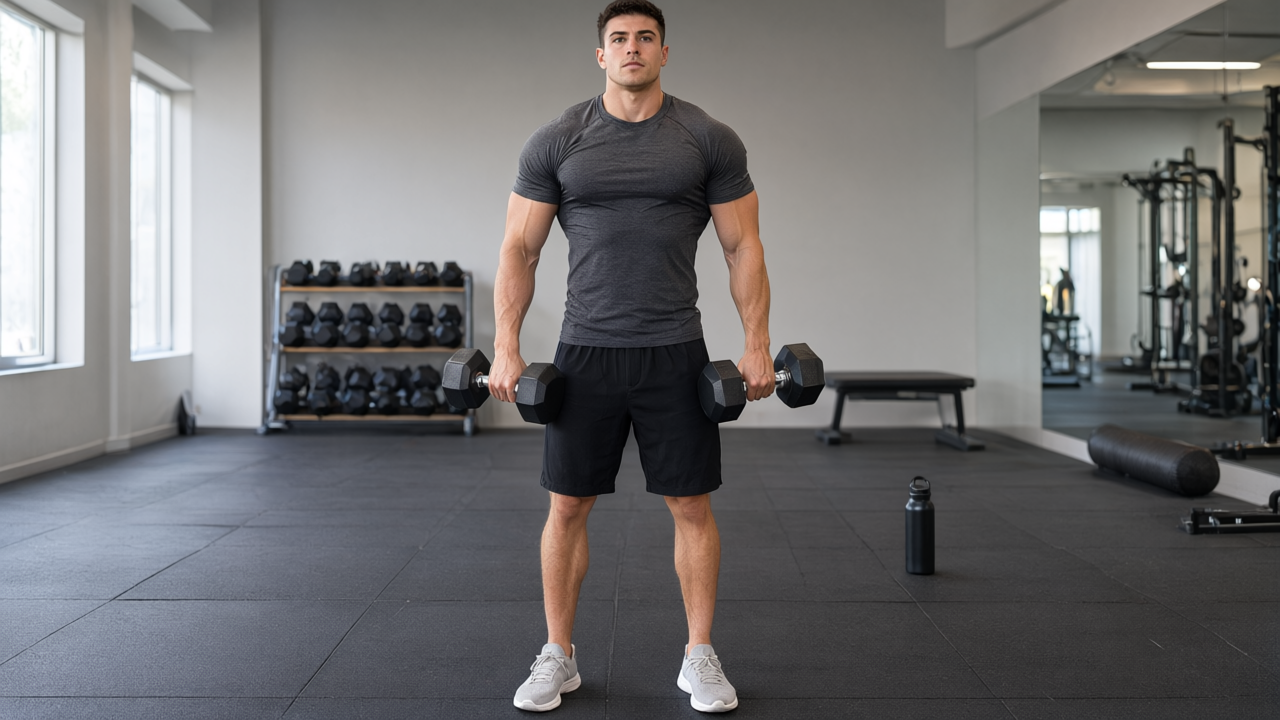
Dumbbell Shrug
dumbbell-shrug
Cẩn thận khi
- avoid · Rotator cuff tear — Rolling the shoulders or using excessive load places shear stress on a healing rotator cuff. Instead, perform scapular wall slides to train shoulder girdle stability without heavy traction forces.
- caution · Shoulder impingement — Elevating the shoulders under heavy load can compress the subacromial space and aggravate impingement symptoms. Instead, use lighter dumbbells with strict vertical elevation or swap to prone Y-raises for trap activation without compression.
- caution · Acute lower back injury — Holding heavy dumbbells at your sides creates axial loading that can compress an injured lumbar spine. Instead, perform seated dumbbell shrugs to isolate the traps while fully supporting the lower back.
When you execute this movement well, you’ll feel a deep, focused tension climbing up the sides of your neck and settling squarely between your shoulder blades. I want you to chase that clean, vertical pull without letting momentum steal the work. Keep your arms long and heavy, your spine tall, and let the traps do the lifting. Every rep should feel deliberate, controlled, and entirely yours.
Nếu bạn mới bắt đầu
Focus entirely on the vertical elevation of your shoulders rather than rolling them backward or forward. Keep your neck long and your gaze fixed forward to protect your cervical spine. You will feel a tight, burning contraction along the upper trapezius; that is exactly where the tension belongs. If you notice your lower back arching excessively or your elbows bending, you have exceeded your current capacity and should immediately lighten the load. True muscular failure here arrives as a heavy, localized fatigue that prevents any further upward movement, not as joint pain or neck strain. Stop the set the moment your posture breaks or your grip slips significantly. Breathe steadily, prioritize control over ego, and let consistent, mindful repetitions build resilient shoulder girdle strength over time.
Vươn xa hơn
To extract more from the dumbbell shrug, extend the peak contraction to two or three seconds at the top, where the traps are fully shortened. Lowering over three to four seconds increases eccentric tension without requiring heavier dumbbells. The ten-to-fifteen rep range suits this muscle well, but sets of fifteen to twenty with a slower tempo and shorter rest periods create substantial metabolic stress if your grip holds out. Add weight only when you can complete every rep with that extended pause and a controlled descent. If your hands fail before your traps do, move on to the barbell shrug, which allows greater absolute loading. Alternatively, try the seated dumbbell shrug; removing your legs from the equation eliminates any subtle hip drive and forces stricter isolation. You might also experiment with a neutral grip, turning the palms to face each other, which slightly alters the line of pull across the upper back.
Những lỗi thường gặp
Lifters frequently sacrifice vertical elevation by rolling their shoulders in circular motions, which shifts tension away from the traps and places unnecessary stress on the rotator cuff. Many also bend their elbows and turn the movement into a heavy upright row, allowing the biceps and lateral deltoids to hijack the work. Another common error is leaning backward at the top of the lift to use momentum, which compromises spinal alignment and reduces time under tension. Finally, rushing through the descent eliminates the eccentric control needed for muscle growth. Keep the motion strictly vertical, maintain rigid arms, and control the weight on the way down to maximize results.
Lịch trình
- Sets
- 3
- Reps
- 10-15
- Rest
- 60s
- Tempo
- 2-0-2-0
- RPE
- 7
- Per set
- ~75s
- Tần suất
- 2-3x/week
Gradually increase the dumbbell weight by five pounds once you can complete all sets with strict form and a one-second peak contraction.
Cues
Cơ bắp
- Traps
- Shoulders
- Forearms
Thiết bị
- Dumbbells
- 1
Stand tall with your feet hip-width apart and hold a dumbbell in each hand at your sides.
- 2
Brace your core gently and keep your arms completely straight with your palms facing your thighs.
- 3
Inhale slowly to stabilize your torso before initiating the lift.
- 4
Exhale as you elevate your shoulders straight up toward your ears in a smooth, vertical path.
- 5
Squeeze your upper back at the top for a full second while maintaining strict posture.
- 6
Inhale and lower the weights with controlled resistance back to the starting position.
- 7
Reset your shoulders down and back slightly before beginning the next repetition.