
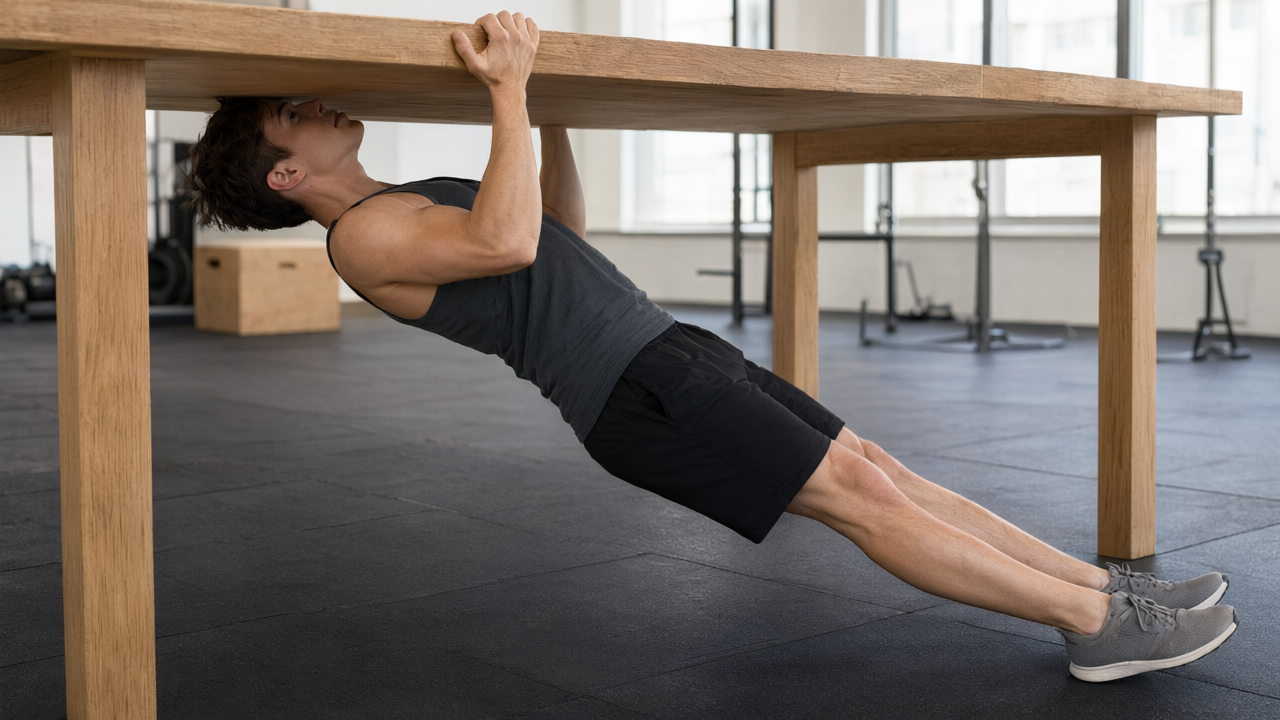
Table Inverted Row
table-inverted-row
Cuidado com
- caution · Shoulder impingement — Overhead reaching and horizontal pulling can compress the subacromial space if the shoulder blades are not properly depressed. Instead, perform a standing doorway row with a neutral spine to reduce impingement risk.
- caution · Acute lower back injury — Maintaining a rigid plank under the table requires sustained spinal stabilisation which may aggravate an injured lower back. Instead, perform a supported chest-supported row on a bench to remove the core stability demand.
When I cue you into a table inverted row, I am asking you to pull your own bodyweight horizontally using nothing but a sturdy table edge. This is your horizontal pull when you have no bar or weights available. You lie beneath the table, grip the edge, keep your spine neutral and drive your elbows back to lift your chest. It builds upper back strength and balances pressing movements.
Se você está começando
The first time you try this, the most common error is letting your hips sag towards the floor, which shifts the load onto your lower back rather than your upper back. Fix this by squeezing your glutes hard and bracing your stomach as though expecting a gentle tap. If a straight leg position feels too heavy, bend your knees and plant your feet flat on the floor; this shortens the lever and makes the pull manageable. Another mistake is shrugging your shoulders up towards your ears as you pull. Keep your shoulders packed down away from your neck throughout the movement. You should feel this working the muscles between and below your shoulder blades, along with your biceps and forearms gripping the table edge. Stop the set if your form breaks down, if your hips drop repeatedly, or if the table shifts even slightly. Safety depends entirely on the furniture being immovable.
Indo além
To increase difficulty, elevate your feet onto a chair or box so your body angles slightly downwards, forcing you to pull a greater percentage of your bodyweight. Use a controlled tempo: two seconds pulling up, one second holding the contraction at the top, and three seconds lowering. Aim for three to four sets of eight to twelve repetitions at an RPE of 8. Once you can perform fifteen strict reps with elevated feet, progress to inverted rows on a proper pull-up bar or gymnastics rings, where the instability demands more core and stabiliser engagement. For variation, use an underhand grip to bias the biceps, or widen your hands significantly to target the rear deltoids and mid-traps more aggressively. Avoid adding weight plates to your chest unless your table is bolted down; stick to manipulating leverage and tempo for overload.
Erros comuns
Pulling with the biceps alone while leaving the shoulder blades spread apart is the most frequent error. This robs the upper back of its work and strains the elbow joints. Initiate every repetition by drawing the shoulder blades together before bending the elbows. Allowing the hips to sag towards the floor turns the movement into a lower back strain rather than a horizontal pull. Maintain a rigid plank from head to heels by bracing the core and squeezing the glutes continuously. Gripping the table edge with bent wrists places unnecessary stress on the forearm tendons. Keep your wrists straight and stacked over your knuckles. Finally, using a flimsy table that rocks or slides is a severe safety hazard. Always test the furniture with your full hanging weight before beginning your set, and never row under glass-topped tables.
Rotina
- Sets
- 3
- Reps
- 8–15
- Rest
- 90s
- Tempo
- 2-1-3-0
- RPE
- 7
- Frequência
- 2
Elevate feet or slow the lowering phase once 15 clean reps are achieved.
Cues
Músculos
- Upper back
- Lats
- Biceps
- Forearms
- Abs
Equipamentos
- Bodyweight
- 1
Find a sturdy dining table that will not tip when you hang from its edge.
- 2
Lie on your back beneath the table so your chest aligns directly under the edge.
- 3
Reach up and grip the table edge with both hands, slightly wider than shoulder width apart.
- 4
Place your heels on the floor and straighten your legs, keeping your hips level with your shoulders.
- 5
Brace your abs and squeeze your glutes to hold a rigid line from head to heels.
- 6
Exhale as you pull your chest up towards the table edge by driving your elbows down and back.
- 7
Squeeze your shoulder blades together at the top when your chest touches the underside of the table.
- 8
Inhale as you lower your body slowly back to the starting position with your arms fully extended.