
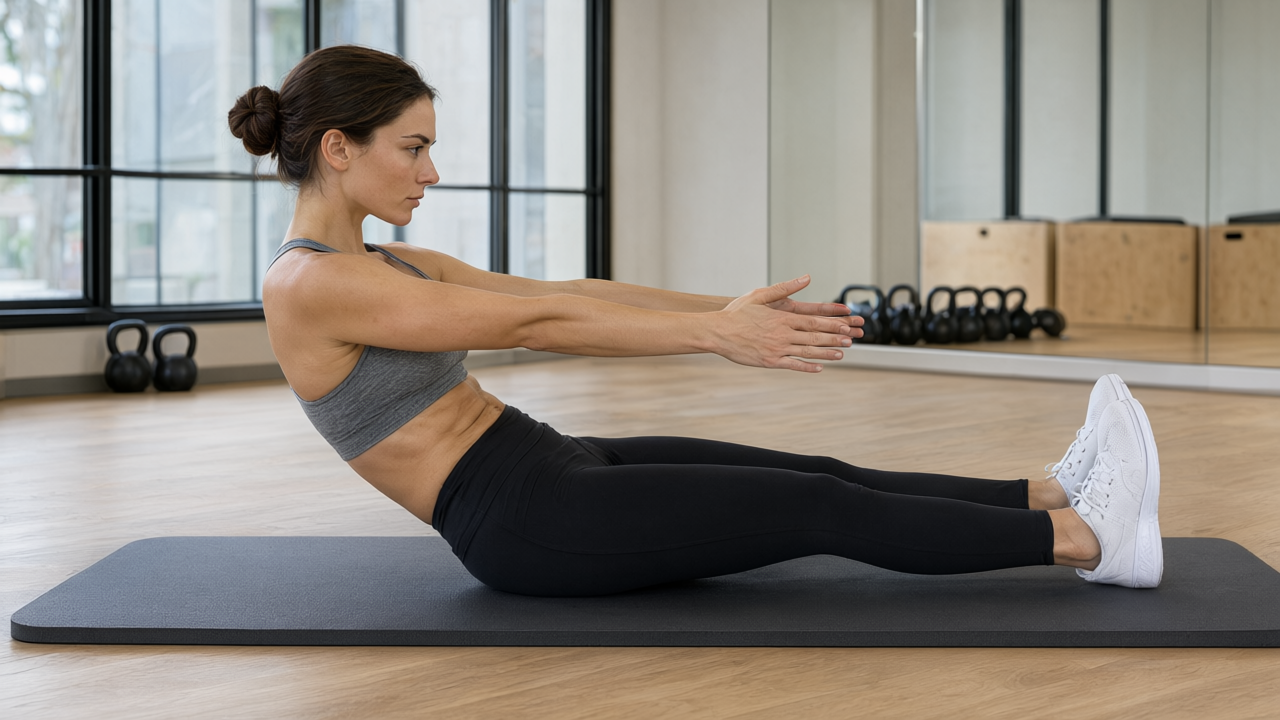
Roll-Up
roll-up
I want you to feel the Roll-Up as a smooth, controlled unspooling of the spine rather than a rigid hinge. When executed well, each vertebra peels off the floor with deliberate intention, guided by a deep, steady core engagement. You should notice a gentle stretch through the hamstrings and a satisfying burn across the abdominal wall, all while maintaining fluid breath and unwavering pelvic stability.
Se você está começando
If you feel your lower back arching or your neck straining, pause and regress the movement immediately. Bend your knees slightly to reduce hamstring tension, and place your hands lightly behind your thighs to guide the lift without pulling. True failure here isn’t muscular exhaustion; it’s a loss of that smooth, segmented spinal curve. When your torso starts to hinge at the hips or your breath becomes shallow, that’s your cue to reset. Focus on peeling up like a rolling carpet rather than sitting straight up. Keep your ribcage knitted down and avoid flaring it open as you rise. You should feel the work concentrated in the center of your abdomen, not your hip flexors or lower spine. Practice half-range movements until the articulation feels natural, and remember that consistency beats depth every single time. Your spine will thank you for the patience.
Indo além
To make the Roll-Up genuinely demanding, extend your lowering phase to four or five seconds and add a distinct two-second pause at the top of the C-curve. That pause forces your abdominals to stabilise without momentum carrying you through. Rep ranges of six to ten suit this work; if you can complete twelve with flawless articulation, the movement needs more resistance rather than more repetitions. Light ankle weights increase the lever load on your core, or you can reach your arms further overhead during the reset to lengthen the lever before you begin peeling up. Harder here means deeper spinal segmentation under greater tension, not speed. Once ankle weights feel manageable across three sets, progress to the Teaser, which demands the same vertebral control while balancing on your sit bones. For variation, try performing the roll-up with one leg lifted slightly off the mat, which introduces an asymmetrical stability challenge your obliques must manage throughout every repetition.
Erros comuns
Most practitioners rush through the movement, sacrificing spinal articulation for momentum, which turns a precise core exercise into a jerky hip hinge. Another frequent error is gripping the floor with your shoulders or tucking the chin too aggressively, which strains the cervical spine and disrupts your breathing rhythm. Many also allow the ribcage to flare open as they reach forward, instantly disengaging the deep abdominals and shifting the load to the lower back. Finally, collapsing the lower back onto the mat during the descent instead of slowly rolling down vertebra by vertebra eliminates the eccentric control that builds true core resilience. Slow down, prioritize the curve, and let the breath dictate your pace.
Rotina
- Sets
- 3
- Reps
- 8-12
- Rest
- 90s
- Tempo
- 3-1-3-0
- RPE
- 3
- Per set
- ~60s
- Frequência
- 2-3x/week
Advance by adding light ankle weights or transitioning to a straight-arm reach overhead while maintaining strict spinal articulation.
Cues
Músculos
- Abs
- Hip flexors
- Obliques
Equipamentos
- Bodyweight
- Mat
- 1
Lie flat on your back with legs extended straight and arms reaching overhead, palms facing each other.
- 2
Inhale deeply to lengthen your spine, then exhale as you gently draw your navel toward your spine to engage your core.
- 3
Inhale to nod your chin slightly toward your chest, then exhale to slowly peel your head, neck, and shoulders off the mat.
- 4
Continue exhaling as you articulate your spine upward, reaching your arms forward and slightly upward toward your toes.
- 5
Pause briefly at the top while maintaining a gentle C-curve through your torso and avoiding any lower back rounding.
- 6
Inhale to prepare, then exhale to slowly lower your spine back to the floor one vertebra at a time, starting from your tailbone.
- 7
Fully release your arms overhead to reset, ensuring your shoulders stay relaxed away from your ears before the next repetition.