
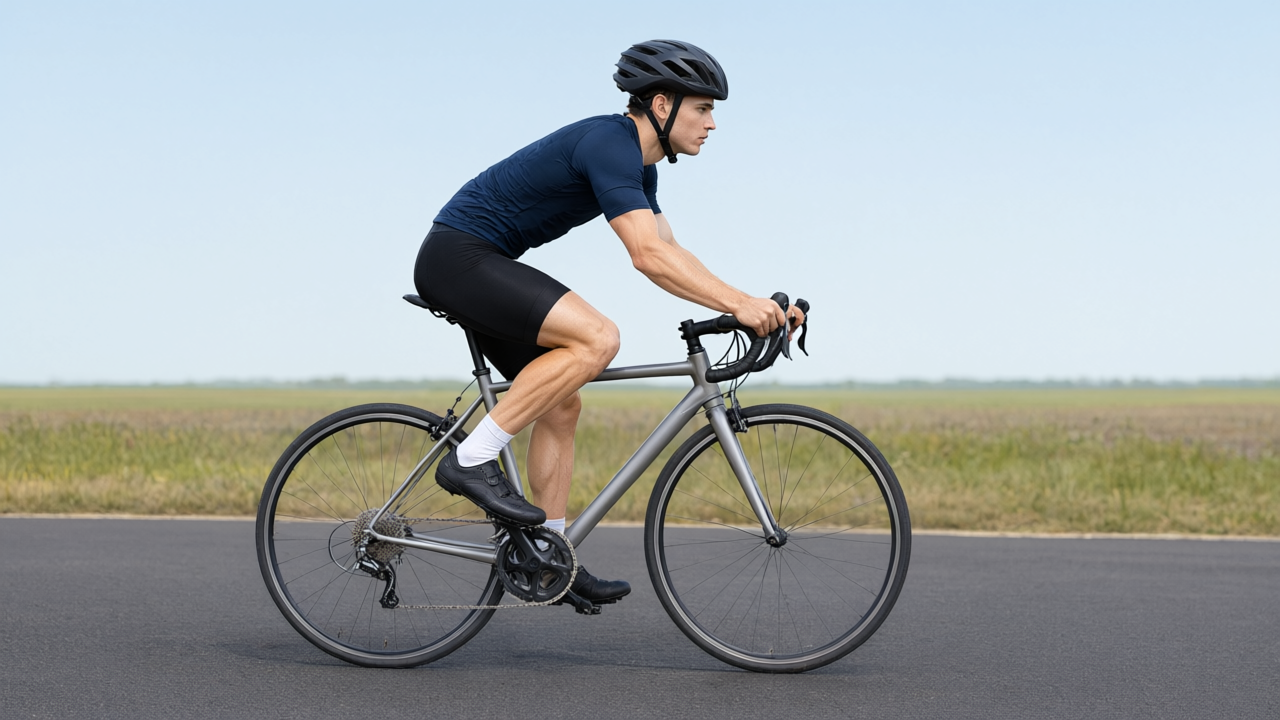
Road Bike Cadence Intervals
road-bike-cadence-intervals
Cuidado com
- avoid · Vertigo / balance disorder — Fast spinning loosens the connection between the body and the bike, and a wobble on a road is a fall into traffic. Do not do this outdoors on a road bike — run the same one-minute efforts on a stationary bike, or hold the drill until balance is assessed.
- avoid · Cardiac condition (un-cleared) — Repeated efforts that lift heart rate above steady pace, on open roads and away from help. Get clearance before adding intervals of any kind; until then ride steadily, and do cadence work later on a stationary bike where the effort stops the instant you stop.
- caution · Uncontrolled hypertension — Repeated surges in cadence push blood pressure up and down inside one ride, and the effort is easy to overshoot without feeling it. Hold steady conversational pace until it is controlled, then do the speed work on a stationary bike where it can be stopped on the spot.
- caution · Acute knee injury — High cadence places repetitive stress on the patellofemoral joint and surrounding tendons. Instead, perform low-cadence strength intervals in a heavier gear if cleared by a physiotherapist.
- caution · Acute lower back injury — Sustained forward flexion on the road bike combined with rapid hip flexor contraction may aggravate lumbar structures. Instead, use an upright stationary bike for cadence drills until pain-free.
Short fast-spinning efforts on a road bike: one minute at 100–110 revolutions per minute in an easy gear, separated by two minutes of normal cruising cadence, repeated inside an endurance ride. The aim is leg speed and a smooth pedal stroke, not power or a heart-rate spike — the effort stays neurological, so the legs come away quicker rather than more tired. The whole drill is judged by how still the hips stay on the saddle.
Se você está começando
The first time you attempt this, your hips will likely bounce on the saddle during the fast minute. This happens because the gear is too light or you are trying to reach 110 revolutions per minute before your nervous system is ready. To fix it, shift one click into a harder gear so there is just enough resistance to anchor your pelvis, and aim for 95 revolutions per minute instead. You should feel your legs spinning quickly but smoothly, as though you are stirring a pot with both feet rather than stomping on the pedals. Your breathing will quicken slightly, but you must never feel out of breath. If your lower back begins to ache or your knees track unevenly, stop the interval immediately and return to your normal cruising pace. Master staying completely still on the saddle at a modest speed before you ever chase higher numbers. Patience here builds the foundation for effortless speed later.
Indo além
Once you can hold 110 revolutions per minute without any hip movement, progress by adding two more rounds or extending the fast portion to ninety seconds. Keep the recovery at two minutes. For tempo guidance, treat the fast minute as a neurological drill rather than a cardiovascular effort; your heart rate should stay within zone two or low zone three throughout. A useful variation is performing these intervals seated on the hoods, then repeating them with your hands in the drops to challenge your core stability under a more aerodynamic posture. Another option is single-leg focus: concentrate entirely on pulling up through the backstroke of each pedal revolution during the fast minute, which further refines your circular power delivery. Do not add resistance to increase difficulty; the goal remains pure speed and smoothness.
Erros comuns
Riders frequently choose a gear that is far too light, causing their hips to bounce vertically on the saddle with every revolution. This bouncing wastes energy and stresses the lower back. Shift one or two clicks harder until your pelvis stays planted. Another error is tensing the upper body and gripping the handlebars tightly, which restricts breathing and transfers unnecessary fatigue into the shoulders and neck. Keep your hands resting lightly on the hoods. Some riders also spike their cadence instantly rather than building up over five to ten seconds, which shocks the cardiovascular system and ruins the rhythm. Accelerate gradually into the target range. Finally, looking down at the cycling computer constantly breaks your aerodynamic posture and distracts from feeling the pedal stroke. Glance briefly, then trust your legs.
Rotina
- Sets
- 1
- Reps
- 6–8 rounds of 3 minutes
- Rest
- 0s
- Tempo
- 100–110 rpm work, 85–90 rpm recovery
- RPE
- 4
- Per set
- ~1440s
- Frequência
- 2
Add one round per week or extend fast interval by 15 seconds
Cues
Cardio
- Style
- interval
- Duração
- 24 min
- Zone
- 2
- Work
- 60s
- Rest
- 120s
- Rounds
- 8
Músculos
- Quadriceps
- Hamstrings
- Hip flexors
- Calves
- Cardiovascular
Equipamentos
- Road bike
- 1
Mount the road bike and select a flat, quiet stretch of road for uninterrupted riding.
- 2
Shift into an easy gear that allows you to spin freely without heavy resistance on the pedals.
- 3
Settle into a normal cruising cadence of 85 to 90 revolutions per minute for two minutes.
- 4
Increase your pedalling speed smoothly to 100 to 110 revolutions per minute for one minute, exhaling steadily throughout.
- 5
Keep your hips quiet on the saddle; if you bounce, shift to a slightly harder gear immediately.
- 6
Return to your normal 85 to 90 revolution per minute cadence for two minutes to recover fully.
- 7
Repeat this one-minute fast and two-minute normal pattern for six to eight total rounds.
- 8
Resume your standard endurance pace once all intervals are complete, maintaining relaxed hands on the handlebars.