
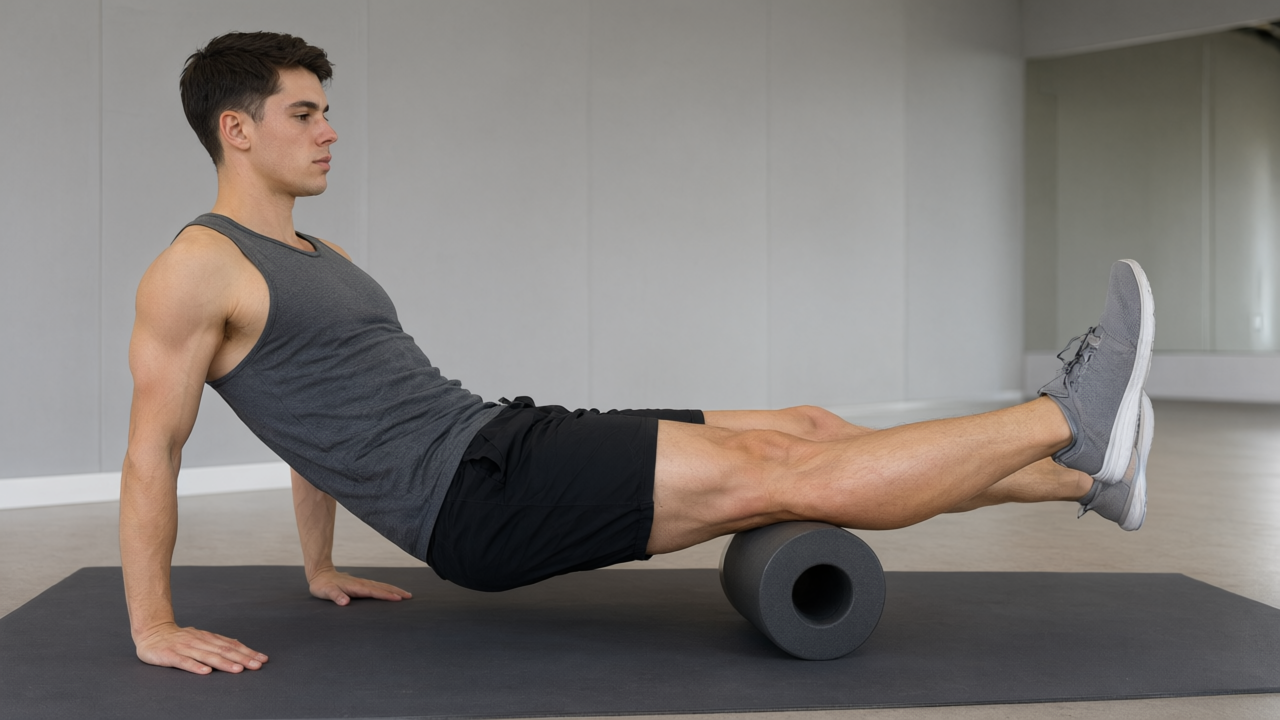
Foam Roll Calves
foam-roll-calves
Cuidado com
- caution · Acute knee injury — Rolling too close to the popliteal fossa can irritate posterior knee structures. Instead, restrict the rolling range to the lower two-thirds of the calf, well below the knee crease.
Self-compression through the fleshy belly of the calf: seated on a mat with the hands behind the hips, one calf resting on a foam roller and the hips lifted so bodyweight loads it, rolling slowly from just above the Achilles to just below the knee crease, turning the leg to reach both heads. It is the lower-leg cooldown after running, jumping or heavy calf work, and the bodyweight alternative when the calves are too sore or too tight to hold a loaded stretch.
Se você está começando
First-timers often sit too far back, placing all their weight on their wrists rather than using their hands merely as light supports. If your shoulders ache before your calves release, walk your hands closer to your hips. Another common error is rolling too quickly; speed does not equal effectiveness here. Move at roughly two centimetres per second so the tissue has time to respond. You should feel a dull, satisfying pressure that borders on uncomfortable but never sharp. If you feel sharp pain near the Achilles tendon or directly behind the knee joint, stop immediately and adjust your range to stay within the fleshy belly of the muscle. Beginners also tend to keep the leg perfectly still, missing the inner and outer portions of the calf. Gently rotate your foot inward and outward as you roll to cover the entire area. Spend sixty to ninety seconds per leg. Stop if you experience tingling or numbness in the foot.
Indo além
To increase intensity, fully stack the non-working leg on top of the working calf, directing all your bodyweight through a single limb. Slow the tempo further: take four full seconds to travel from the ankle to the knee, and another four to return. Pause on dense adhesions for twenty to thirty seconds while actively dorsiflexing and plantarflexing the ankle to pin and stretch the tissue simultaneously. Progress by switching to a firmer foam roller once the standard density no longer produces adequate sensation. For targeted work, isolate the soleus by bending the working knee slightly during the roll, which slackens the gastrocnemius and directs pressure deeper. Perform this after heavy plyometric sessions or long runs when the calves are thoroughly warmed. Two minutes per side is appropriate at this level.
Erros comuns
Rolling directly over the Achilles tendon or the back of the knee joint causes unnecessary irritation to sensitive structures; always start just above the heel and stop just below the crease of the knee. Moving too fast turns the exercise into a superficial skin rub rather than meaningful tissue work, so slow down deliberately. Keeping the hips resting heavily on the mat removes the necessary pressure, rendering the foam roller ineffective; you must press through your hands to elevate your weight onto the roller. Finally, neglecting to rotate the leg means you only address the central fibres of the gastrocnemius, leaving the medial and lateral heads untouched. Turn the toes inward and outward throughout each pass to ensure complete coverage.
Rotina
- Sets
- 1
- Reps
- 60–90 seconds per side
- Rest
- 0s
- Tempo
- slow
- RPE
- 4
- Per set
- ~90s
- Frequência
- 5
increase pressure by stacking legs or use a firmer roller
Cues
Músculos
- Calves
Equipamentos
- Foam roller
- Mat
- 1
Sit on the mat with your hands planted behind your hips for support.
- 2
Place the foam roller horizontally beneath your right calf muscle.
- 3
Rest your left foot flat on the mat beside you or cross it over the right shin.
- 4
Press through your hands to lift your hips slightly off the mat.
- 5
Roll slowly forward until the foam roller reaches just below your right knee.
- 6
Roll backward until the foam roller returns to just above your right Achilles tendon.
- 7
Rotate your right leg slightly inward and outward during each pass to target both calf heads.
- 8
Pause for ten seconds on any tender spots without holding your breath.
- 9
Lower your hips back to the mat and repeat on the left calf.