
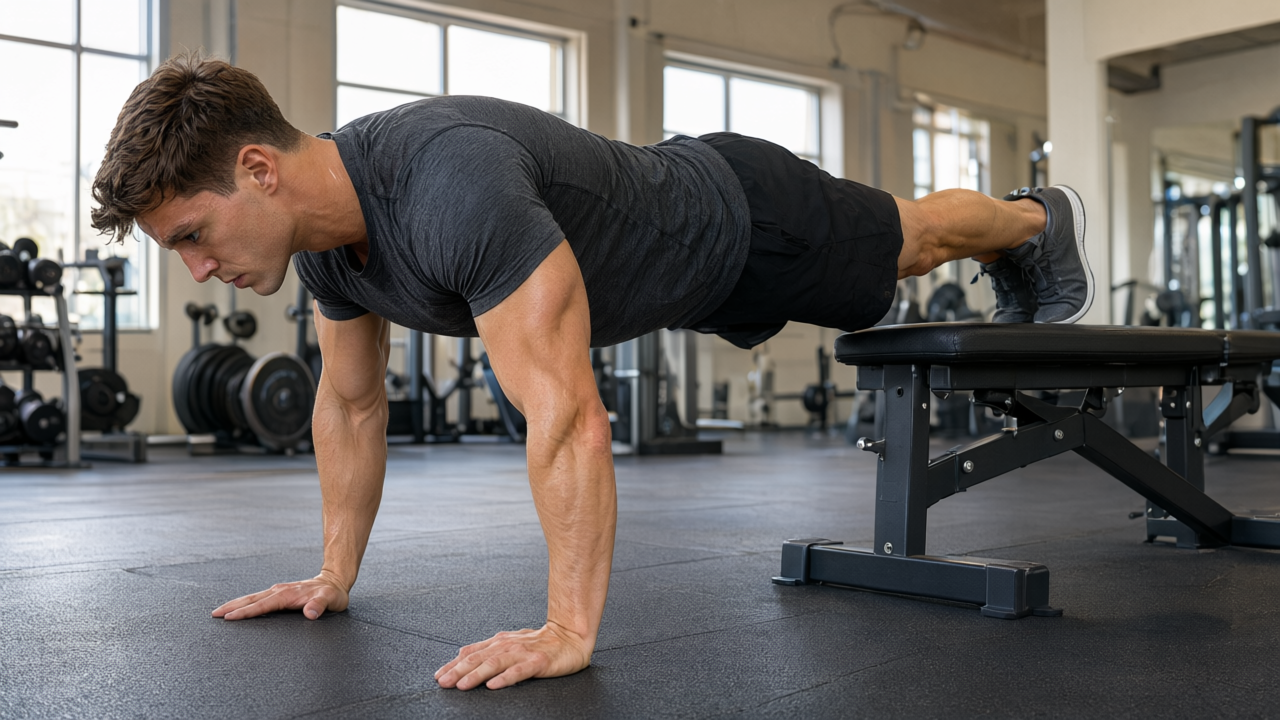
Decline Push-Up
decline-push-up
When I place my feet on the bench and lower my chest, I immediately feel that deep, controlled burn across my upper chest and front delts. Good reps demand a tight core and steady rhythm, turning gravity into a relentless but rewarding partner. Every descent should feel deliberate, and every push back up leaves my arms trembling with that satisfying, heavy fatigue that tells me I’m building serious pushing strength.
Se você está começando
Start with a lower elevation, like a sturdy step or aerobic platform, to master the angle before progressing to a full bench. Keep your ribs drawn down and your pelvis slightly tucked to prevent your lower back from overarching. As you lower yourself, focus on maintaining a straight plank rather than chasing depth. True muscular fatigue will manifest as a heavy, burning sensation across the front of your shoulders and chest, accompanied by a gradual loss of core stiffness. Stop your set the moment your hips begin to dip toward the floor or your shoulders start to shrug toward your ears. These are clear signs that your stabilizers are failing and form is breaking down. If your wrists ache, rotate your hands outward slightly or use push-up handles. Progress patiently, building confidence in your alignment before adding height. You will develop remarkable upper body strength by prioritizing quality over quantity.
Indo além
Slowing the lowering phase to three or four seconds increases time under tension for the upper chest and front delts, while a brief pause at the bottom eliminates any elastic rebound. Press up deliberately but without rushing. The eight-to-twelve rep range builds muscle effectively; if you can complete three sets of twelve with your feet on the bench while maintaining strict alignment, add a weighted vest or raise your feet onto stacked plates to steepen the angle. Alternatively, shift your hands further back towards your hips to transition into the pseudo-planche push-up, which demands considerably more shoulder strength. For variation, try placing only one foot on the bench to introduce an anti-rotation challenge that forces your obliques to work harder, or narrow your hand placement to bias the triceps whilst keeping the same decline angle.
Erros comuns
The most frequent error is allowing the hips to sag or pike upward, which instantly shifts tension away from the chest and places unnecessary shear force on the lumbar spine. Many lifters also flare their elbows out to ninety degrees, grinding the shoulder joints and sacrificing mechanical efficiency. Another common flaw involves cutting the range of motion short by bouncing off the floor or failing to press through to full lockout, which robs the movement of its strength-building potential. Finally, neglecting to brace the core and glutes leads to a disconnected torso that wobbles under load, turning a powerful horizontal push into a disjointed struggle.
Rotina
- Sets
- 3
- Reps
- 8-12
- Rest
- 90s
- Tempo
- 2-0-2-0
- RPE
- 8
- Per set
- ~90s
- Frequência
- 2-3x/week
Elevate the feet higher to increase the angle, add a weighted vest, or transition to a pseudo-planche push-up.
Cues
Músculos
- Chest
- Triceps
- Shoulders
- Abs
- Glutes
- Upper back
Equipamentos
- Bodyweight
- Bench
- 1
Place hands on the floor slightly wider than shoulder-width.
- 2
Elevate both feet securely on a stable bench.
- 3
Align the body into a straight line from head to heels.
- 4
Brace the core and squeeze the glutes to prevent hip sagging.
- 5
Inhale steadily as elbows bend at a 45-degree angle to lower the chest.
- 6
Descend until the upper chest lightly grazes the floor.
- 7
Exhale forcefully while pressing through the palms to extend the arms.
- 8
Drive the torso back to the starting position without locking the elbows.
- 9
Step one foot down carefully from the bench to dismount.
- 10
Stand upright and relax the shoulders to complete the repetition cycle.