
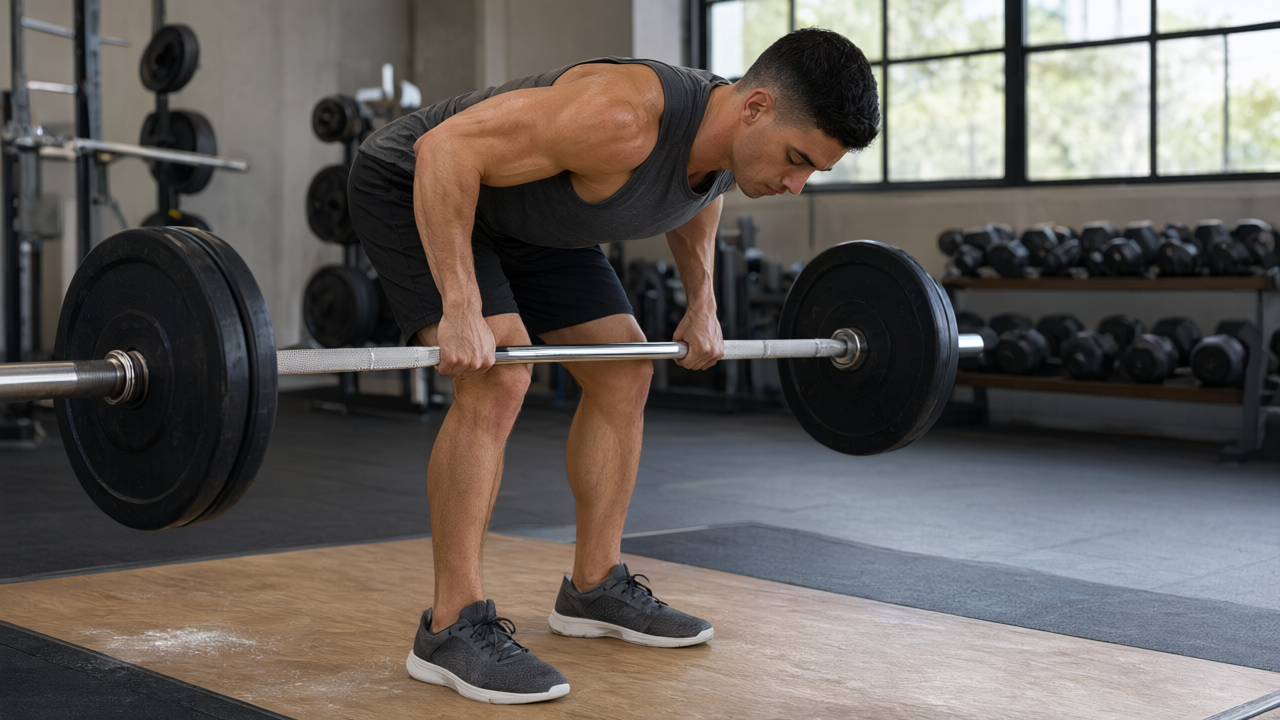
Barbell Bent-Over Row
barbell-bent-over-row
Cuidado com
- avoid · Acute lower back injury — The sustained hip hinge places heavy isometric demand on the lumbar erectors under load. Instead, perform chest-supported rows to target the upper back without stressing the lower spine.
- avoid · Herniated disc — Axial shear forces from the bent-over position can compress and irritate a vulnerable disc. Instead, use single-arm cable rows standing upright to train horizontal pulling safely.
- caution · Pregnancy — The deep forward hinge increases intra-abdominal pressure and strains the lower back as the center of gravity shifts. Instead, perform seated cable rows to maintain back training without heavy spinal loading.
When I hinge at the hips and grip the bar, I immediately feel a solid, grounding tension lock into my lower back and hamstrings. Good reps never feel like frantic pulling; instead, they’re a deliberate, powerful squeeze that drives my elbows past my torso. I love how the heavy iron drags down my lats on the descent, leaving my upper back thoroughly pumped and fiercely engaged.
Se você está começando
Start lighter than you think you need, because mastering the hinge is far more important than moving heavy iron right now. Keep a slight bend in your knees and imagine sitting back into an invisible chair until your chest is parallel to the floor. If your lower back begins to round or ache, you have gone too deep or chosen too much weight. True muscular fatigue will manifest as a burning tightness across your upper back and a temporary inability to squeeze your shoulder blades together, not as sharp pain in your spine. Stop the set the moment your torso starts to swing upward or your elbows drift forward uncontrollably. Focus on pulling with your back, not your arms, and visualize dragging the bar along your thighs. It is completely normal for your grip to tire first; chalk or straps can help you keep practicing the movement pattern safely. Trust the process, prioritize a stable spine, and celebrate each rep where your form stays locked in.
Indo além
Lengthen the lowering phase to three or four seconds, letting the barbell drag your lats into a deep stretch before you reverse direction. That pause at full extension builds strength where most lifters are weakest. Pull fast and drive the elbows back hard, but hold the squeeze against your lower abdomen for a full second on every rep. Sets of six to eight with heavier loads bias raw pulling strength, while ten to twelve reps build muscular endurance across the upper back. Add 2.5 kg to the bar only when you complete all prescribed sets without your torso angle shifting by even a few degrees. Once you can row your bodyweight for strict sets of eight, consider the Pendlay row, resetting the bar on the floor between reps to demand more starting power from a dead stop. Switching to an underhand grip shifts emphasis towards the lower lats and biceps, changing the stimulus without needing extra kit.
Erros comuns
Most lifters compromise this exercise by using excessive momentum, turning a controlled pull into a swinging deadlift hybrid that shifts tension away from the back. Another frequent error is flaring the elbows straight out to the sides, which places unnecessary stress on the shoulder joints rather than targeting the lats and rhomboids. Rounding the lower spine under load is equally common and dangerous, usually happening when the hips sit too high or the core remains completely unbraced. Finally, cutting the range of motion short by failing to fully extend the arms at the bottom robs you of the crucial stretch phase, while yanking the bar too aggressively toward the chest turns a horizontal pull into a vertical one.
Rotina
- Sets
- 3
- Reps
- 8-12
- Rest
- 90s
- Tempo
- 2-1-1-0
- RPE
- 8
- Per set
- ~180s
- Frequência
- 2-3x/week
Add 2.5 to 5 lbs to the bar once you complete the top of the rep range for all sets with strict form.
Cues
Músculos
- Lats
- Upper back
- Biceps
- Forearms
- Lower back
Equipamentos
- Barbell
- 1
Stand with feet shoulder-width apart and position the barbell directly over the midfoot.
- 2
Hinge at the hips and bend the knees slightly to grip the bar with an overhand grip just outside shoulder width.
- 3
Brace the core and retract the shoulder blades to establish a rigid, neutral spine.
- 4
Drive through the heels to lift the bar off the floor while keeping the torso fixed at a 30- to 45-degree angle.
- 5
Exhale and pull the barbell toward the lower abdomen, driving the elbows straight back.
- 6
Squeeze the back muscles tightly at the peak and pause briefly to verify full contraction.
- 7
Inhale and lower the weight with strict control, maintaining the exact starting torso position.
- 8
Repeat the pull and lower cycle for the prescribed repetitions without allowing the hips to rise.
- 9
Bend the knees and hinge forward to safely guide the barbell back to the ground.
- 10
Release the grip and stand completely upright to decompress the spine before the next set.