
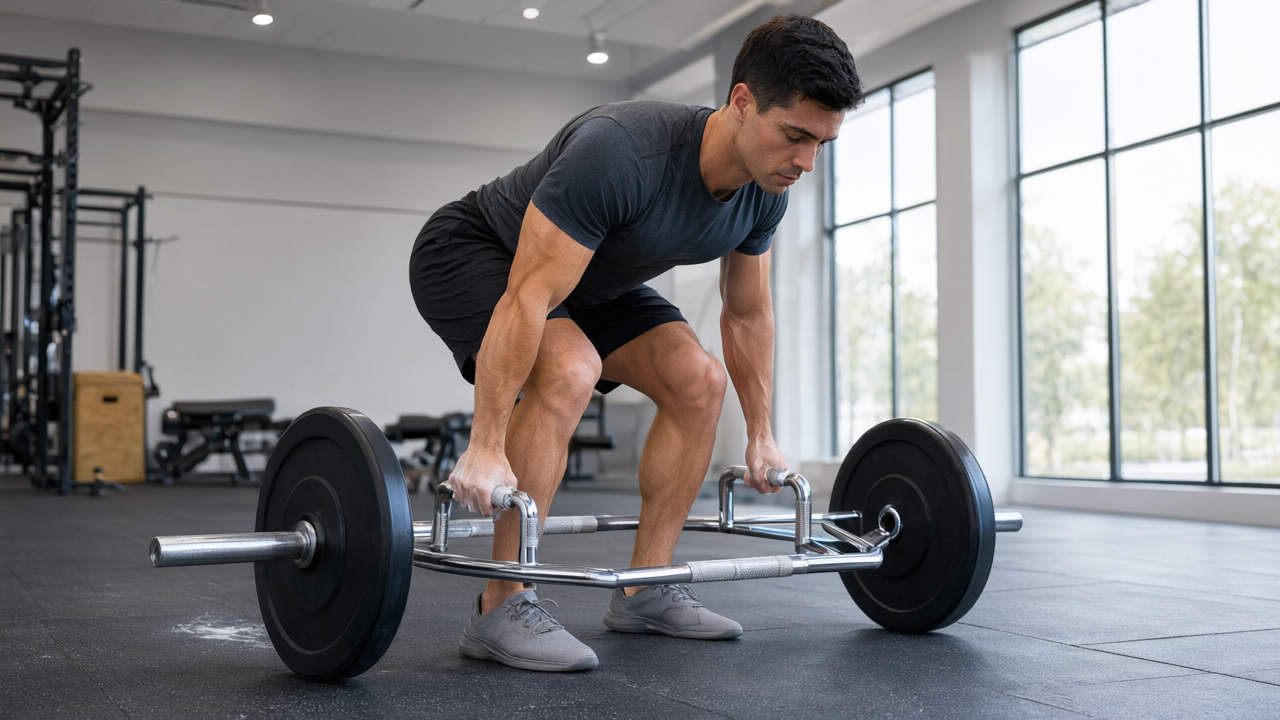
Trap Bar Deadlift
trap-bar-deadlift
Zwróć uwagę na
- caution · Osteoporosis — Heavy compressive loads carry a fracture risk for compromised bone density. Use light-to-moderate weights with strict form, avoiding any spinal flexion. If cleared by a physician, proceed with caution; otherwise, substitute with seated resistance band rows or machine-based leg presses to build strength without vertical spinal loading.
- caution · Herniated disc — While the trap bar reduces shear force compared to a straight bar, heavy axial loading can still aggravate acute disc issues. Ensure perfect neutral spine; if pain radiates, stop. Consider substituting with Hip Thrusts or Glute Bridges which load the posterior chain with minimal spinal compression.
- modify · Acute lower back injury — The hinge pattern places significant demand on the lumbar stabilizers. If the injury is acute, avoid. For chronic/stable conditions, reduce range of motion by using elevated handles or blocks to limit flexion. Substitute with Rack Pulls if maintaining a neutral spine at the bottom position is painful.
I love how the trap bar centers your weight, making every rep feel grounded and secure. When you nail the movement, you’ll notice a clean, powerful hinge that loads your glutes and hamstrings like coiled springs. There’s no lower back strain—just smooth, full-body tension that drives the weight upward in a straight line. Good reps leave you feeling explosive, balanced, and ready to attack the next one without hesitation.
Jeśli dopiero zaczynasz
As you begin, focus on keeping your heels flat and your knees tracking directly over your toes throughout the entire range of motion. If your heels lift or your knees cave inward, lighten the load immediately. True muscular failure will manifest as a heavy, grinding sensation in your legs and glutes, not a sharp pinch in your lower back or neck. The moment your spine begins to round or your torso leans too far forward, you have reached your working limit and should rack the weight. Beginners often compensate by jerking the bar off the floor or letting their shoulders roll forward, which shifts the tension away from your prime movers and strains your joints. Start with a lighter plate to master the hip hinge and knee extension timing, treating the first few sessions as a movement rehearsal. Trust the process, keep your gaze fixed on a point ahead of you, and let your body learn the groove before chasing heavier loads. You are building a resilient foundation that will serve every future lift.
Więcej
Take two to three seconds lowering the plates back to the floor, pausing briefly at the bottom to kill any momentum before driving up fast. That dead stop forces your glutes and hamstrings to restart the pull from zero each rep. The six-to-ten range suits this lift well: stay near six when building strength with heavier loads, or push towards ten for muscular endurance. Once you complete all three sets of ten cleanly at RPE 9, add 2.5 to 5 kg. When you can handle heavy sets of six with a solid pause, consider moving to the conventional barbell deadlift, which demands more hip hinge depth and spinal control. For variation, try the high-handle trap bar deadlift if your gym’s bar offers it; the raised grip shortens the range and lets you overload the lockout. Alternatively, perform deficit reps by standing on a low plate to increase the stretch on your hamstrings at the bottom.
Typowe błędy
Lifters frequently rush the descent, allowing the weight to crash into the floor which eliminates the crucial eccentric loading and resets your bracing. Another common error is initiating the pull with the lower back instead of driving through the legs, which places unnecessary compressive forces on the spine. Many also neglect to keep the traps engaged, allowing the shoulders to shrug upward and destabilize the upper torso mid-lift. Finally, overextending the hips at the top by leaning backward shifts the center of gravity and compromises joint integrity. Correcting these habits requires slowing the tempo, consciously engaging the core before each rep, and treating the lockout as a tall, stacked posture rather than an exaggerated lean.
Plan treningowy
- Sets
- 3
- Reps
- 6-10
- Rest
- 120s
- RPE
- 9
- Per set
- ~220s
- Częstotliwość
- 2-3x/week
Add 2.5 to 5 kg to the bar when you can complete the top of the rep range across all sets with controlled form.
Cues
Mięśnie
- Glutes
- Quadriceps
- Hamstrings
- Lower back
- Abs
- Traps
- Forearms
Sprzęt
- Barbell
- 1
Step inside the frame and position feet shoulder-width apart with toes angled slightly outward.
- 2
Bend at the hips and knees to lower the torso until the hands comfortably reach the handles.
- 3
Grip the handles firmly with palms facing inward and keep the arms completely straight.
- 4
Pull the shoulder blades down, brace the core, and inhale deeply into the abdomen to stabilize.
- 5
Drive through the midfoot while extending the hips and knees simultaneously to stand upright.
- 6
Squeeze the glutes at the top while keeping the chest up and avoiding any backward lean.
- 7
Reverse the movement by pushing the hips back first and bending the knees to control the descent.
- 8
Exhale steadily as the handles lower to the floor and release the core brace before resetting.