
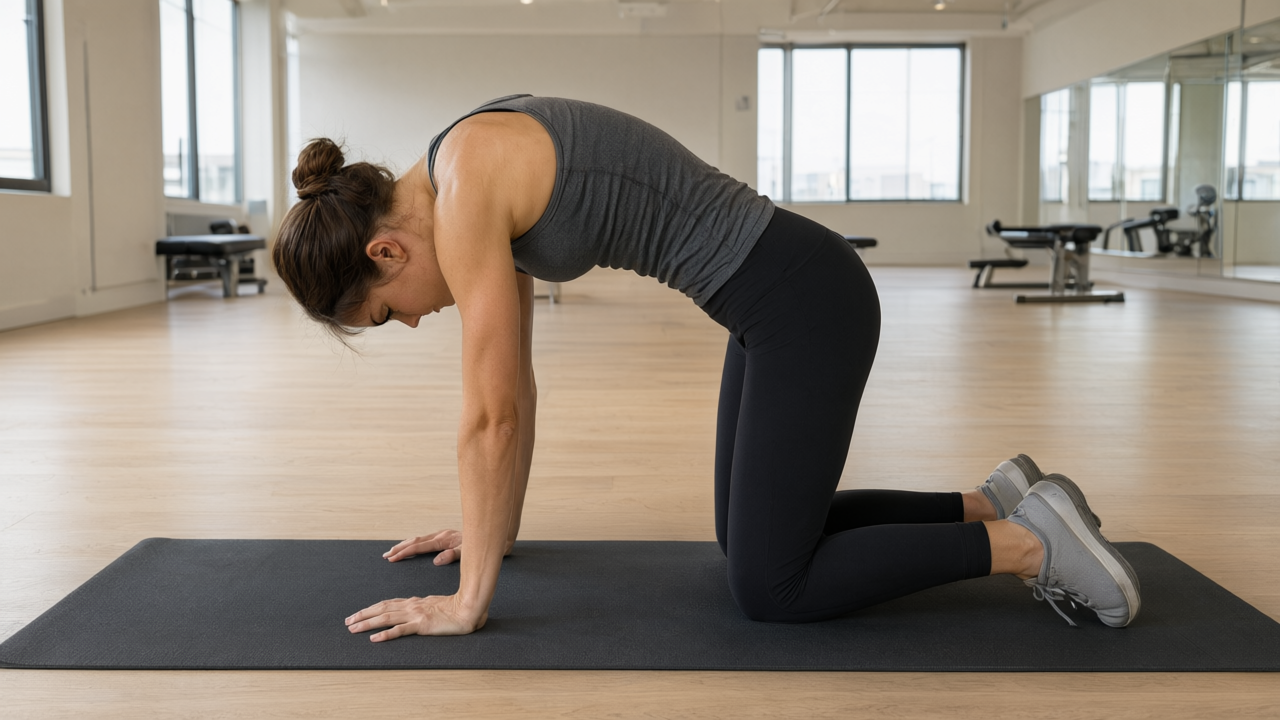
Cat-Cow
cat-cow
Zwróć uwagę na
- caution · Osteoporosis — End-range rounding under bodyweight is a flexion load on the spine, and with reduced bone density the concern is a vertebral compression fracture rather than a strain. Move within a small, comfortable range without pressing into the ends, and take the rotation and extension from a neutral-spine position instead. If you have a diagnosed density loss, get the safe range from the clinician managing it — this drill should not be the thing you test that ceiling with.
- modify · Acute lower back injury — The cow phase is loaded lumbar extension, and an acute back frequently refuses it even though the cat phase feels fine. Take only the direction that is comfortable — most people keep the rounded cat and drop the arch entirely — and shorten the range so the movement comes from one spinal segment at a time rather than a big swing. If a direction produces sharp pain or a stick, stop there and do not chase it; stiffness that eases with movement is a different thing from pain that arrives with it.
When I coach this movement, I want you to notice a smooth, rhythmic wave traveling through your spine. Proper reps feel completely fluid, with zero joint pinching or stiffness. You will experience a gentle release along your entire back that leaves you feeling lighter and deeply relaxed. Each shift should naturally sync with your breathing, melting away tension until the motion feels completely effortless and intuitive.
Jeśli dopiero zaczynasz
Focus on moving from your pelvis and ribcage rather than forcing the curve with your neck. I recommend starting with just three to five slow cycles to build body awareness before adding more volume. If you feel sharp pinching in your lower back or a sudden tension spike behind your knees, pause immediately and reduce your range of motion until the movement feels smooth and controlled. Failure in this context means losing your neutral wrist alignment or compensating by shrugging your shoulders toward your ears. Keep your elbows slightly soft and your gaze following your spine’s natural arc. When your breath starts to hitch or your wrists ache, it is time to rest on your heels and reset. Remember that consistency beats intensity here; I want you to prioritize fluid, mindful transitions over deep arching or extreme rounding. Your nervous system learns the pattern faster when you move with deliberate calm.
Więcej
To make this movement genuinely challenging, slow the transitions to a four- or five-second count in each direction and add a three-second isometric pause at full flexion and full extension. Those pauses force you to own the end range rather than bounce through it. Eight to twelve cycles remain appropriate, but harder here means greater time under tension and finer segmental control, not more repetitions. If you can articulate each vertebra smoothly without your breath hitching, extend the holds by another second before considering any other change. Once you command the full pattern on all fours, progress to performing it seated upright or standing against a wall, where gravity no longer assists the curve and your trunk muscles must work independently. You might also try shifting your hands slightly forward of your shoulders during the floor version, which increases the demand on your thoracic spine and anterior chain while reducing the contribution from your hips.
Typowe błędy
Most practitioners rush through the movement, sacrificing spinal articulation for speed and missing the neuromuscular benefits entirely. Another frequent error is overextending the cervical spine during the cow phase, which places unnecessary strain on the vertebrae instead of distributing the curve evenly across the thoracic and lumbar regions. Many also collapse through the shoulders, allowing the chest to sink too low and compromising wrist stability, while others forget to exhale fully during the cat phase, leaving tension trapped in the ribcage. Finally, keeping the knees locked or flaring them too wide disrupts the kinetic chain and forces the lower back to overcompensate. Slow the tempo, maintain a neutral head position, and let your breath dictate the rhythm to correct these habits.
Plan treningowy
- Sets
- 3
- Reps
- 8-12
- Rest
- 30s
- Tempo
- 2-1-2-1
- RPE
- 3
- Per set
- ~60s
- Częstotliwość
- 4-6x/week
Gradually increase spinal range of motion, add 2-second isometric pauses at end-range flexion and extension, or slow the tempo for greater neuromuscular control.
Cues
Mięśnie
- Upper back
- Lower back
- Abs
- Glutes
Sprzęt
- Bodyweight
- 1
Position your hands directly under your shoulders and your knees directly under your hips on a stable surface.
- 2
Press your palms firmly into the floor, spread your fingers wide, and align your spine in a completely neutral position.
- 3
Inhale slowly while dropping your abdomen, lifting your chest, and tipping your tailbone upward into the Cow stretch.
- 4
Exhale fully while rounding your back toward the ceiling, drawing your navel inward, and tucking your chin into the Cat stretch.
- 5
Hold the rounded position for one second to confirm the entire spine is evenly curved.
- 6
Inhale again to smoothly reverse the curve, passing through neutral and returning to the arched Cow position.
- 7
Maintain a steady pace by exhaling through the Cat phase and inhaling through the Cow phase for the remaining repetitions.
- 8
Exhale to settle back into the neutral tabletop position, then sit your hips toward your heels and rest your forehead on the floor to complete the sequence.