
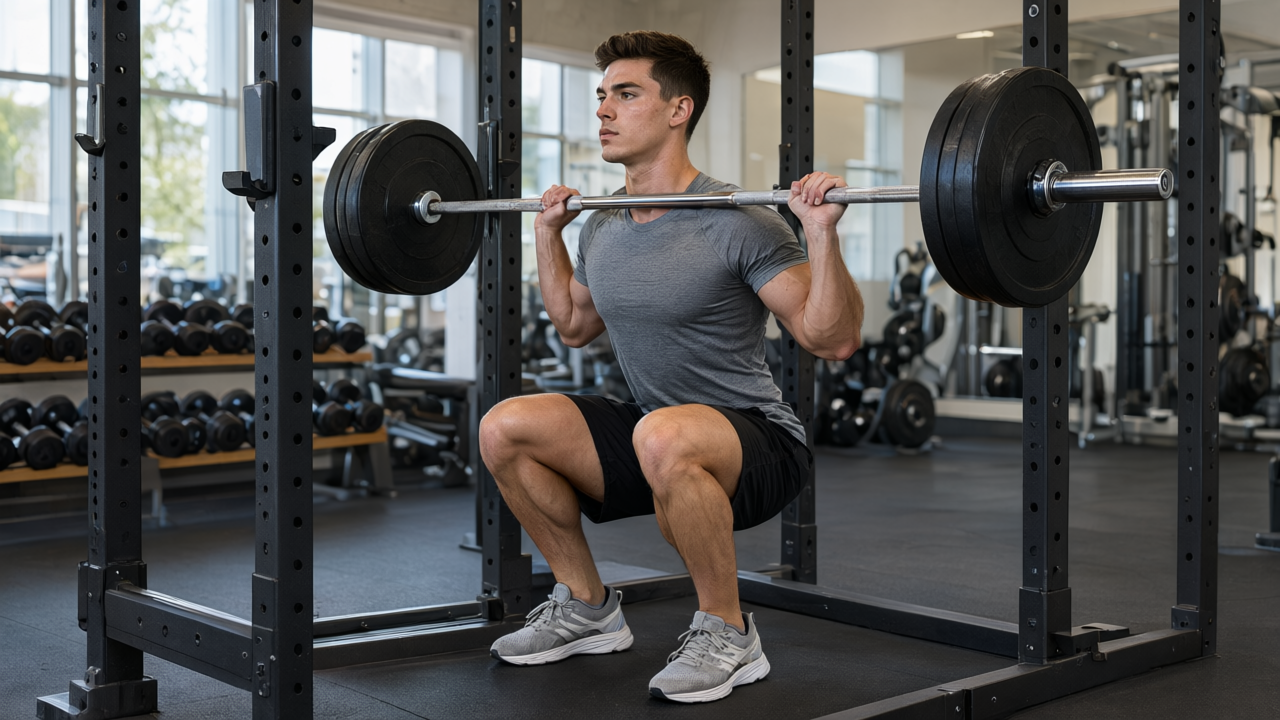
Barbell Front Squat
barbell-front-squat
Zwróć uwagę na
- avoid · Rotator cuff tear — The front rack position requires significant external rotation and shoulder flexion, which places high stress on the rotator cuff. Instead, perform a Goblet Squat or use a Safety Squat Bar to keep the load anterior without demanding extreme shoulder mobility.
- caution · Shoulder impingement — Holding the bar in the front rack position can compress the subacromial space and aggravate impingement symptoms. Instead, try a Zercher Squat (holding a barbell or dumbbell in front of the hips) or a Goblet Squat to maintain an upright torso with less shoulder strain.
- modify · Acute lower back injury — While the front squat is generally more spine-friendly than the back squat, the requirement to keep elbows high can cause thoracic rounding, transferring shear force to the lumbar spine if mobility is limited. Instead, perform a Box Squat to control depth and ensure neutral spine alignment, or use a Safety Squat Bar.
I want you to feel the barbell anchored securely across your front delts, your torso standing tall like a proud pillar. Each rep should feel like a controlled descent into a deep, stable hinge, where your knees track smoothly over your toes and your core stays fiercely braced. Good reps leave your quads burning, your upper back engaged, and your breathing steady. You’re building resilient legs and an unbreakable midline, one deliberate rep at a time.
Jeśli dopiero zaczynasz
As you start, focus entirely on keeping your elbows high and your torso upright. If your chest drops forward, your lower back will round, so prioritize a lighter weight until your mobility catches up. Good form feels like a smooth, controlled hinge where your weight stays centered over your midfoot. Muscle failure in this movement usually presents as your heels lifting off the ground or your torso collapsing forward. When that happens, stop the set immediately to protect your spine and joints. Beginners often compensate by letting their knees cave inward or rushing the descent. Slow down, widen your stance slightly if needed, and actively push your knees outward as you descend. Remember that depth is earned through consistent practice, not forced with heavy loads. Trust the process, keep your breathing rhythmic, and celebrate every rep that maintains a tall chest and stable core.
Więcej
Once your 2-0-2-0 tempo feels routine, introduce a two-second pause at the bottom. This removes any elastic rebound and forces your quads and upper back to work harder out of the hole. Drive up fast from that dead stop. The eight-to-twelve rep range builds muscle, but dropping to sets of four to six with heavier loads develops strength; add 2.5 kilograms when you complete all prescribed reps without your elbows dipping or your heels lifting. If you want more time under tension rather than more weight on the barbell, extend the lowering phase to four seconds. When you can handle heavy triples cleanly with a full clean grip, you are ready to transition into front squat variations like the one-and-a-quarter rep, where you pause at parallel, rise halfway, descend again, then stand fully. Alternatively, use the front squat as your primary strength builder before moving to heavier barbell back squat work.
Typowe błędy
Most lifters struggle to maintain an upright torso, which forces the lower back to compensate and shifts tension away from the quads. Another frequent error is allowing the elbows to drop, causing the barbell to roll forward and destabilize the entire kinetic chain. Many beginners also rush the descent, bouncing out of the bottom position instead of controlling the eccentric phase, which compromises joint integrity and reduces muscle engagement. Finally, lifting the heels or letting the knees cave inward during the ascent creates uneven force distribution and places unnecessary stress on the ankle and knee ligaments. Prioritizing mobility, deliberate tempo, and mindful bracing will quickly correct these patterns.
Plan treningowy
- Sets
- 3
- Reps
- 8-12
- Rest
- 90s
- Tempo
- 2-0-2-0
- RPE
- 8
- Per set
- ~240s
- Częstotliwość
- 2-3x/week
Add 2.5-5 pounds to the bar once you can complete all sets with flawless form and controlled depth.
Cues
Mięśnie
- Quadriceps
- Glutes
- Abs
- Upper back
Sprzęt
- Squat rack
- Barbell
- 1
Position the barbell on a squat rack at upper-chest height.
- 2
Step under the bar and rest it securely across your front delts, crossing your arms or using a clean grip to lock it in place.
- 3
Lift the bar off the rack and step back until your feet are shoulder-width apart with toes slightly turned out.
- 4
Inhale deeply into your belly and brace your core tightly to stabilize your spine.
- 5
Push your hips back and bend your knees simultaneously, keeping your chest high and elbows lifted.
- 6
Lower yourself until your hip crease drops below your knee line, maintaining full foot contact with the floor.
- 7
Drive through your midfoot and heels to stand back up, exhaling steadily as you pass the sticking point.
- 8
Fully extend your hips and knees at the top, then reset your breath before beginning the next repetition.