
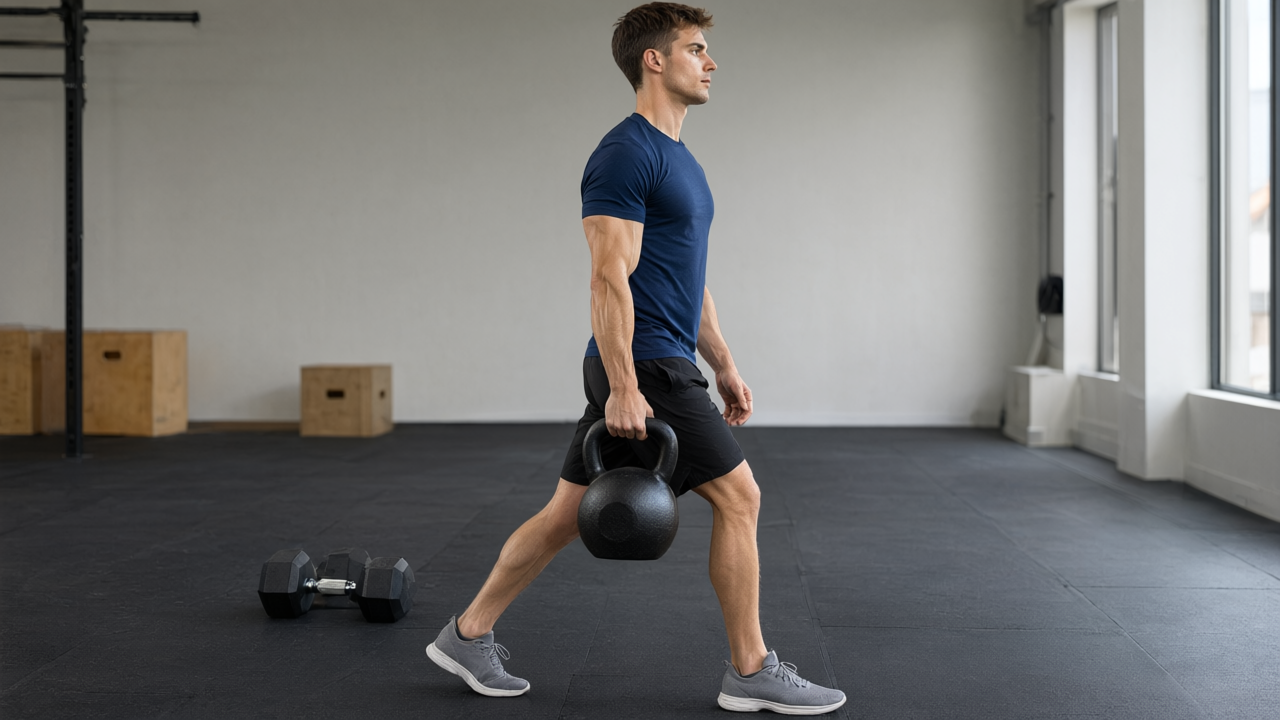
Suitcase Carry
suitcase-carry
주의할 점
- avoid · Vertigo / balance disorder — You are walking while carrying an offset load that pulls you to one side, which is the opposite of a stable gait — and a recovery step while holding a heavy dumbbell means either dropping it from height or going down with it. Avoid the walking part. Instead, hold the position still for time beside a wall with the load already in hand from a raised surface, or substitute Glute Bridge, which trains the brace with nothing to carry and nowhere to fall.
- avoid · Uncontrolled hypertension — Sustained heavy gripping and deep bracing during the carry can cause dangerous spikes in blood pressure. Instead, perform slow bodyweight marches to train balance and gait without extreme intra-abdominal pressure.
- caution · Pregnancy — Heavy unilateral bracing increases intra-abdominal pressure against the growing uterus and challenges pelvic stability. Instead, perform light bilateral farmer's walks to maintain gait mechanics and core engagement safely.
- modify · Acute lower back injury — An asymmetrical load makes the trunk work harder to stay level, which is useful for most backs and unpleasant for one that is currently reactive. Take the same brace with the load held in both hands instead — Farmer's Carry trains the gait and the ribcage control without pulling you sideways. Set the weight on a bench rather than lifting it from the floor, keep the walk short, and stop while the shoulders are still level. If the hinge to pick it up is the problem, use Suitcase Carry from a raised surface or switch to Glute Bridge.
- modify · Herniated disc — Single-sided loading is the point, and it demands that the spine resist bending sideways while you walk — a sustained brace rather than a flexion load, which most discs tolerate better than a hinge. The risk is picking up the weight: steps 3 and 8 both require a loaded bend, and that is where a disc gets caught out. Set the dumbbell on a Bench or a low surface so you never hinge to lift it, keep the load light and the walk short, and swap sides often. If the walking itself reproduces symptoms, substitute Bird Dog, which trains the same brace with the feet still.
When I pick up a heavy kettlebell or dumbbell in one hand, a proper set feels like a quiet battle between tension and control. My core locks in automatically, my shoulders stay level, and every step translates into grounded, deliberate momentum. I’m not just hauling weight; I’m teaching my entire midline to resist rotation while moving with calm, unwavering posture. That steady, anti-rotational burn is exactly where strength lives.
처음이라면
Start with a moderate weight that allows you to maintain flawless posture for the entire distance. Focus on keeping your ribs stacked directly over your hips, and imagine a string pulling the crown of your head toward the ceiling. If you feel your torso tilting toward the opposite side or your lower back arching, the load is too heavy and it is time to drop down. Grip failure will present as a slipping handle or forearm cramping, while core fatigue will feel like a gradual loss of that tall, braced posture. Stop immediately if you notice your shoulders hiking toward your ears or your steps becoming uneven. Beginners often compensate by swinging the weight like a pendulum or leaning heavily into the loaded side to make it feel lighter. Instead, keep the weight close to your hip, walk slowly, and prioritize a rigid, symmetrical frame over speed or distance. Master the anti-lateral flexion pattern first, and the heavier carries will follow naturally.
더 나아가기
To make the suitcase carry genuinely demanding, slow your steps until each footfall feels deliberate, and add a two-second pause mid-stride every few metres to test whether your bracing holds under stillness. The standard thirty to forty-five seconds per side suits endurance, but sets of fifteen to twenty seconds with a heavier kettlebell or dumbbell shift the stimulus toward maximal anti-lateral strength. Add load when you can walk forty-five seconds without your shoulders drifting; alternatively, extend the distance by ten metres before increasing weight. Once you handle heavy loads comfortably for three sets, progress to the waiter’s carry, holding the weight overhead in one hand to challenge the same pattern through a longer lever. For variation, try the bottoms-up kettlebell carry, which forces greater grip and shoulder stability, or alternate between the dumbbell and kettlebell to change how the load sits against your thigh.
흔한 실수
Lifters frequently allow the weight to pull them into a lateral lean, surrendering to gravity instead of actively fighting it with their core. Another frequent error is letting the working shoulder shrug upward, which shifts tension away from the lats and into the neck. Many also take overly long, uncontrolled strides that cause the torso to bounce and compromise spinal alignment. Finally, holding your breath throughout the walk creates unnecessary intra-abdominal pressure spikes and leads to early fatigue. Keep your steps short, your shoulders packed down, and your breathing rhythmic to maintain control.
루틴
- Sets
- 3
- Reps
- 30-45 seconds per side
- Rest
- 90s
- RPE
- 8
- Per set
- ~90s
- 빈도
- 2-3x/week
Increase load by 5-10 lbs or add 10 meters per side while maintaining strict upright posture and anti-lateral core tension.
Cues
근육
- Obliques
- Forearms
- Abs
- Glutes
준비물
- Dumbbells
- Kettlebell
- 1
Place a dumbbell or kettlebell on the floor beside one foot.
- 2
Stand with feet shoulder-width apart and toes pointed slightly outward.
- 3
Hinge at the hips and bend the knees to lower the torso toward the weight.
- 4
Grip the handle firmly with one hand, keeping the wrist straight and elbow tucked.
- 5
Inhale deeply, brace the core, and drive through the heels to stand tall while keeping the weight close to the thigh.
- 6
Walk forward with short, controlled steps, exhaling steadily to resist lateral bending and maintain level shoulders.
- 7
Keep the gaze forward and the ribcage down to prevent torso rotation throughout the movement.
- 8
Plant both feet firmly, inhale to reset posture, and exhale while hinging the hips to lower the weight back to the floor.
- 9
Release the grip completely, stand upright, and switch sides to repeat the sequence.