
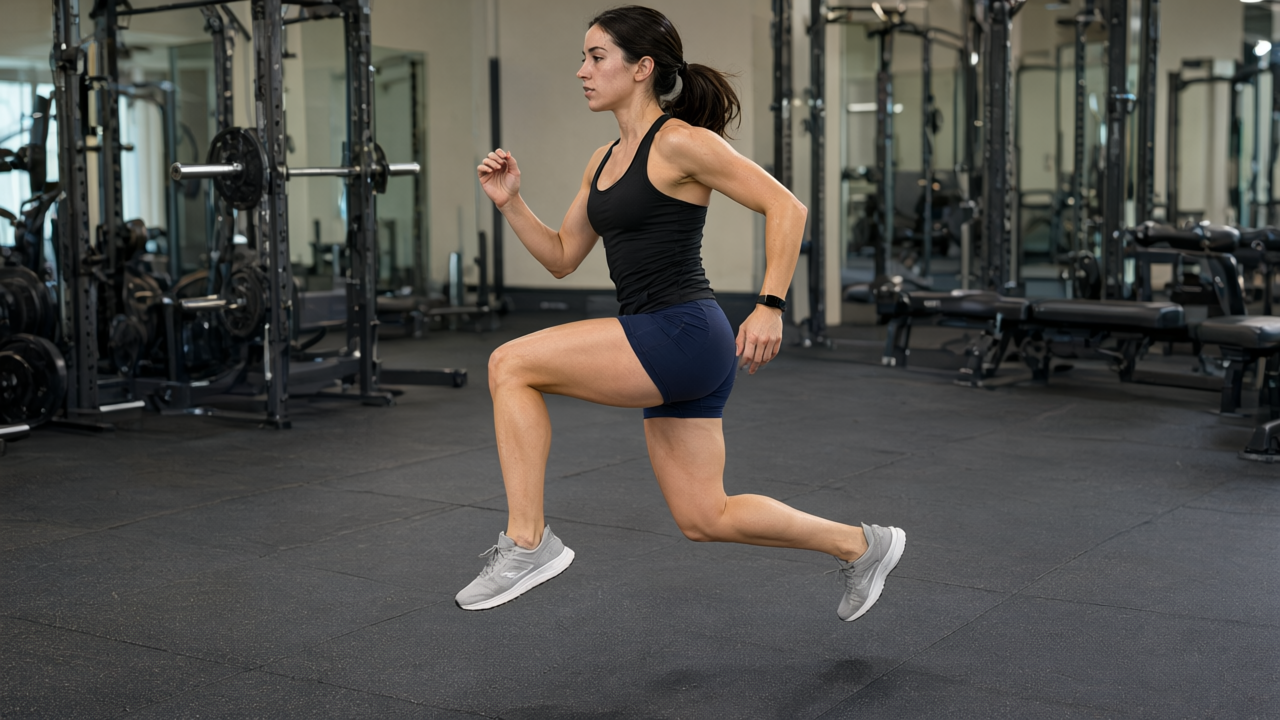
Jump Lunge
jump-lunge
주의할 점
- avoid · Vertigo / balance disorder — Airborne with no option to put a hand down mid-rep; a wobble at touchdown has nowhere to go but a fall. Substitute Reverse Lunge or Split Squat with a wall within arm's reach.
- avoid · Osteoporosis — High-impact landings increase the risk of vertebral compression fractures or lower extremity stress fractures. Instead, perform low-impact alternating forward lunges holding light dumbbells for resistance.
- avoid · Acute knee injury — High-impact plyometric loading and rapid deceleration place excessive shear force on the knee joint. Instead, perform static reverse lunges or step-ups to build strength without impact.
- avoid · Postpartum (first 6 weeks) — Repeated landing impact against healing pelvic floor and abdominal tissue is the wrong first load back. Substitute Reverse Lunge or Glute Bridge, and return to hopping only once you can land quietly without any pressure or leaking.
- avoid · Acute lower back injury — The explosive hip extension and landing impact can aggravate lumbar instability or disc issues. Instead, perform controlled bodyweight split squats with a focus on slow eccentric lowering.
- avoid · Pregnancy — A midair leg switch landed on one leg at a time asks for balance a shifting centre of gravity no longer guarantees, and the impact travels through a laxened pelvic ring. Substitute Reverse Lunge or Split Squat, both feet on the floor, depth to comfort.
Alternating jump lunge: drop into a deep lunge, explode upward, switch the legs in midair and land in the lunge on the other side. Quads and glutes drive the jump, calves and hip flexors handle the switch, and the midline stays braced so the pelvis does not drop on touchdown. The work is the landing; how high you leave the floor is only what lets the feet change.
처음이라면
Master the reverse lunge first — if you cannot sink into a deep lunge and stand back up quietly, the jump only adds impact to a position you do not yet own. Then keep the hop tiny: two inches of air is plenty to change feet. Torso upright, front knee tracking over the middle toes, never caving inward. Your landings should be audible only to you; when they turn loud or shallow, the set is finished, not pushed through. Sharp pain in the knee or ankle is a stop. Impact tolerance is built over weeks of quiet landings, never inside one session.
더 나아가기
For power, keep it short and fast: 4–6 switches per side, maximal intent, two to three minutes' rest, because you are training the switch and not your lungs. For conditioning, 12–15 continuous reps at moderate height and a brisk rhythm. To build strength out of the hole, pause two seconds in the bottom lunge before each jump — this kills the stretch reflex and makes the quads and glutes produce force from dead stillness. Progress when every landing is silent and the knees stay stacked through all sets: land deeper and quieter before you ever jump higher. Adding external load makes this a different movement — take that to the loaded lunge entries instead. Single-leg alternating hops are the honest last step, and the fastest way to find a side-to-side power gap a two-foot switch will hide.
흔한 실수
Most people sacrifice depth and control in pursuit of unnecessary height, which turns a powerful drill into a joint-pounding hazard. You will often see the trailing knee collapse inward upon impact, a clear sign of weak glute engagement and poor hip alignment. Another frequent error is leaning the torso too far forward, which shifts the center of gravity and places excessive shear force on the lumbar spine. Finally, many rush the transition phase, skipping the crucial eccentric loading that actually generates the upward drive. By prioritizing a soft, silent landing, keeping your knees aligned with your toes, and taking a deliberate micro-pause to load the hips before each jump, you will transform sloppy bounces into efficient, powerful movement.
루틴
- Sets
- 3
- Reps
- 8-12
- Rest
- 90s
- RPE
- 8
- Per set
- ~90s
- 빈도
- 2-3x/week
Add light dumbbells or increase jump height once you consistently land with silent control and stable knees.
Cues
근육
- Quadriceps
- Glutes
- Hamstrings
- Calves
- Abs
- Hip flexors
준비물
- Bodyweight
- 1
Stand tall with feet hip-width apart, shoulders relaxed, and core lightly braced.
- 2
Step your right foot back into a deep lunge, lowering until both knees form ninety-degree angles.
- 3
Inhale deeply, driving through your front heel while loading your glutes and preparing to explode upward.
- 4
Exhale sharply as you push off both feet simultaneously, switching legs in midair.
- 5
Land softly with your left foot forward, absorbing the impact through bent knees and a stable midline.
- 6
Immediately sink into the next lunge without pausing, keeping your chest upright and weight centered.
- 7
Reset to the starting stance once your set is complete, taking a full breath to recover.