
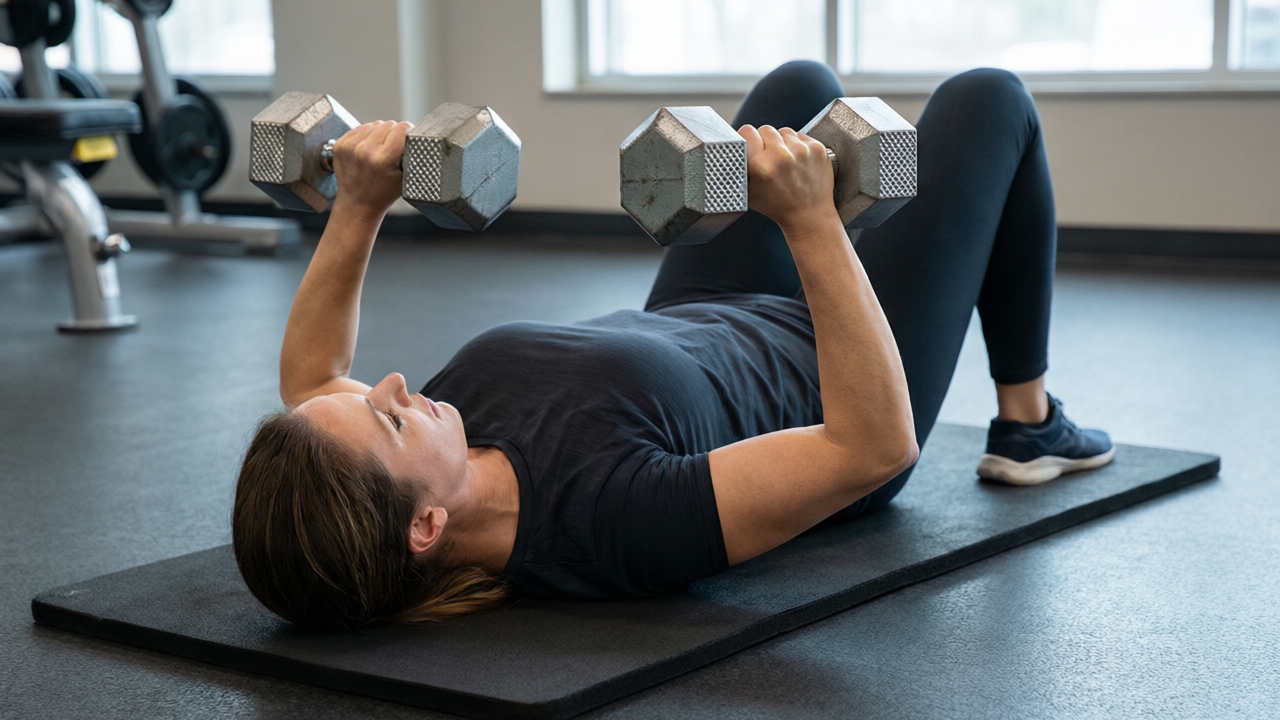
Dumbbell Floor Press
dumbbell-floor-press
주의할 점
- avoid · Rotator cuff tear — Holding the dumbbells at chest level with the arms away from the body asks the cuff to centre the joint for every second of every rep, and the wide elbow position most people drift into makes it worse. Keep the elbows tucked near the ribs as step 7 implies, take a neutral grip with the palms facing each other, and use a lighter load than feels necessary while the cuff heals. If holding the position tires the shoulder before the chest does, substitute Glute Bridge or a single-arm Suitcase Carry and let the cuff rest. Anything diagnosed as a tear is a clinician's question about range and load, not a reason to find a clever pressing angle.
- modify · Shoulder impingement — Flaring elbows out to 90 degrees can compress the subacromial space. Instead, tuck elbows closer to the body (45-degree angle) or switch to a neutral grip (palms facing each other) to reduce impingement risk.
I love how the floor press strips away momentum and forces your chest to own every rep. When I execute it well, I feel a steady, controlled burn across my pecs as my elbows lightly kiss the floor, then drive upward with grounded power. That shorter range isn’t a limitation—it’s a cue to brace my core, pack my shoulders, and maintain deliberate tension throughout. It’s raw, honest pushing that leaves zero room for sloppy form.
처음이라면
If you are new to this press, I recommend starting with lighter dumbbells so you can focus entirely on elbow and wrist alignment. Focus on keeping your lower back pressed gently into the floor throughout the entire set to prevent arching. You will know you are approaching failure when the weight slows significantly or your shoulders begin to shrug toward your ears, which is your signal to safely rack the dumbbells. Stop immediately if you feel sharp joint pain or notice your ribs flaring upward, as this indicates your core has disengaged. A common compensation I see beginners make is bouncing the elbows off the floor to generate momentum, which defeats the purpose of this controlled variation. Another is letting the wrists collapse backward under the load. Keep your grip tight, move with patience, and let the floor guide your bottom position. Trust that even a lighter weight will build remarkable stability and chest development when you respect the tempo and prioritize clean mechanics over heavy numbers.
더 나아가기
To get more from the dumbbell floor press, add a deliberate two-second pause with your triceps resting on the mat before each press. This dead stop eliminates any residual stretch reflex and forces your chest and triceps to initiate the drive from zero momentum. Press fast, but lower the weight over three seconds. The eight-to-twelve rep range builds muscle effectively, but dropping to sets of six to eight with heavier dumbbells shifts the emphasis towards raw pressing strength. Increase the load only when you complete all prescribed reps across every set without your shoulders shrugging or your wrists drifting out of alignment. Once heavy dumbbells no longer challenge you in this shortened range, progress to the full-range dumbbell bench press. For variation, try the neutral-grip floor press with palms facing each other; it tucks the elbows closer, placing greater demand on the triceps while reducing shoulder strain.
흔한 실수
Most lifters undermine this exercise by allowing their wrists to bend backward instead of maintaining a straight, stacked alignment over the elbows, which shifts stress away from the target muscles and into the joints. I frequently see athletes bounce their elbows off the floor to rebound into the next rep, which sacrifices muscle tension and compromises shoulder safety. Another frequent error is flaring the elbows out to a full ninety-degree angle, creating unnecessary strain on the anterior capsule rather than keeping them tucked at a comfortable forty-five to sixty degrees. Some also arch their lower back aggressively to cheat the weight upward, which completely bypasses the core stabilization that makes this floor variation so effective. Focus on smooth transitions, controlled tempo, and strict alignment to maximize your results.
루틴
- Sets
- 3
- Reps
- 8-12
- Rest
- 90s
- Tempo
- 2-0-2-0
- RPE
- 8
- Per set
- ~180s
- 빈도
- 2-3x/week
Increase dumbbell weight once you can complete all prescribed sets at the top of the rep range with strict, controlled form.
Cues
근육
- Chest
- Triceps
- Shoulders
- Abs
준비물
- Dumbbells
- Mat
- 1
Lie flat on your back with your knees bent and feet planted firmly on the floor.
- 2
Grip a dumbbell in each hand and hold them at chest level with your palms facing forward.
- 3
Brace your core and press your lower back gently into the floor to maintain a stable base.
- 4
Exhale as you drive both dumbbells straight up toward the ceiling until your arms are fully extended.
- 5
Pause briefly at the top while keeping your shoulders pulled down and away from your ears.
- 6
Inhale as you slowly lower the weights until your upper arms and triceps make light contact with the floor.
- 7
Exhale to press the dumbbells back up to complete the repetition.
- 8
Place the weights securely on the floor beside your hips before rolling to your side and sitting up safely.