
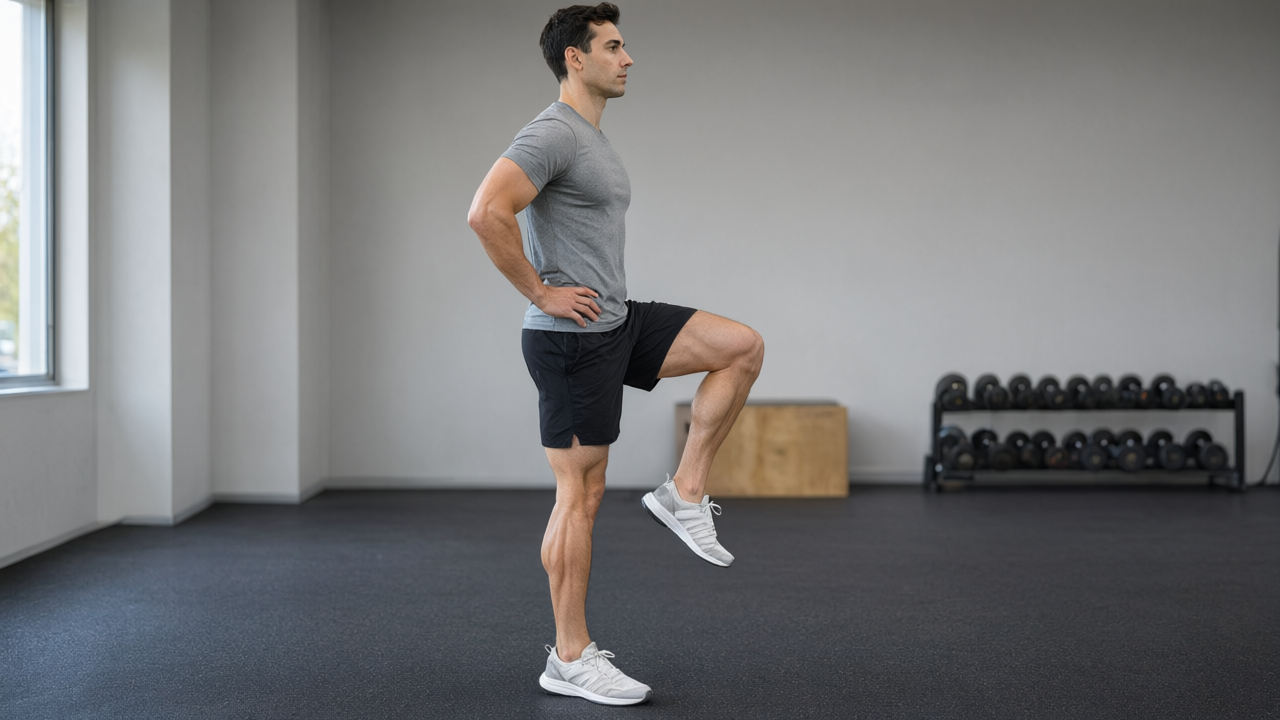
Single-Leg Calf Raise
single-leg-calf-raise
सावधानी बरतें
- caution · Uncontrolled hypertension — A single-leg calf raise is a small muscle group working hard, and the instinct is to hold the breath at the top of the squeeze — which produces a much sharper pressure spike than the effort looks like it should warrant. Keep the breath moving continuously, take the pause short, and stay well below failure. Stop on headache or spots in your vision, and avoid until your pressure is controlled and cleared.
- caution · Osteoporosis — Progressive loading through the foot and calf is a useful stimulus for bone, so the answer is usually to do this rather than avoid it — but a single-leg balance on one foot is a fall risk if you have already lost height or have had a vertebral fracture. Keep both hands within reach of a wall or a sturdy chair, work both legs seated, and stay out of the top-end range where you would lose balance. Get clearance and a safe loading plan from the clinician managing your bone density.
- modify · Acute knee injury — The calf transmits its force through the knee, and the knee is also what keeps you upright on one leg — so a sore knee often ends the set before the calf does. Keep the knee soft rather than locked, hold the wall for balance, and take the range shallower rather than pushing the heel lower. If standing on one leg is the problem rather than the raise, substitute Glute Bridge, which loads the back of the leg with both feet planted.
- modify · Pregnancy — Standing on one leg gets less reliable as the centre of mass shifts and balance changes, and the late-pregnancy version of a fall is a genuine concern rather than an inconvenience. Hold a wall or a sturdy chair throughout, or do the same work seated with a weight on the knee, which takes the balance demand out entirely. Stop if you feel light-headed.
When you execute this properly, you’ll feel a deep, controlled burn radiating through the lower leg with every deliberate rise and fall. Focus on maintaining a steady, unwavering balance while isolating the push from your ankle. The movement should feel smooth and grounded, never jerky or rushed. I want you to chase that full range of motion, letting gravity guide the descent so your calves absorb every ounce of tension.
यदि आप इसमें नए हैं
Focus entirely on the quality of each repetition rather than chasing height or speed. Keep your torso upright and avoid leaning heavily into your support hand; let it merely guide your balance. True muscular failure here feels like a sharp, localized burn in the lower leg, accompanied by a noticeable loss of stability in the ankle joint. Stop immediately if you feel sudden joint pain in the Achilles or knee, as this signals compromised form or overextension. Beginners often compensate by bending the knee excessively, bouncing at the bottom, or rushing the tempo to finish faster. Slow down, respect the full stretch, and let the muscle do the work. Consistent, mindful practice will rapidly build ankle resilience and lower-leg definition. Trust the process, and your calves will respond beautifully to the steady tension.
आगे बढ़ें
To push this movement further, extend the lowering phase to three or four seconds and add a distinct two-second pause at the bottom stretch. This eliminates any residual elastic energy and forces the calf to initiate the concentric from a dead stop. Once twelve strict reps feel manageable, load a backpack or hold a dumbbell. The eight-to-twelve range builds size, but sets of fifteen to twenty with shorter rests are equally valuable for muscular endurance; choose your target based on what you lack. When added weight becomes cumbersome, increase difficulty by standing on a step or thick book so your heel can drop below the ball of your foot, deepening the stretch under load. You might also try performing the raise with the working knee slightly more bent to shift emphasis towards the soleus, though keep that bend fixed throughout each repetition rather than pumping it.
सामान्य गलतियां
Most lifters rush the movement, sacrificing the deep stretch at the bottom for a quicker, bouncier contraction that robs the muscle of real tension. Another frequent error involves bending the standing knee throughout the motion, which shifts the workload away from the calf and into the quadriceps. Many also rely too heavily on their balance support, effectively turning a single-leg challenge into a two-leg push that eliminates the stabilizing demand. Finally, skipping the top contraction or cutting the range short prevents full muscle fiber recruitment. Prioritize a slow, controlled tempo and maintain a rigid, straight leg to maximize the stimulus.
रूटीन
- Sets
- 3
- Reps
- 8-12
- Rest
- 90s
- Tempo
- 2-0-2-0
- RPE
- 7
- Per set
- ~90s
- बारंबारता
- 2-3x/week
Once you can comfortably hit twelve strict reps, add a backpack or hold a dumbbell to increase the load.
Cues
मांसपेशियां
- Calves
- Abs
उपकरण
- Bodyweight
- 1
Stand tall near a wall or sturdy chair for light balance support if needed.
- 2
Shift your entire weight onto your working leg, keeping your standing knee soft but stable.
- 3
Plant the ball of your working foot firmly on the ground, letting your heel hang freely.
- 4
Inhale deeply to brace your core, then slowly lower your heel until you feel a deep stretch in the calf.
- 5
Exhale forcefully as you drive through the ball of your foot, pushing upward until your calf fully contracts.
- 6
Hold the peak squeeze for one full second while maintaining strict balance.
- 7
Inhale and slowly lower your heel back to the starting stretched position with complete control.
- 8
Complete your target repetitions, then gently step down and switch to the opposite leg.