
Box Breathing
box-breathing
When you practice this technique with me, you’ll feel an immediate shift from scattered tension to grounded clarity. I design each four-second phase to flow seamlessly, creating a rhythmic container that anchors your focus. You should notice your shoulders dropping, your chest softening, and a quiet confidence replacing mental static as your breath becomes a steady metronome.
यदि आप इसमें नए हैं
Focus on keeping your breathing smooth and unforced rather than chasing a perfect count. If your chest rises before your belly during the inhale, pause and reset your posture to allow the diaphragm to lead. True fatigue here isn’t muscular burning; it’s a sudden spike in lightheadedness, tingling fingers, or an urge to gasp. When those signals appear, stop immediately, let your breath return to its natural rhythm, and resume only when you feel steady. Avoid tightening your neck, flaring your ribs, or forcing the exhale too aggressively, as these compensations trigger tension rather than calm. Start with three comfortable cycles and build endurance gradually. Trust that consistency matters far more than pushing through discomfort, and remember that mastering this rhythm takes patience. Your nervous system will adapt beautifully if you honor your current capacity.
आगे बढ़ें
Once four-second phases feel effortless, extend each to six or eight seconds. Harder here means longer time under tension for the diaphragm and greater parasympathetic demand, not muscular strain. Keep the ratio equal across all four phases; if your holds falter before your inhales do, you have found your current ceiling. Aim for eight to twelve cycles per set, resting ninety seconds between them. To deepen control, add a two-second pause at the midpoint of each exhale, forcing finer regulation of airflow. You can also shift the entire practice to nasal-only breathing, which increases resistance and recruits the lower lobes more fully. When you sustain eight-second phases comfortably for three sets without lightheadedness or throat tension, progress to extended-ratio breathing, where the exhale deliberately outlasts the inhale. Alternatively, practise this pattern while standing unsupported, removing the chair’s stability to challenge postural control alongside respiratory discipline.
सामान्य गलतियां
Most practitioners rush the count, treating the four-second phases as a race rather than a deliberate rhythm, which defeats the calming purpose of the technique. Others forcefully contract the abdominal wall during the hold phase, creating unnecessary tension across the diaphragm and neck. Many also allow their shoulders to creep toward their ears on the inhale, shifting the workload away from the deep respiratory muscles and into the upper traps. Finally, stopping abruptly without a brief cool-down period often leaves the nervous system jolted rather than settled, so always finish by letting the breath find its natural cadence.
रूटीन
- Sets
- 3
- Reps
- 8-12
- Rest
- 90s
- RPE
- 2
- Per set
- ~120s
- बारंबारता
- 2-3x/week
Gradually extend each phase to five or six seconds as your lung capacity and parasympathetic control improve.
Cues
मांसपेशियां
- Abs
- Cardiovascular
उपकरण
- Bodyweight
- 1
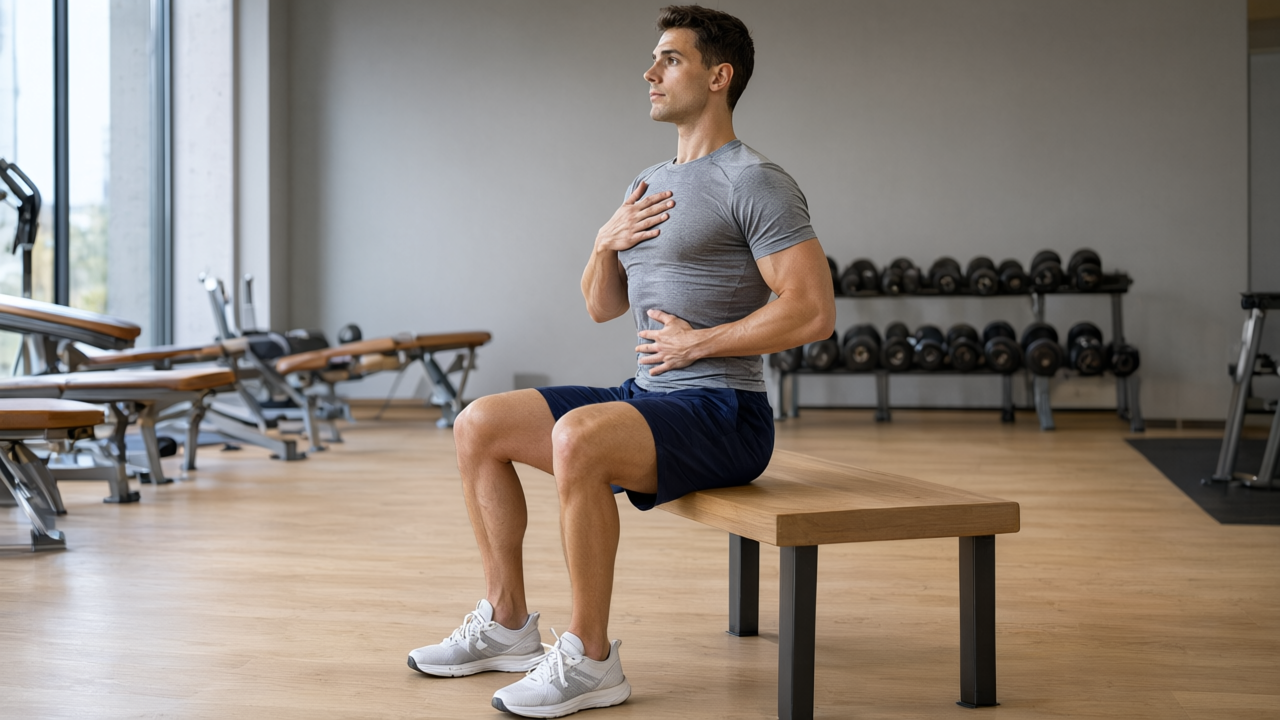
Sit upright on a stable chair or lie flat on your back with your spine neutral and shoulders relaxed.
- 2
Place one hand on your abdomen and the other on your chest to monitor breath placement.
- 3
Inhale slowly through your nose for exactly four seconds, feeling your lower ribs expand outward.
- 4
Hold the breath gently at the top for four seconds without clenching your throat or jaw.
- 5
Exhale steadily through your mouth for four seconds, drawing your navel inward to empty the lungs.
- 6
Pause at the bottom for four seconds, maintaining a relaxed posture and an open chest.
- 7
Repeat the complete four-phase cycle continuously for the target duration.
- 8
Gently release the pattern and return to natural, unmeasured breathing to complete the set.