
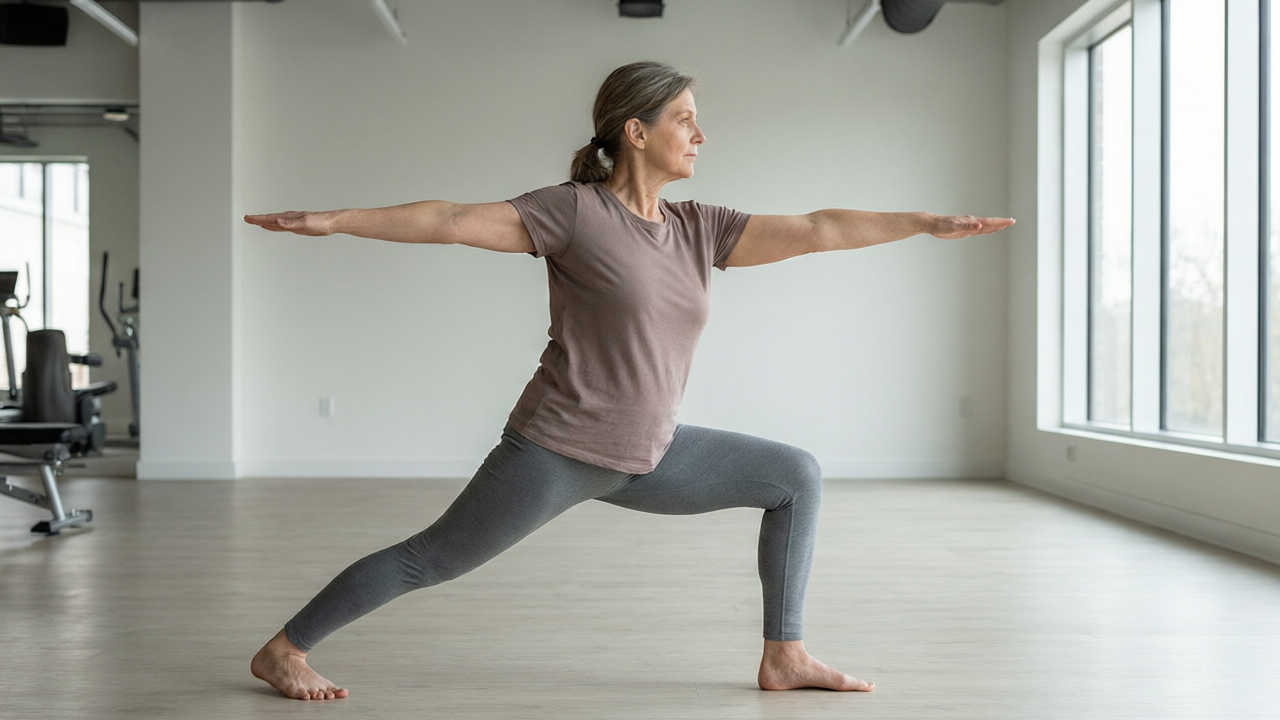
Warrior Series
warrior-series
When I flow through the Warrior Series, I feel a grounded stability radiating from my front heel while my hips open with quiet, deliberate warmth. Each breath deepens the stretch along my inner thighs and shoulders, turning tension into length. There’s a steady, expansive energy in my chest, like I’m holding space without forcing it. Good reps leave my joints feeling oiled and my mind sharply present, anchored in strength and graceful mobility.
Si vous débutez
Start by narrowing your stance slightly to prioritize stability over depth, and focus on keeping your front knee aligned with your ankle rather than pushing past it. If your front knee collapses inward, gently press the outer edge of your foot down to recruit your outer hip and restore tracking. You will know you are approaching fatigue when your standing leg begins to tremble uncontrollably or your breath becomes shallow and rushed; at that point, step back to a neutral standing position and reset rather than holding a compromised shape. Beginners often compensate by overarching the lower back or letting the shoulders creep toward the ears, so actively draw your belly button toward your spine and roll your shoulder blades down your back. Move slowly through each transition, and remember that the series is about mindful alignment, not how low you can sink. Trust the process, respect your current range of motion, and let consistency build the necessary strength over time.
Aller plus loin
To make this static hold genuinely demanding, extend your time under tension to 45–60 seconds per side. Harder here means widening the stance by another few inches or sinking the hips lower while keeping the front knee stacked over the ankle, which intensifies the demand on your hip and ankle mobility. Breathe deliberately; a slow four-count inhale and six-count exhale forces you to maintain shape under rising discomfort rather than bracing against it. Add a three-second pause at your deepest point of flexion before rising, using that stillness to check your back foot remains grounded through its outer edge. Practise this four to five times weekly, progressing only when your current depth feels steady and your breathing stays smooth throughout. Once you can hold 60 seconds cleanly at maximum comfortable depth, move on to Warrior II with a bound extended side angle, which layers lateral spinal mobility onto the same hip-opening pattern.
Erreurs courantes
Practitioners frequently let their front knee drift past the toes or cave inward, which places unnecessary strain on the joint and disrupts the kinetic chain. Another common error is allowing the back foot to roll inward or the heel to lift, which compromises the foundational stability required to hold the posture safely. Many also rush the transitions between stances, sacrificing spinal alignment and breath control for speed, which turns a mindful flow into a disjointed sequence. Finally, collapsing the chest and letting the shoulders round forward negates the upper back engagement needed to maintain an open, expansive posture. By consciously correcting these patterns, you preserve joint integrity and unlock the full mobility benefits of the series.
Routine
- Sets
- 3
- Reps
- hold 20-30s per side
- Rest
- 30s
- RPE
- 3
- Per set
- ~60s
- Fréquence
- 4-5x/week
Increase hold duration by 5 seconds or deepen the lunge stance to progressively improve hip and ankle mobility.
Cues
Muscles
- Quadriceps
- Glutes
- Abs
- Hip flexors
- Shoulders
Matériel
- Bodyweight
- 1
Stand tall with feet hip-width apart, ground evenly through both soles, and inhale deeply to lengthen your spine.
- 2
Exhale as you step your left foot back three to four feet, pivoting it outward to a 90-degree angle.
- 3
Inhale while bending your right knee until it aligns directly over your right ankle, keeping your torso centered.
- 4
Exhale to sweep both arms out to shoulder height, palms facing down, and draw your shoulder blades gently together.
- 5
Inhale to turn your head toward your right hand, fixing your gaze on a steady point while maintaining smooth breathing.
- 6
Exhale to press firmly through the outer edge of your left foot, feeling a stretch along your left inner thigh.
- 7
Inhale to straighten your front leg, exhale to step your left foot forward to meet the right, and lower your arms to your sides.