
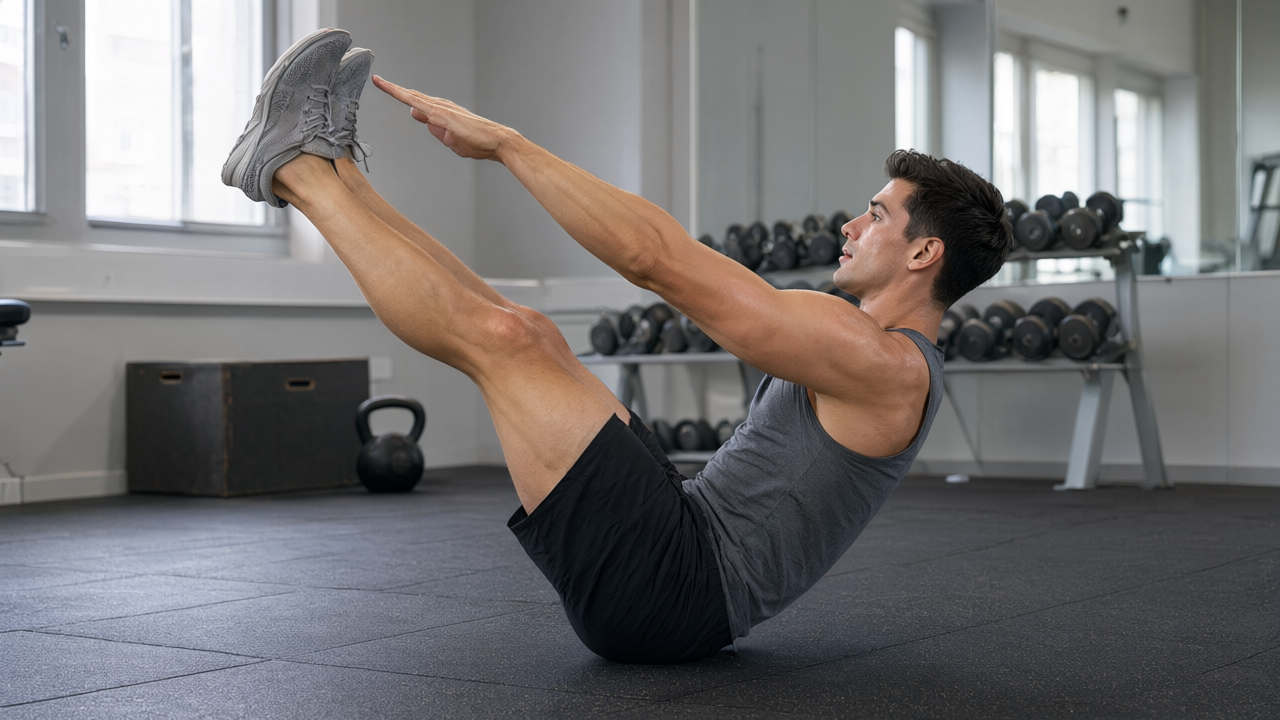
V-Up
v-up
I want you to feel a smooth, continuous tension that starts deep in your lower abdomen and ripples outward as your torso and legs rise. Good V-Ups never feel like frantic flailing; they feel like a controlled hinge. Focus on drawing your ribs toward your pelvis while keeping your lower back anchored. When executed properly, each rep delivers a crisp, unified contraction that leaves your midsection warm and engaged without straining your neck or hips.
Si vous débutez
As a beginner, prioritize control over height. Your lower back must stay glued to the floor throughout the descent; if it arches, you are losing the core engagement that makes this exercise effective. Stop immediately if you feel sharp pulling in your neck or lower back, and regress to a tucked-knee variation until your midline builds endurance. Failure here feels like your legs suddenly dropping faster than your torso can follow, or your shoulders creeping toward your ears as you compensate with momentum. Keep your gaze fixed on your toes, draw your shoulder blades down, and move at a pace that lets you feel the abdominal wall shorten. Consistent, deliberate reps will rapidly improve your mind-muscle connection and build the foundational stability needed for more advanced movements. Trust the process and let your core dictate the rhythm.
Aller plus loin
Extend the lowering phase to three or four seconds while keeping the ascent brisk but unforced. A deliberate two-second pause at the top, where your fingertips meet your toes, forces the abdominal wall to work isometrically rather than bouncing through the sticking point. Sets of eight to twelve build strength; pushing towards fifteen or twenty shifts the stimulus toward endurance. Add weight only when you can complete twelve controlled reps without your heels touching the floor between them. Holding a light medicine ball overhead increases the lever length and demands more from the upper abdominals. Elevating your feet slightly on a low step changes the starting angle, removing the brief rest at the bottom and keeping constant tension on the midline. Once you own the weighted version for multiple sets, progress to hanging V-ups on a pull-up bar, which removes back support entirely and challenges your compression strength under full bodyweight.
Erreurs courantes
Most lifters sacrifice form for range of motion by bending their knees or using a violent swinging momentum to generate height, which shifts the workload away from the abdominal wall and onto the hip flexors. Another frequent error is craning the neck forward or pulling on the head, which creates unnecessary cervical strain instead of relying on true midline contraction. Finally, rushing the eccentric phase by dropping straight down eliminates the time-under-tension required for meaningful strength development and often causes the lower back to hyperextend upon landing. Slow the tempo, keep your joints stacked, and let your abs do the lifting.
Routine
- Sets
- 3
- Reps
- 8-12
- Rest
- 90s
- Tempo
- 2-0-2-0
- RPE
- 7
- Per set
- ~60s
- Fréquence
- 2-3x/week
Add a light medicine ball between your hands or elevate your feet slightly to increase leverage and core demand.
Cues
Muscles
- Abs
- Hip flexors
- Obliques
Matériel
- Bodyweight
- 1
Lie flat on your back with your arms extended overhead and legs fully straight on the floor.
- 2
Press your lower back firmly into the ground to create a stable pelvic foundation.
- 3
Inhale deeply, then exhale sharply as you simultaneously lift your straight legs and torso off the floor.
- 4
Reach your fingertips toward your toes, forming a tight V-shape at the peak of the movement.
- 5
Hold the top position for a brief second while maintaining steady, controlled breathing.
- 6
Inhale as you slowly lower your arms and legs back toward the starting position without letting your heels or hands touch down.
- 7
Reset your posture by re-anchoring your lower back before initiating the next repetition.