
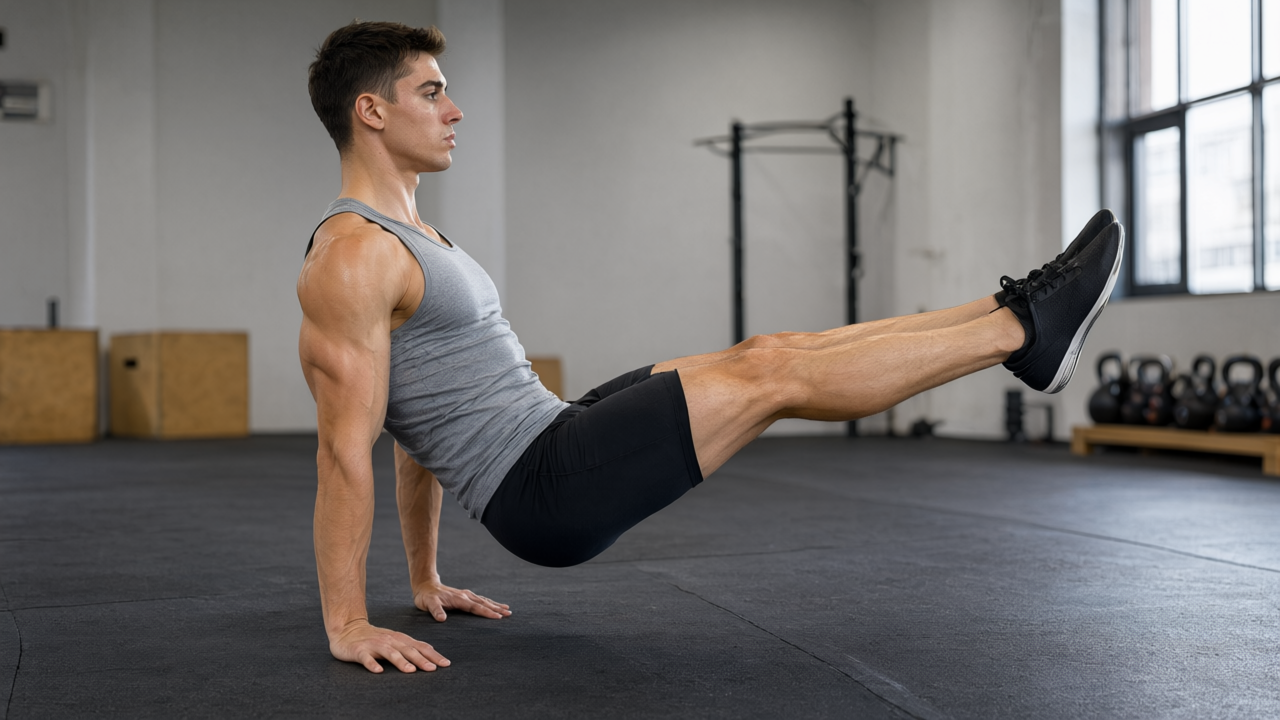
L-Sit
l-sit
When I hold a solid L-sit, it’s a quiet, electric tension that radiates from my hips straight down to my pointed toes. My core locks into place like a steel brace, while my shoulders sink away from my ears. It’s not about straining; it’s about finding that crisp, suspended stillness where every muscle hums in perfect alignment. Breathe into the burn, own the pause, and feel your body defy gravity.
Si vous débutez
Start by practicing with your knees bent and tucked close to your chest, as this significantly reduces the leverage against your core and hip flexors. Keep your shoulders actively pushed down away from your ears throughout the entire hold. If your lower back begins to arch or your shoulders start creeping up toward your neck, you have reached technical failure and should lower your legs immediately. Do not push through sharp joint pain or intense lower back strain, as these signals indicate compromised alignment. Common compensations include sagging through the midsection or allowing your elbows to bend, both of which steal tension from the target muscles and place unnecessary stress on your joints. Build your capacity gradually by holding for short, perfectly aligned intervals rather than grinding through sloppy form. Rest fully between attempts to restore your nervous system and muscular control. Over time, your connective tissues will adapt, and you will naturally progress to extending your legs fully while maintaining that rigid, straight posture.
Aller plus loin
Once you can hold a clean L-sit for three sets of twenty-five seconds, stop adding time and start changing the leverage. Move to parallettes or two sturdy books; the extra clearance lets you press your legs below hand level, demanding far more from your hip flexors and lower abdominals. For load, think in terms of lever length rather than weight: straightening the knees fully is your primary progression, and pointing the toes hard adds meaningful tension without any kit. If you want to build endurance, accumulate seventy-five seconds of total hold time across your sets at an RPE of eight. To bias strength, shorten the holds to ten to fifteen seconds but lift the legs slightly above parallel. Slow the descent when lowering out of the position—a three-second count builds eccentric control that a fast drop wastes. When the full floor L-sit feels settled, progress to the V-sit by driving your toes toward the ceiling while maintaining locked arms and depressed shoulders.
Erreurs courantes
Most practitioners compromise the integrity of the hold by allowing their shoulders to elevate, which collapses the upper body foundation and shifts the load away from the core. Another frequent error is bending the knees slightly or pointing the toes downward, which reduces the lever arm and creates an illusion of proper form without delivering the intended stimulus. Many also neglect full elbow extension, leaving a slight bend that destabilizes the wrists and reduces overall tension. Finally, holding your breath under heavy isometric load spikes internal pressure prematurely, causing premature fatigue and a rapid breakdown of spinal alignment. Prioritize a straight line from your hands through your hips to your heels, and maintain steady, controlled breathing throughout.
Routine
- Sets
- 3
- Reps
- 15-25s holds
- Rest
- 90s
- RPE
- 8
- Per set
- ~75s
- Fréquence
- 2-3x/week
Add 2-3 seconds to each hold until reaching 30s, then advance to parallettes or transition to a full straight-leg L-sit.
Cues
Muscles
- Abs
- Hip flexors
- Shoulders
- Triceps
- Quadriceps
Matériel
- Bodyweight
- 1
Sit on the floor with legs extended straight and place both palms flat beside the hips, fingers pointing forward.
- 2
Push down through the hands to straighten the arms and depress the shoulders while exhaling completely.
- 3
Tighten the abdominal wall and lift the hips just enough to clear the floor.
- 4
Sweep both legs upward to a horizontal position while inhaling deeply to brace the midsection.
- 5
Hold the legs parallel to the ground and maintain steady rhythmic breathing to sustain the position.
- 6
Lower the legs slowly toward the floor while exhaling until the glutes and heels make contact.
- 7
Remove weight from the hands, relax the shoulders, and sit back to complete the reset.