
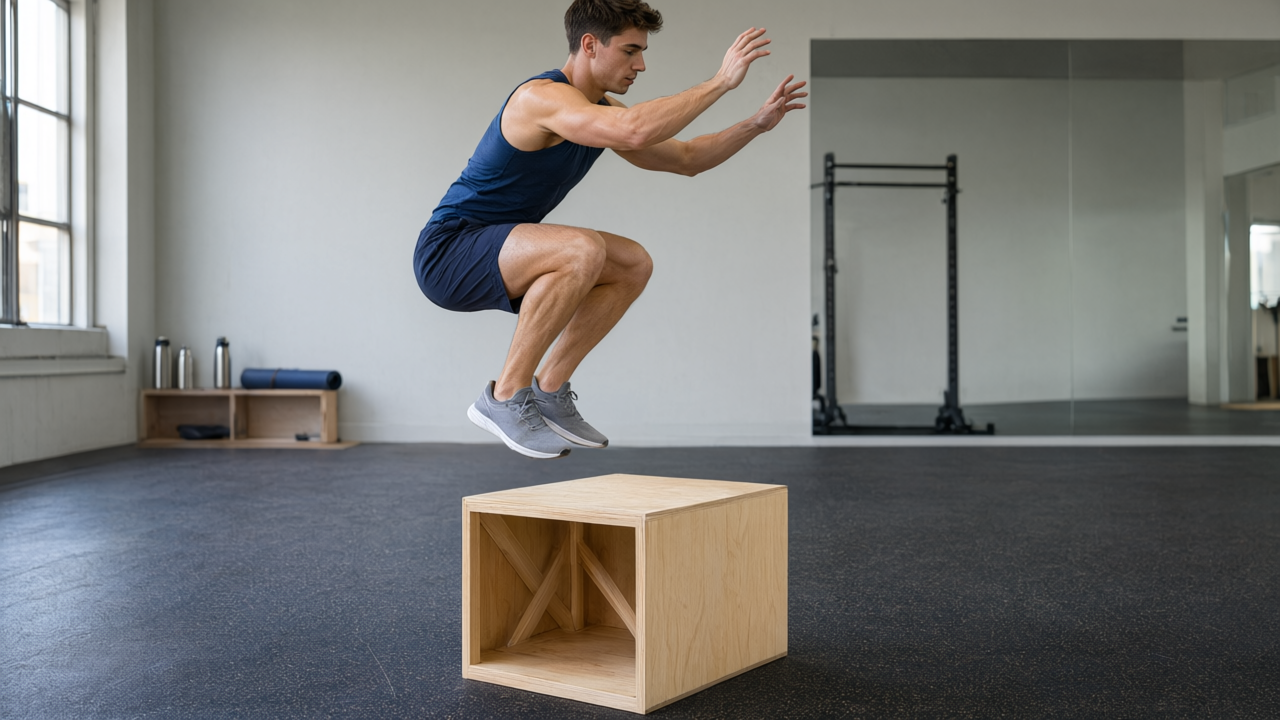
Box Jump
box-jump
Faites attention à
- avoid · Osteoporosis — High-impact plyometrics increase the risk of vertebral compression fractures or lower extremity stress fractures. Instead, focus on resistance training with controlled tempos and balance exercises.
- avoid · Acute knee injury — High-impact landing places significant shear force on the knee joint and patellar tendon. Instead, perform step-ups or low-impact box squats to build strength without the impact.
- caution · Acute lower back injury — The explosive hip extension and potential for poor landing mechanics can aggravate lumbar issues. Instead, perform controlled bodyweight squats or glute bridges to strengthen the posterior chain safely.
When I step onto the box, a good rep feels like a sudden, clean burst of electricity shooting from my calves straight to the platform. I notice the landing is quiet, my knees bending like coiled springs to swallow the impact without a heavy thud. The whole sequence stays snappy and grounded, leaving me light, balanced, and instantly ready to spring again. That effortless snap is exactly how I know I’m tapping into true power.
Si vous débutez
When first learning this movement, start with a low, stable platform that allows you to land confidently. Focus heavily on landing mechanics before chasing height. Keep your eyes fixed on the box edge rather than looking down at your feet. If you feel your heels slipping, your knees collapsing inward, or your lower back arching upon impact, step down immediately and reset. True failure here is not muscle fatigue; it is when your landing becomes loud, heavy, or unbalanced. Stop the set the moment your control degrades or the impact feels jarring. Beginners often compensate by using an exaggerated countermovement or swinging their arms wildly for extra lift, which sacrifices stability. Instead, prioritize a smooth hip hinge and a quiet, two-footed touchdown. Build confidence gradually, adding height only once you consistently land softly and stand fully upright. Trust the process, and let control always precede elevation.
Aller plus loin
Keep your reps between three and five per set, resting ninety seconds to let your nervous system recover fully. This is power work, not conditioning; the moment your take-off slows or your landing grows heavy, end the set. Progress by raising the plyo box incrementally, but only when you can still land quietly with a shallow knee bend at your current height. If you have maxed out your available boxes, add a brief pause in the quarter squat before driving upward to eliminate momentum and demand more from your hips. You can also experiment with tempo by stepping down slowly over three seconds to build eccentric control without adding extra jumps. When the highest stable box feels routine, move on to depth drops off the plyo box to train reactive strength, or try single-leg box jumps if your balance and unilateral power are ready for the demand.
Erreurs courantes
Most practitioners sabotage this exercise by treating it as a maximal height contest rather than a technical power drill. The most damaging error is landing with locked knees or collapsing into a deep, uncontrolled squat, which transfers excessive impact force directly to the patellar tendon and lumbar spine. Another frequent mistake is jumping backward off the platform, which introduces unpredictable impact and risks ankle sprains; always step down deliberately. Many also neglect the preparatory arm swing, relying solely on leg drive and consequently losing upward momentum. Finally, athletes often rush their reset phase, bouncing immediately into the next repetition without fully absorbing the landing. This compromises joint alignment and turns a precise power movement into a sloppy scramble. Prioritize quiet landings and deliberate resets to maintain long-term joint health.
Routine
- Sets
- 3
- Reps
- 3-5
- Rest
- 90s
- RPE
- 7
- Per set
- ~90s
- Fréquence
- 2-3x/week
Increase box height incrementally while maintaining explosive takeoffs and soft, controlled landings.
Cues
Muscles
- Glutes
- Quadriceps
- Calves
- Hamstrings
- Abs
Matériel
- Bodyweight
- Plyo box
- 1
Place a sturdy box at a comfortable height directly in front of the starting position.
- 2
Stand facing the box with feet shoulder-width apart and toes pointed slightly outward.
- 3
Hinge at the hips and bend the knees into a quarter squat while inhaling deeply through the nose.
- 4
Swing both arms upward and drive through the entire foot to launch vertically off the ground.
- 5
Pull the knees toward the chest mid-air to safely clear the top edge of the box.
- 6
Land softly on both feet with knees slightly bent while exhaling forcefully through the mouth.
- 7
Stand fully upright on the box to stabilize the core and confirm secure balance.
- 8
Step down carefully one foot at a time to the starting position and reset posture.