
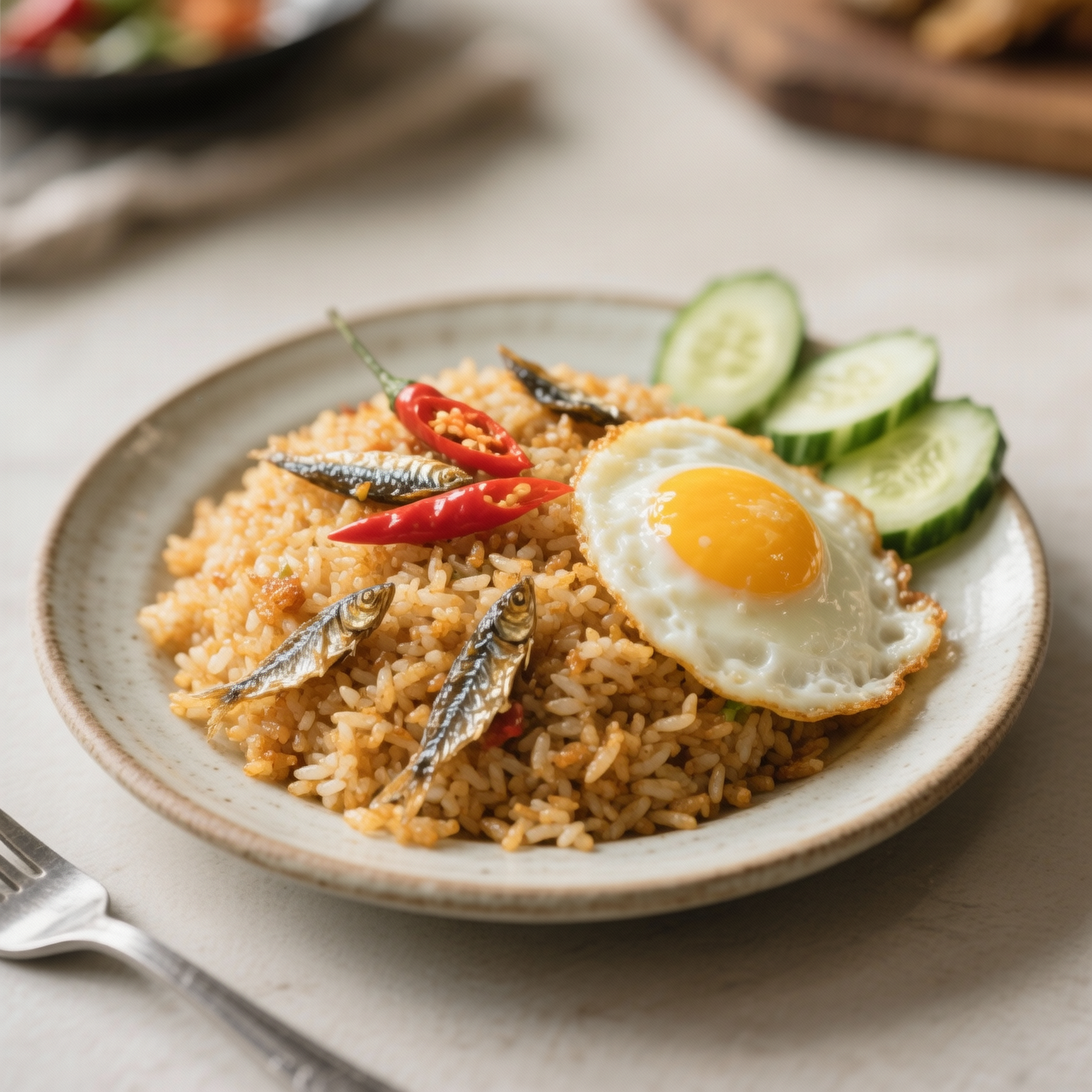
Nasi Goreng Kampung
When I think of Nasi Goreng Kampung, I am instantly transported to the bustling, humid mornings of a Malaysian village kitchen. This humble dish, translating to village-style fried rice, is the ultimate testament to the resourcefulness of Malaysian home cooks. Historically, it was born out of the necessity to transform leftover, day-old rice into a vibrant, satisfying meal using whatever pantry staples were on hand. What makes this dish so deeply meaningful to me is its unpretentious elegance; it doesn't rely on expensive proteins or complex spice pastes, but rather on the bold, unapologetic flavors of dried shrimp paste, fiery bird's eye chilies, and the quintessential star: ikan bilis, or dried anchovies. These tiny fish provide an incredible depth of umami that defines the dish's soul. However, achieving that perfect, smoky wok hei and distinct texture is where many stumble. The most common pitfall I see is using freshly cooked, warm rice. You must use day-old, refrigerated rice; otherwise, the moisture will steam the grains, resulting in a tragic, mushy disappointment rather than distinct, chewy kernels. Another frequent mistake is burning the ikan bilis. They fry in seconds, and if you add them too early or leave them unattended, they turn bitter and ruin the entire wok. To keep this under thirty minutes, I always prep my anchovies and blend my sambal belacan ahead of time, ensuring the actual cooking is a lightning-fast, high-heat dance. Mastering this quick meal means respecting its rustic roots while executing the technique with precision.
Nutrición
| Por ración | calories | protein | carbs | fat | satFat | fibre | sugar | sodium |
|---|---|---|---|---|---|---|---|---|
| beginner | 321kcal | 17g | 43g | 9g | 2g | 3g | 7g | 1431mg |
| intermediate | 312kcal | 16g | 41g | 9g | 2g | 2g | 7g | 1389mg |
| expert | 317kcal | 16g | 42g | 9g | 2g | 2g | 7g | 1391mg |
Por ración · Estimado por Ava — una guía, no una cifra clínica.
- 400 gcooked jasmine rice— preferably day-old and chilled for best results
- 15 gbelacan
- 30 gikan bilis
- 4 piecechilies
- 50 gdried anchovy— heads and guts removed, rinsed and patted dry
- 4 piecesshallot— peeled
- 2 piecesgarlic clove— peeled
- 3 piecesbird's eye chili— adjust to spice preference
- 2 piecesegg— large
- 150 gkangkung— washed and cut into 2-inch pieces
- 2 tbspsweet soy sauce— kecap manis
- 1 tbsplight soy sauce
- 0.5 tspsalt— to taste
- 3 tbspcooking oil— vegetable or palm oil
- 200 gwater spinach
- 4 piecescallions
- 60 gsalted fish
This beginner-friendly Nasi Goreng Kampung embraces smart shortcuts to deliver authentic Malaysian flavor in under thirty minutes. Instead of laboriously grinding fresh chilies, shallots, and fermented shrimp paste, you will use a high-quality store-bought sambal or Nasi Goreng paste, which forms the rich, spicy base of the dish. The true hallmark of Kampung (village) style fried rice is the use of dried anchovies (ikan bilis) and water spinach (kangkung), rather than the sweet soy sauce and chicken found in city-style versions. The biggest secret to success here is using day-old, chilled rice; fresh, warm rice will steam and turn mushy when stir-fried. Keep the heat high but manageable to toast the paste without burning it. Watch the anchovies closely when frying them initially—they go from perfectly crispy to bitter and burnt in seconds. This approach guarantees a confident first attempt, yielding a fragrant, savory, and slightly spicy plate of rice with a satisfying crunch from the fried anchovies.
Equipment
- Heavy-bottomed pan or wok— non-stick is highly recommended for beginners to prevent rice sticking
- Slotted spoon— for safely removing the crispy anchovies from hot oil
Method
- 1
Rinse the dried anchovies under cold water and pat them completely dry with paper towels.
Moisture is the enemy of crispiness; any water will cause dangerous oil splatters.
drying~ 2 min - 2
Heat oil in your pan over medium heat and fry the dried anchovies until golden and crispy, about 3 minutes.
Stir constantly so they brown evenly without burning.
shallow-frying~ 3 minTricky bit - 3
Remove the crispy anchovies with a slotted spoon, leaving the oil in the pan, then add the store-bought sambal paste.
Lower the heat to medium-low to prevent the chili paste from scorching.
blooming~ 2 minTricky bit - 4
Add the chilled, day-old rice to the pan, breaking up any clumps with your spatula, and toss vigorously to coat every grain in the red paste.
Use a folding motion rather than pressing down to keep the rice grains intact.
stir-frying~ 4 min - 5
Add the chopped water spinach and a splash of water, tossing just until the leaves wilt, then fold in the crispy anchovies and serve immediately.
The residual heat will finish cooking the spinach; overcooking makes it slimy.
wilting~ 2 min
Cocinar desde congelado
Thaw overnight in the fridge and reheat in a hot wok or microwave with a splash of water to restore moisture.
Los tiempos de almacenamiento son una guía — siempre usa tu criterio y guarda los alimentos de forma segura.