
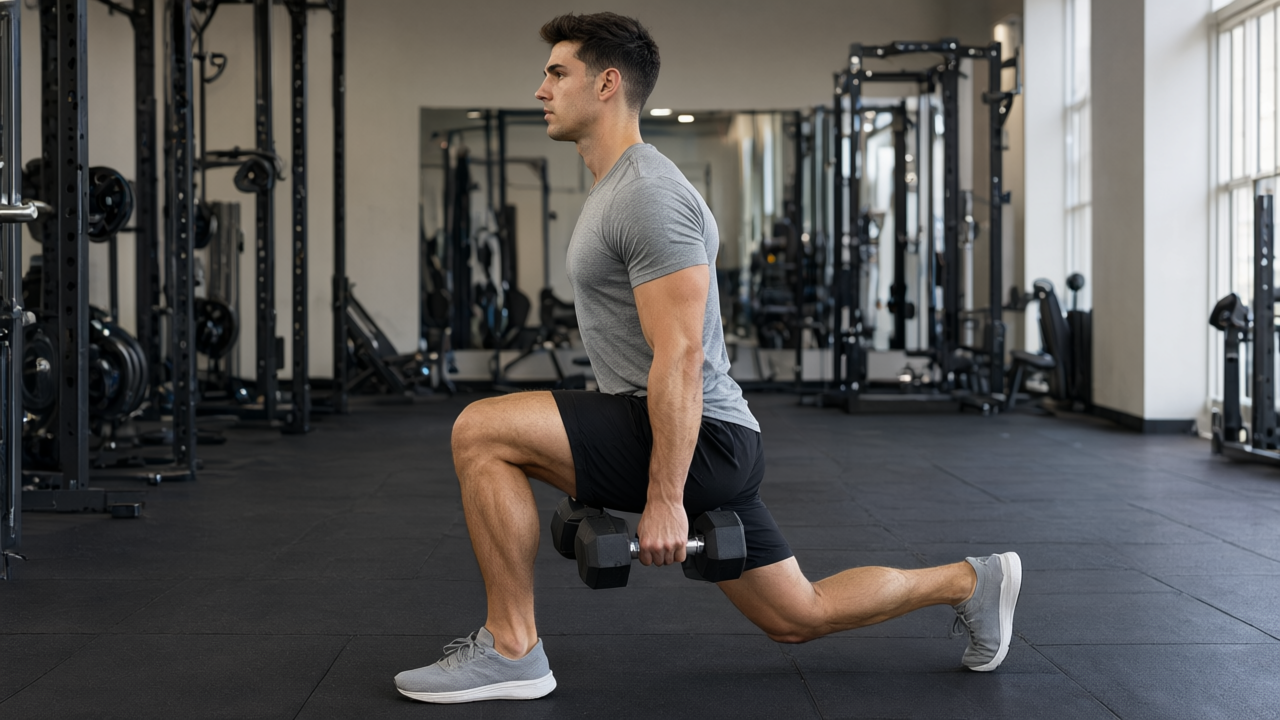
Reverse Lunge
reverse-lunge
Будьте обережні з
- caution · Vertigo / balance disorder — Stepping backward without visual reference and changing vertical levels can trigger dizziness or loss of balance. Instead, perform stationary split squats holding a sturdy support to eliminate the stepping motion.
- caution · Acute knee injury — Deep knee flexion under bodyweight loads the patellofemoral joint and surrounding ligaments. Instead, perform glute bridges or wall sits to strengthen the legs with less knee shear.
- caution · Hip replacement (post-op) — The deep hip flexion required to reach parallel can exceed safe range-of-motion limits for a replaced joint. Instead, perform supported mini-squats or seated leg presses within a restricted range.
When I step back into a reverse lunge, I immediately feel a deep, controlled burn in my front glute and quad. Good reps feel grounded and smooth, like I am lowering myself into a sturdy chair. There is no wobbling or knee strain, just steady tension and a clean, vertical drive back to standing. I love how this movement builds real stability while keeping my joints protected and my core quietly engaged.
Якщо ви новачок у цьому
When you are new to this pattern, prioritize balance and range of motion over depth. Step back only as far as you can control, and use a wall or sturdy chair for light fingertip support if needed. Keep your weight centered over your front foot, ensuring your front knee tracks in line with your second toe rather than collapsing inward. If you feel your lower back arch excessively or your torso lean heavily forward, shorten your step and reset. Stop the set the moment your form breaks down or your joints ache, as muscular fatigue is normal but joint strain is not. Beginners often rush the return phase or let the front heel lift, which shifts tension to the knee. Instead, press evenly through your entire front foot and move with deliberate control. Your breathing should remain rhythmic; do not hold your breath during the descent. Trust the process, and remember that consistency beats depth every time. With each session, your stability will naturally improve, allowing you to lower yourself further without sacrificing alignment.
Рухатися далі
To bias the glute, lengthen your lowering phase to three or four seconds and add a distinct two-second pause with the back knee hovering just above the floor. This removes momentum entirely and forces the front hip to stabilise under load. Drive up with intent, but never so fast that you lose balance at the top. Sets of eight to twelve per leg suit this movement well for building tissue tolerance. Once you can complete twelve controlled reps with a two-second pause at the bottom, hold dumbbells to increase demand rather than simply adding more repetitions. If dumbbells no longer challenge you, progress to a barbell reverse lunge or elevate your front foot on a low step to deepen the range. For variation, try a deficit reverse lunge by standing on a small plate; this increases hip flexion and stretches the working glute further. Alternatively, a 1.5-rep style—lowering fully, rising halfway, lowering again, then standing—doubles time under tension without extra weight.
Поширені помилки
The most frequent error is stepping too far back or too far forward, which disrupts the natural hinge and places undue stress on the knee joint. Many lifters also allow their front knee to cave inward during the descent, losing the stabilizing engagement of the gluteus medius. Another common breakdown is leaning the torso excessively forward or rounding the lower back, which shifts the workload away from the legs and compromises spinal neutrality. Finally, rushing the concentric phase by bouncing off the back knee eliminates the eccentric control that drives real strength gains. Keep your step length moderate, align your knee over your toes, maintain an upright chest, and move with deliberate, uninterrupted tension.
Програма
- Sets
- 3
- Reps
- 8-12
- Rest
- 90s
- Tempo
- 2-0-2-0
- RPE
- 7
- Per set
- ~90s
- Частота
- 2-3x/week
Progress by adding dumbbells or a barbell, increasing reps toward the top of the range, or incorporating a brief pause at the bottom.
Cues
М'язи
- Glutes
- Quadriceps
- Hamstrings
- Abs
- Hip flexors
Обладнання
- Bodyweight
- Dumbbells
- 1
Stand tall with feet shoulder-width apart, toes slightly turned out, and brace your core.
- 2
Inhale steadily while stepping one foot straight back until the ball of the foot contacts the floor.
- 3
Lower your hips by bending both knees until the front thigh is parallel to the ground and the back knee hovers just above it.
- 4
Maintain an upright chest and ensure the front knee stays aligned directly over the ankle.
- 5
Exhale forcefully while driving through the front heel to push your body back to the starting position.
- 6
Bring your feet together, reset your posture, and alternate legs for the next repetition.