
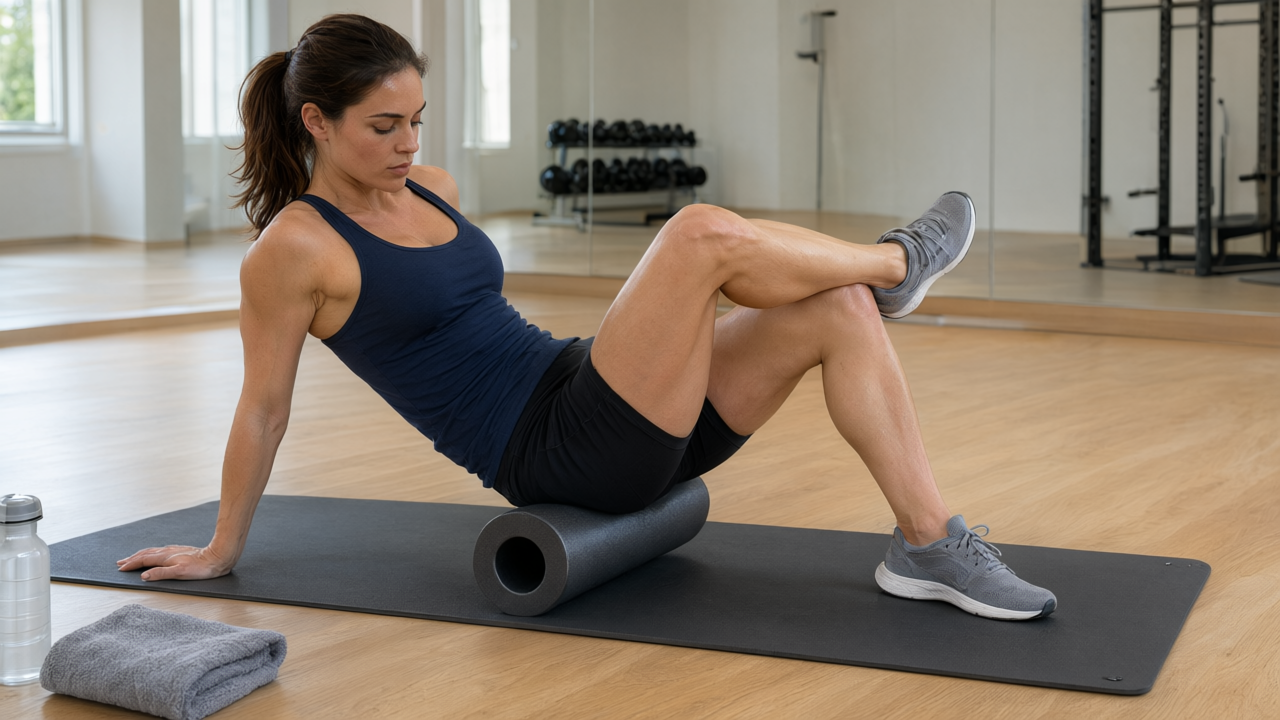
Foam Roll Glutes
foam-roll-glutes
Будьте обережні з
- caution · Hip replacement (post-op) — Direct pressure near a prosthetic joint may cause discomfort or irritation. Instead, perform gentle standing hip circles without equipment.
- caution · Acute lower back injury — Leaning back onto the hands while seated can compress the lumbar spine. Instead, perform a supine figure-four stretch on the mat without the roller.
When I cue you into this cooldown, I want you to sit on the foam roller and cross one ankle over the opposite knee. You will lean towards the crossed side so the roller sits beneath that glute. This eases the glutes and deep hip rotators after hinges, squats, or long periods of sitting. Breathe out as you pause on tender spots.
Якщо ви новачок у цьому
The first time you try this, you will likely keep your hips too square, meaning the roller presses into your tailbone rather than the meaty part of your glute. To fix this, actively lean your weight towards the side you are rolling; imagine pointing your belly button slightly towards that same-side shoulder. Another common error is rolling too quickly. This is not about speed. Move in slow, deliberate sweeps no longer than five centimetres at a time. It should feel like a firm, tolerable pressure, never sharp or shooting pain down your leg. If you feel nerve-like tingling, shift the roller slightly higher or lower away from the sciatic path. Beginners often hold their breath when they find a sore spot. Instead, exhale slowly through your mouth to let the tissue release. Stop if the discomfort exceeds a six out of ten. Sixty seconds per side is plenty for your first session.
Рухатися далі
For deeper tissue penetration, stack your feet together rather than crossing them, placing all your bodyweight onto a single glute. Use a denser foam roller if the standard one no longer provides adequate feedback. Spend two to three minutes per side, moving at a pace of roughly one inch per second. When you locate an adhesion, perform active internal and external rotation of the working hip while maintaining pressure on the spot. Progress to a lacrosse ball placed on the mat once the foam roller feels entirely comfortable, targeting the piriformis specifically. Incorporate this immediately after heavy hip hinge work or prolonged seated periods to restore resting muscle tone. Avoid using this as a warm-up substitute for dynamic movement; reserve it strictly for your cooldown routine.
Поширені помилки
Rolling too fast defeats the purpose entirely. Rapid sweeping does not allow the nervous system to down-regulate tension in the fascia, leaving the muscle just as tight as before. Slow down to one inch per second. Sitting perfectly upright places the roller against the sacrum instead of the gluteal muscles. You must lean heavily towards the working side to target the correct tissue. Holding your breath when you hit a tender spot causes your pelvic floor and surrounding musculature to brace, which blocks the release. Exhale deliberately through pursed lips. Finally, rolling directly over the bony prominence of the greater trochanter on the outer hip can irritate the bursa. Keep the pressure on the soft tissue of the glute itself, stopping just short of the hard bone.
Програма
- Sets
- 1
- Reps
- 45–60 seconds per side
- Rest
- 0s
- Tempo
- slow
- RPE
- 4
- Per set
- ~60s
- Частота
- 5
increase duration or use denser roller
Cues
М'язи
- Glutes
- Hip flexors
Обладнання
- Foam roller
- Mat
- 1
Place the foam roller horizontally on the mat and sit directly on top of it.
- 2
Position your hands flat on the mat behind your hips for support.
- 3
Cross your right ankle over your left knee, forming a figure-four shape.
- 4
Lean your torso and hips towards the right side until the roller sits under your right glute.
- 5
Exhale and slowly roll your body in small movements across the right glute and outer hip.
- 6
Pause on any tender spot for three to five seconds while breathing out fully.
- 7
Return your hips to the centre, uncross your legs, and repeat on the left side.