
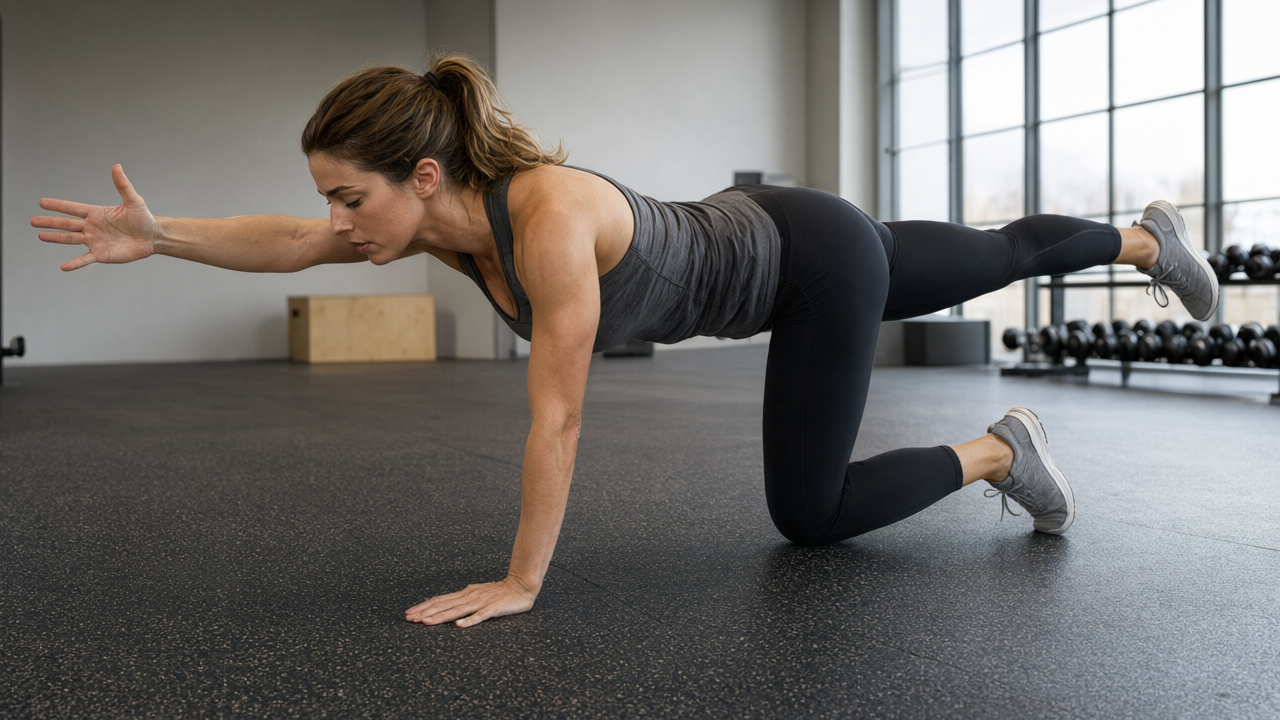
Bird Dog
bird-dog
Будьте обережні з
- modify · Acute knee injury — Kneeling on a hard floor with bodyweight through a bent knee is the uncomfortable part, not the exercise. Put a folded towel or a Mat under the shins. If kneeling is genuinely impossible, stand the drill against a wall instead: hinge and lift one elbow and the opposite knee toward it, keeping the spine long — same brace, no knee compression. And because this is an all-fours position, the wrist takes load too: this library has no condition key for it, so if your wrist aches, spread the fingers and press through the knuckles instead of the heel of the hand, or do the drill with the forearms on a Bench. If it still hurts, that is a wrist question for someone qualified, not something to train through.
- modify · Acute lower back injury — This is usually the safe choice, and for most backs it is — but the failure mode is arching into extension as the leg lifts, which is exactly what a reactive spine dislikes. Keep the ribs stacked and the hip crease square to the floor, and lower the range so the knee only goes as high as the back stays quiet. If extension itself hurts, take the leg out and work the arm only. The sign to stop is a pinch or a stick in the lower back, not the burn in the glute you came for.
When I nail this move, I feel a deep, steady tension across my entire midline. It’s not about reaching far; it’s about staying perfectly still while extending opposite limbs. Good reps feel like a quiet, controlled balance where my lower back stays completely protected and my core acts as an unshakable anchor. You’ll notice a smooth, rhythmic flow that leaves you feeling grounded, focused, and surprisingly challenged by the simplicity.
Якщо ви новачок у цьому
As you learn this movement, focus entirely on keeping your hips perfectly level. If your lower back begins to arch or your pelvis tilts, you have gone past your current stability threshold. Stop immediately, reset to the starting position, and reduce your range of motion until you can maintain a rigid midline. You might feel a slight tremor in your core or shoulders as they adapt to the anti-rotation demand; this is normal neuromuscular fatigue, not injury. Avoid compensating by shrugging your working shoulder or flaring your ribcage upward. Instead, keep your shoulder blades gently drawn down and back, and maintain a steady, rhythmic breath. If you notice your extended foot dragging or your hand collapsing inward, shorten the reach slightly. Quality always outweighs height or distance. Trust the process, move slowly, and let your nervous system map the correct alignment before pushing for longer holds.
Рухатися далі
Once the standard two-second hold feels routine, extend it to four or five seconds per side. That longer isometric pause is where the real anti-rotation work happens, forcing your deep stabilisers to fight fatigue rather than just momentum. Keep the lowering phase slow and deliberate; rushing back down wastes the eccentric demand on your trunk. Because this is a bodyweight stability drill, making it harder means increasing time under tension or altering leverage, not chasing speed. Aim for sets of six to eight reps with those extended holds, or shift to timed sets of thirty to forty-five seconds per side. When you can complete three clean sets without any pelvic shift, introduce light ankle and wrist weights, or perform the movement on an unstable surface like a folded mat. For a more demanding progression that keeps the same pattern, move to the contralateral bird dog with knee-to-elbow contact, which adds dynamic flexion while testing your balance through a fuller range.
Поширені помилки
Most practitioners rush the tempo, sacrificing spinal neutrality for momentum. This often leads to excessive lumbar extension, where the lower back arches dramatically as the leg lifts, shifting stress away from the core and into the spinal joints. Another frequent error involves dropping the hips on the extended side, which breaks the anti-rotation objective and turns the drill into an unbalanced hip flexor stretch. Many also flare their elbows or shrug the working shoulder toward the ear, creating unnecessary neck tension and disrupting the kinetic chain. Finally, holding the breath during the extension phase spikes intra-abdominal pressure prematurely and destabilizes the torso. Slow the pace, maintain a flat back, keep the hips square, and breathe continuously to preserve the exercise’s stabilizing intent.
Програма
- Sets
- 3
- Reps
- 8-12
- Rest
- 60s
- Tempo
- 2-1-2-1
- RPE
- 4
- Per set
- ~90s
- Частота
- 2-3x/week
Add a 2-second isometric hold at full extension, then progress to light ankle/wrist weights or an unstable surface.
Cues
М'язи
- Abs
- Lower back
- Glutes
- Shoulders
Обладнання
- Bodyweight
- 1
Position yourself on all fours with your wrists stacked directly under your shoulders.
- 2
Align your knees directly beneath your hips and spread your fingers wide for stability.
- 3
Engage your abdominal muscles to create a flat, neutral spine without arching or rounding.
- 4
Inhale deeply through your nose to brace your core before initiating movement.
- 5
Extend your right arm straight forward while simultaneously kicking your left leg straight back.
- 6
Hold the extended position for two seconds, checking that your hips remain parallel to the floor.
- 7
Exhale steadily through your mouth as you lower your right arm and left leg back toward the ground.
- 8
Touch your knee and palm lightly to the floor to reset your posture.
- 9
Switch sides by extending your left arm and right leg while maintaining a rigid midsection.
- 10
Hold the opposite extension briefly, then exhale fully to return both limbs to the starting tabletop.