
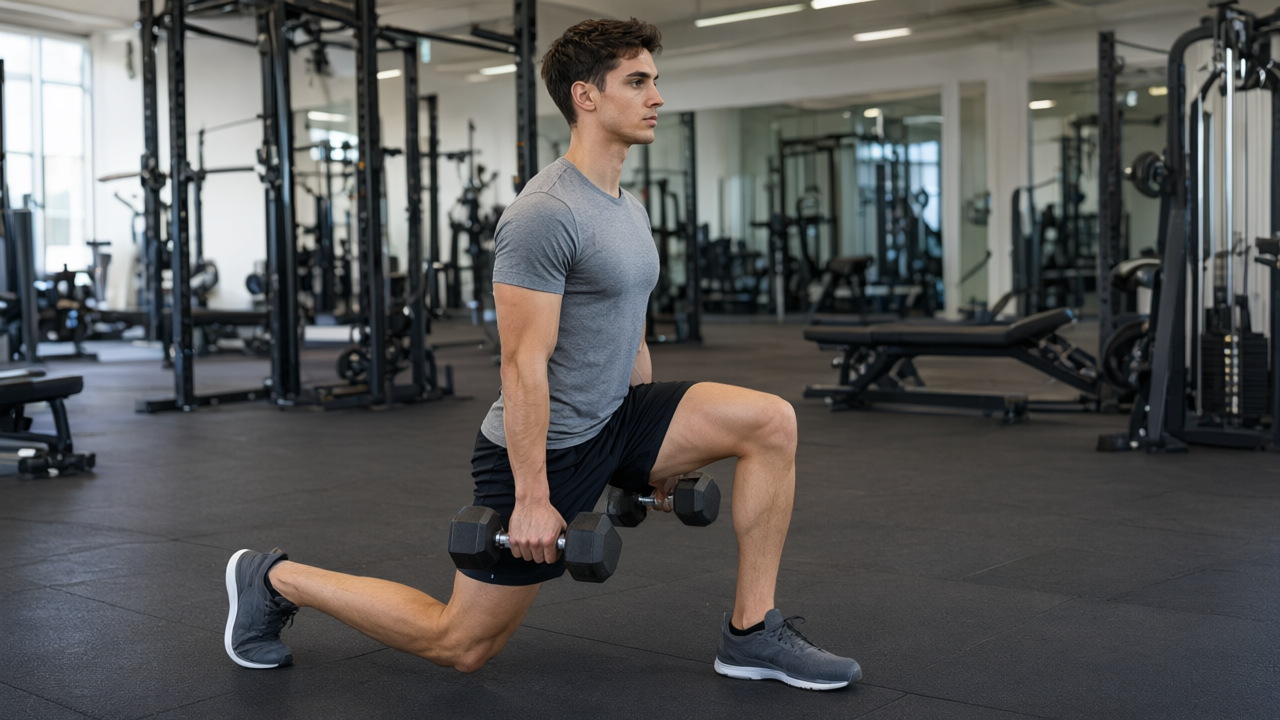
Walking Lunge
walking-lunge
Dikkat Edilmesi Gerekenler
- avoid · Acute knee injury — Excessively long strides and deep knee flexion place dangerous shear stress on the joint. Instead, perform reverse lunges or split squats to control depth and reduce forward knee travel.
- caution · Hip replacement (post-op) — Deep hip flexion and single-leg balance demands can exceed safe range-of-motion limits for a replaced joint. Instead, perform supported partial split squats to build leg strength within a restricted, stable range.
- caution · Pregnancy — A shifting center of gravity increases fall risk during dynamic stepping, and deep lunging may strain the pelvic floor. Instead, perform stationary split squats holding a wall or rack for added balance support.
When I nail a set of walking lunges, I feel a steady, controlled burn across my quads and glutes, with each step landing light and balanced. My core stays engaged, keeping my torso tall while my back knee hovers just above the floor. It is a smooth, rhythmic flow rather than a choppy struggle. Every rep leaves me feeling grounded, strong, and ready to carry that momentum into my next stride.
Buna Yeni Başlıyorsanız
When you are just starting out, I want you to focus entirely on balance and controlled depth rather than stride length. Step only as far forward as you can comfortably manage while keeping your front heel flat on the floor and your back knee from touching the ground prematurely. If you feel your torso leaning too far forward or your front knee drifting past your toes, shorten your step immediately. True muscular fatigue will feel like a heavy burn in your thighs and a gentle wobble in your balance, but sharp knee pain or a pinching sensation in your hips means you must stop and reset your alignment. Beginners often compensate by rushing the steps or using momentum to bounce out of the bottom position, which strips the tension from your target muscles. Instead, I encourage you to pause for a full second at the bottom of each lunge to build stability. Trust the process, keep your gaze fixed ahead, and let your muscles, not your momentum, do the lifting.
Daha İleri
To make the walking lunge harder without adding weight, lengthen your stride slightly to increase hip extension and time under tension, or slow the lowering phase to a deliberate three-second count. Staying in the eight-to-twelve rep range per leg builds size and endurance; dropping to six to eight with dumbbells shifts the emphasis towards strength. Add load or reps only when you can finish every set without your balance wavering or your torso pitching forward. A two-second pause at the bottom of each step removes momentum entirely and forces your quads and glutes to restart the drive from a dead stop. Once bodyweight sets feel manageable across all prescribed sessions, hold dumbbells at your sides. When those become comfortable, progress to deficit walking lunges by stepping off a low plate to deepen the range. Alternatively, try reverse walking lunges, stepping backwards instead of forwards, which changes the demand on your knees and places greater emphasis on the glutes.
Yaygın Hatalar
The most frequent error I see is taking excessively long strides, which forces the front knee to travel too far forward and places dangerous shear stress on the joint. Many lifters also allow their front knee to collapse inward toward the midline, which compromises tracking and reduces glute activation. Another widespread issue is leaning the torso forward like a sprinter instead of maintaining a tall, upright posture that keeps tension squarely on the legs and glutes. I also notice beginners bouncing out of the bottom position using momentum rather than driving through the heel, which eliminates the eccentric control that makes the movement so effective. Finally, letting the trailing leg swing wildly or dragging the foot disrupts your center of gravity and turns a controlled strength builder into a chaotic balancing act.
Rutin
- Sets
- 3
- Reps
- 8-12
- Rest
- 90s
- Tempo
- 2-0-2-0
- RPE
- 7
- Per set
- ~120s
- Sıklık
- 2-3x/week
Add dumbbells or increase step distance once you can complete the top of the rep range with strict control and balance.
Cues
Kaslar
- Glutes
- Quadriceps
- Hamstrings
- Abs
- Calves
Ekipman
- Bodyweight
- Dumbbells
- 1
Stand tall with your feet hip-width apart, shoulders back, and core engaged.
- 2
Step forward with your right leg, planting your heel firmly while keeping your chest lifted.
- 3
Inhale as you bend both knees to lower your hips straight down until your front thigh reaches parallel to the floor.
- 4
Pause briefly to verify your front knee aligns directly over your ankle and your back knee hovers just above the ground.
- 5
Exhale as you drive through your front heel, pushing your body upward and stepping your left foot forward into the next stride.
- 6
Inhale as you lower into a lunge on the opposite side, maintaining a straight torso and controlled pace.
- 7
Complete your final repetition by bringing both feet together, standing fully upright, and exhaling to reset your stance.