
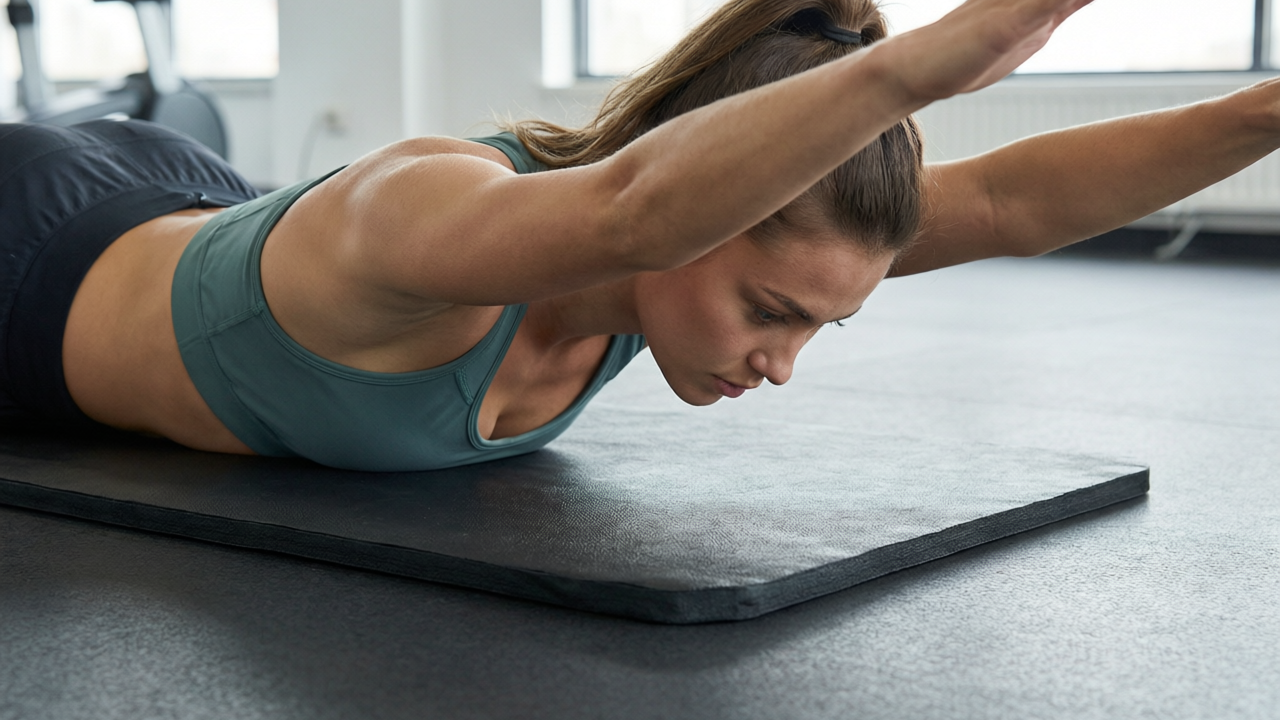
Superman
superman
Dikkat Edilmesi Gerekenler
- caution · Osteoporosis — Loaded spinal extension is usually the safer direction for bone density than loaded flexion, but this one adds arms extended overhead, which lengthens the lever through the thoracic spine. Keep the range small, do not crane the head back, and breathe continuously rather than holding. If you have a diagnosed density loss or any history of vertebral fracture, get the safe range and load from the clinician managing it before adding weight — do not use this exercise to find out what your spine will accept.
- modify · Acute lower back injury — This is the opposite direction from a curl-up: the whole movement is the lumbar spine extending against the weight of the trunk and limbs, and it is set at difficulty 1, so it is often one of the first things a new trainee does. Lift less than the entry suggests — a few centimetres is plenty — and squeeze the glutes to do the work, which is step 4's real purpose. Take the arms and legs up one at a time rather than both together. The sign to stop is a pinch, a cramp or a stick low in the back, not the burn in the muscle you are aiming at. Substitute Glute Bridge, which strengthens the same back-of-the-hip chain with the spine supported on the floor.
- modify · Pregnancy — Lying face down stops being available as the pregnancy continues, and the extension itself loads an abdominal wall and linea alba already under tension. Instead, use Bird Dog, which trains the same back-of-the-chain brace on all fours with nothing pressing into the belly, or Glute Bridge with the hips lifted to a comfortable height. Stop if you feel coning along the midline, heaviness in the pelvis, or any leaking — report those to the clinician or physiotherapist doing your antenatal and postnatal checks rather than working through them.
When you execute this correctly, you’ll feel a firm, continuous tension spanning from your lower back through your glutes and into your upper posterior chain. The movement shouldn’t feel like a frantic lift; it’s a controlled, deliberate squeeze that wakes up dormant stabilizers. Focus on lengthening through your fingertips and toes while keeping your neck relaxed. Each repetition should leave you feeling anchored, aligned, and deeply connected to your core.
Buna Yeni Başlıyorsanız
As a beginner, your goal is quality over height. You only need to lift your limbs a few inches; chasing maximum elevation will immediately trigger lower back compression. Focus on creating a long line from your crown to your heels rather than arching your spine. If you feel sharp pain in your lumbar region, stop immediately and reduce your range of motion. Muscle fatigue will feel like a steady burn across your glutes and posterior chain, not a joint ache. Common compensations include flaring your ribs, craning your neck to look forward, or using momentum to kick your legs up. Keep your chin slightly tucked and let your shoulder blades guide the lift. Breathe steadily throughout; holding your breath spikes intra-abdominal pressure and compromises stability. Trust the process, move deliberately, and let your nervous system adapt to the sustained tension before chasing higher volume.
Daha İleri
To make this harder without adding load, extend the peak hold to four or five seconds and slow your lowering phase to a deliberate three-second count. This extra time under tension forces the erectors and glutes to work longer rather than relying on elastic rebound. For strength endurance, aim for sets of twelve to fifteen; for pure isometric control, drop to six to eight reps with longer holds. Progress when you can complete three sets of twelve with a four-second pause cleanly, then introduce light ankle and wrist weights to increase leverage demands. Alternatively, move to the single-arm, opposite-leg variation, which challenges rotational stability by removing half your base of support. You might also try the hollow-body Superman, lifting slightly higher while actively drawing your ribs down to intensify the anti-extension demand on your deep core.
Yaygın Hatalar
Most lifters rush through the movement, using momentum to jerk their limbs upward instead of relying on controlled muscular contraction. This compromises the exercise’s stabilizing benefits and places unnecessary shear force on the lumbar spine. Another frequent error is hyperextending the neck by staring straight ahead, which strains the cervical vertebrae and disrupts spinal alignment. Many also over-arch the lower back by squeezing the erector spinae too aggressively without engaging the glutes, turning a full-body tension exercise into a localized spinal compression drill. Finally, forgetting to exhale during the lift creates internal pressure that reduces core stability and limits your range of motion. Prioritize smooth, deliberate pacing over height to maximize posterior chain activation.
Rutin
- Sets
- 3
- Reps
- 8-12
- Rest
- 90s
- Tempo
- 2-0-2-0
- RPE
- 7
- Per set
- ~60s
- Sıklık
- 2-3x/week
Increase your hold duration by one to two seconds per rep, or add light ankle and wrist weights once you master the full range of motion.
Cues
Kaslar
- Lower back
- Glutes
- Upper back
- Hamstrings
- Abs
Ekipman
- Bodyweight
- Mat
- 1
Lie face down on a comfortable surface with your arms fully extended overhead and legs straight behind you.
- 2
Press your hips firmly into the floor to establish a stable base.
- 3
Inhale deeply, then exhale as you simultaneously lift your chest, arms, and legs a few inches off the ground.
- 4
Squeeze your glutes and engage your lower back while keeping your gaze directed toward the floor to protect your neck.
- 5
Hold the peak contraction for two seconds while maintaining steady, shallow breathing.
- 6
Inhale as you slowly lower your limbs and torso back to the starting position.
- 7
Rest for a moment to reset your alignment before beginning the next repetition.