
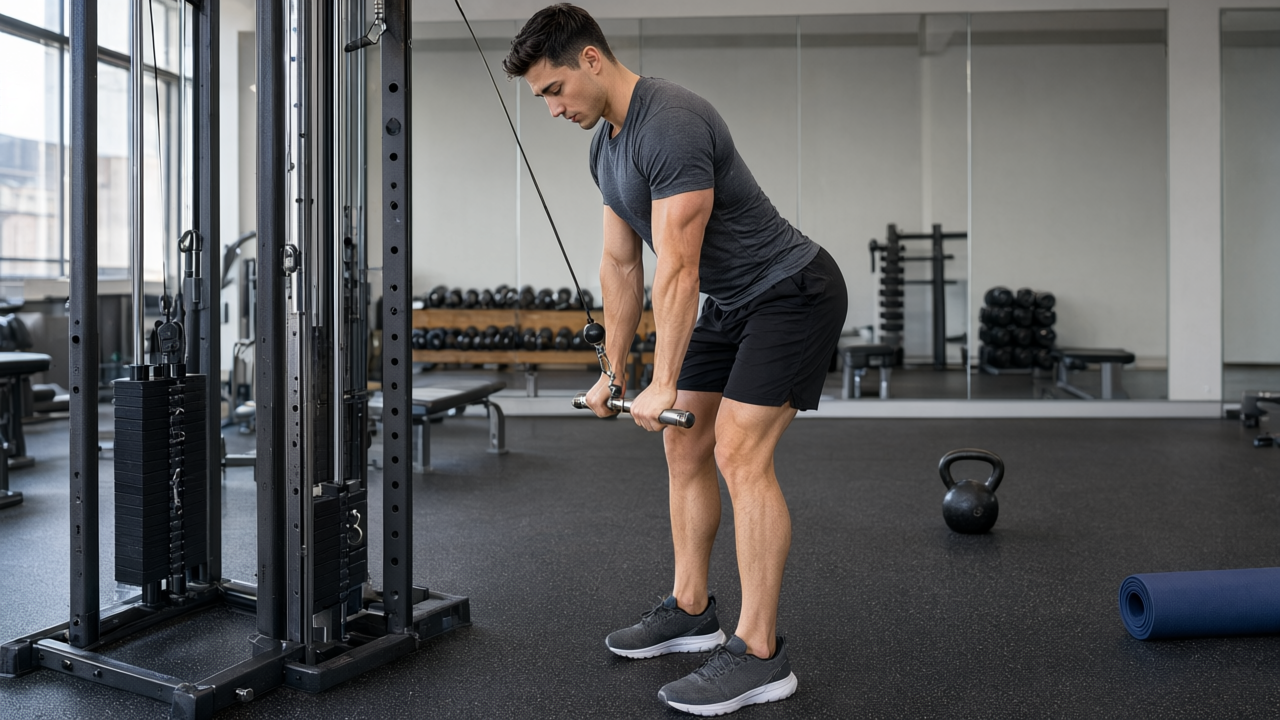
Straight-Arm Pulldown
straight-arm-pulldown
Dikkat Edilmesi Gerekenler
- avoid · Rotator cuff tear — Driving the arms through a long lever arc places high shear stress on compromised rotator cuff tendons. Instead, use cable face pulls with light resistance to train the upper back safely.
- caution · Shoulder impingement — The hands start overhead and the arms stay locked straight, so the shoulder is loaded in exactly the arc that narrows the space under the front of the joint. Set the shoulder blades down before you pull, stop the hands short of full overhead height at the top of the rep by limiting how high you let them travel, and drop the pulley one notch if the catch sits at the start rather than the middle. Substitute Lat Pulldown with a normal elbow bend, which takes the long lever out and lets the shoulder move through a range it can control, or Doorway Row if even that pinches. If the shoulder goes weak or the pain runs down the outside of the arm, stop loading it and have it looked at.
- caution · Acute lower back injury — Hinging forward at the hips while resisting cable tension loads the lumbar erectors isometrically throughout the set. Instead, perform kneeling lat pulldowns to isolate the lats with a supported, upright torso.
- caution · Herniated disc — The standing version holds a forward hinge while the cable keeps pulling you deeper into it, so the disc is loaded in flexion for the entire set. Take the hinge out of it: work kneeling or seated with a tall torso and the ribs stacked over the hips. Numbness, tingling or pain travelling down a leg means this is a physiotherapist's question before it is anyone's training decision.
I want you to feel a deep, sweeping stretch across your upper back as the cable lifts, followed by a sharp, isolating contraction in your lats as you drive down. Keep your arms rigid like steel rods; the movement happens entirely at your shoulder joints. Breathe steadily, maintain a proud chest, and let your back do all the work while your arms simply guide the weight. Any handle will serve on the high pulley: a straight bar is the classic and gives you the widest arc, a V-bar brings the hands closer together, and a rope lets them finish either side of your hips for a longer contraction. Use whatever the machine has — the fixed elbow angle matters far more than the attachment.
Buna Yeni Başlıyorsanız
Focus on keeping your elbows completely locked in place from start to finish. If you feel the tension shift into your arms or lower back, lighten the weight immediately. True failure here feels like a deep burn in the sides of your ribcage, not joint pain in your elbows or shoulders. Stop the set the moment your arms start bending to compensate or your torso begins rocking back and forth. Keep a soft bend in your knees, press your shoulders down away from your ears, and imagine your hands are just hooks pulling the bar down. This movement rewards patience and precision over heavy loading. Start light, master the arc, and trust that controlled tension will build the width and definition you are chasing. You will quickly learn to isolate the lats without recruiting your biceps or traps.
Daha İleri
Slow the return phase to three or four seconds, letting the cable drag your arms overhead until you feel a deep stretch across the lats. Add a two-second pause at the bottom with your hands against your thighs to eliminate momentum and maximise peak contraction. The eight-to-twelve rep range builds tissue, but sets of fifteen to twenty at a lighter load are excellent for metabolic stress without compromising form. Increase weight in 2.5 kg increments only when every rep across all sets finishes with that deliberate bottom squeeze. For greater difficulty without adding plates, step further from the machine to change the cable angle and increase tension at the top of the arc. Once you own the straight bar, switch to a rope attachment; this lets your hands travel past your hips, extending the range of motion and altering the resistance curve to challenge the lower fibres of the lats more directly.
Yaygın Hatalar
The most frequent error is bending the elbows mid-rep, which instantly shifts the workload from your lats to your biceps and triceps. Many lifters also lean back excessively or use momentum to swing the weight down, robbing the target muscles of constant tension. Another common flaw is shrugging the shoulders upward at the top of the movement, which engages the traps instead of keeping the lats fully stretched. Finally, gripping the bar too tightly or over-squeezing your forearms can cause premature fatigue before your back ever reaches true failure. Keep your arms rigid, your torso stable, and let the shoulder joint drive the entire motion.
Rutin
- Sets
- 3
- Reps
- 8-12
- Rest
- 90s
- Tempo
- 2-0-2-0
- RPE
- 7
- Per set
- ~90s
- Sıklık
- 2-3x/week
Gradually increase the working weight by 2.5–5 lbs once you can complete 12 reps across all sets with strict, controlled form.
Cues
Kaslar
- Lats
- Upper back
- Shoulders
Ekipman
- Cable machine
- 1
Adjust the cable pulley to the highest position and attach a handle.
- 2
Step back from the machine, grip the handle with a pronated, shoulder-width grip, and hinge forward slightly at the hips.
- 3
Plant your feet shoulder-width apart, brace your core, and lock your elbows into a fixed, slightly bent position.
- 4
Inhale to prepare, then exhale as you pull the handle down in a wide arc until your hands reach your upper thighs.
- 5
Squeeze your lats hard at the bottom, keeping your shoulders depressed and your arms completely straight.
- 6
Inhale slowly as you guide the handle back along the exact same arc to the starting position, resisting the upward momentum.
- 7
Maintain constant tension throughout the movement and reset your shoulder blades before beginning the next repetition.