
Hip CARs
hip-cars
Dikkat Edilmesi Gerekenler
- avoid · Hip replacement (post-op) — This circles the hip through deep flexion and draws the knee across the midline, which is the position most likely to destabilise a replaced joint. Do not attempt it after hip replacement without the surgeon's sign-off. Hip Abduction trains the same area without taking the leg past the body's midline.
- caution · Vertigo / balance disorder — Every rep is a controlled fall-and-recover on one leg, and the head stays still while the pelvis moves, which can provoke dizziness. Keep both hands on a sturdy support and both feet down, working the circles from a half-squat stance with the toe barely lifting. Glute Bridge gives the same hip range with no balance demand at all.
- modify · Acute knee injury — Lifting the knee to hip height loads the joint in deep flexion and the sweep twists the tibia under it. Keep the foot low, an inch or two off the floor, and let the hip do the work. 90/90 Hip Stretch takes the hip through range with the knee unloaded.
- modify · Acute lower back injury — When the hip runs out of range the lumbar spine finishes the circle by rocking, which is exactly the movement an irritable back will not tolerate. Cut the arc to the size where the pelvis genuinely stays still, even if that is a very small circle. Wall Hip Hinge is the better choice while it settles.
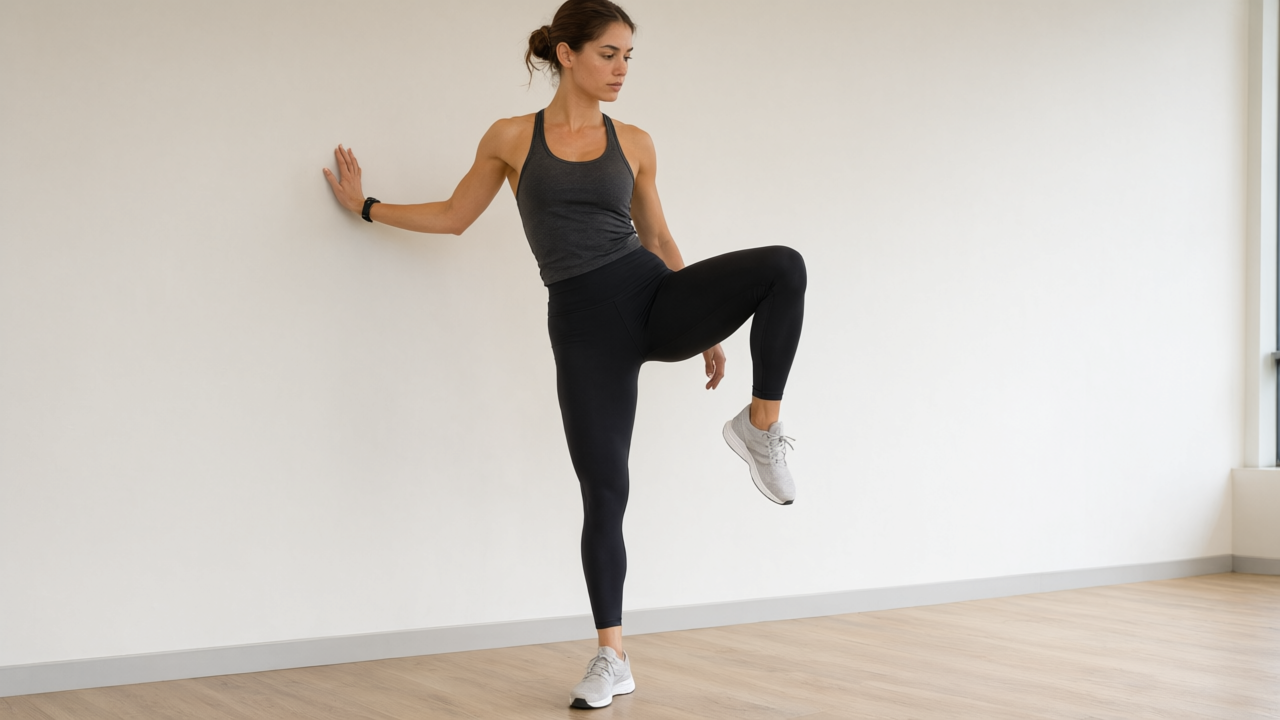
Standing controlled articular rotations for the hip: the working leg travels a slow full circle through flexion, abduction, extension and adduction while the pelvis stays deliberately still. A mobility drill for the hip capsule and for owning your range under control, not a stretch to be forced deeper. One hand rests on a wall for balance only — it is not there to lean on.
Buna Yeni Başlıyorsanız
Start smaller than feels worthwhile: lift the knee only as high as you can while the pelvis stays genuinely still, which for most people is well below hip height, and circle the foot an inch off the floor. Do not press your back into anything — you are standing, so instead keep the ribs stacked over the hips and the belly lightly braced the whole way round. It should feel smooth and slightly awkward, never sharp, pinching or catching in the groin; if it does, the arc is too big, so shrink it and carry on. Watch yourself for hiking the working hip upward, leaning away from the wall, bending the standing knee repeatedly or holding your breath — all four mean the nervous system is borrowing range from somewhere else. Two slow circles per side, once a day, is enough to start; add range before you add reps.
Daha İleri
Harder here does not mean faster: it means slower and stricter. Extend to eight or ten seconds per phase and add a two-second pause at the deepest points of flexion, abduction and extension, so you own the end range instead of coasting through it. Keep the pelvis locked while the leg works at full speed — no counter-lean, no hip hike, no help from the hand on the wall. Once a flawless unweighted circle is available on both sides at full range, progress by removing feedback and adding demand: work facing away from the support, then with the eyes closed, then with the standing knee soft and held low so the hip carries more of the body. One to two reps per side still applies because each circle should take real concentration. Beyond this, the next step is lengthened-position isometrics at end range rather than bigger circles — more arc is not more of the training.
Yaygın Hatalar
The usual compromise is letting the pelvis tilt or rotate alongside the leg, which turns a precise joint drill into a lumbar twist and takes the load off the hip entirely. Rushing removes the feedback the drill exists to build and leaves it momentum-driven. Many stop at the front and never finish the extension or the adduction half, so the anterior capsule goes untrained and the circle is really a swing. Gripping the breath and tensing the neck and shoulders adds systemic tension to a drill meant to reduce it. And reaching for a big range by leaning on the wall for support produces a wide arc that is not hip motion at all.
Rutin
- Sets
- 2
- Reps
- 1-2 per side
- Rest
- 30s
- Tempo
- 5-1-5-1
- RPE
- 3
- Per set
- ~60s
- Sıklık
- 5-7x/week
Increase end-range control and gradually expand range of motion before adding light ankle weights.
Cues
Kaslar
- Glutes
- Hip flexors
- Abductors
- Adductors
- Abs
Ekipman
- Bodyweight
- 1
Stand facing a wall or sturdy support with feet hip-width apart.
- 2
Place one hand lightly on the support to maintain balance while keeping the spine tall.
- 3
Shift body weight completely onto the standing leg and gently brace the abdominal muscles.
- 4
Inhale deeply to stabilize the pelvis before lifting the free knee to hip height.
- 5
Exhale and slowly guide the lifted knee outward until reaching a comfortable end range.
- 6
Sweep the knee forward across the midline while keeping the torso completely stationary.
- 7
Continue the arc by drawing the leg behind the body and returning to the starting position while inhaling.
- 8
Maintain strict pelvic alignment and avoid any leaning or twisting throughout the full rotation.
- 9
Lower the working foot back to the floor with deliberate control and restore the initial stance.
- 10
Reset the hips and take two normal breaths before switching to the opposite side.