
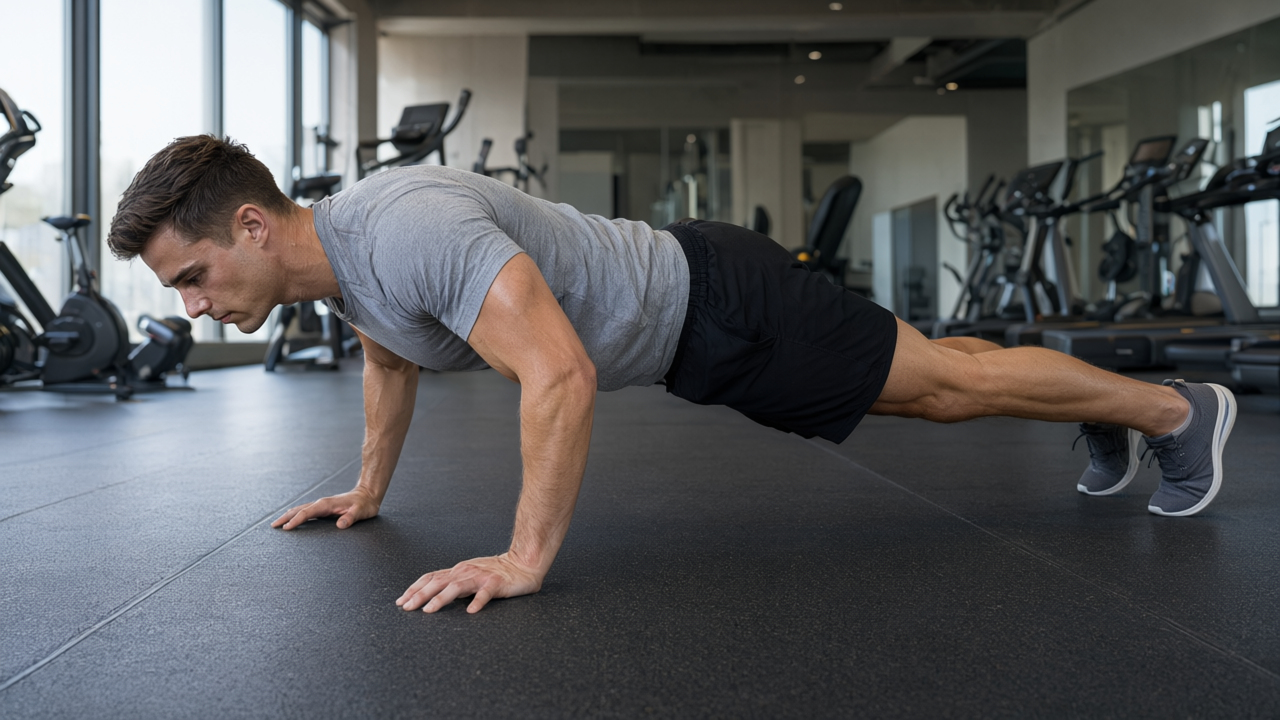
Burpee
burpee
Dikkat Edilmesi Gerekenler
- avoid · Vertigo / balance disorder — Every rep takes your head from standing height to the floor and back in under two seconds, and then adds a jump — repeated position changes that are a reliable trigger, with a hard landing to recover from if the room moves. Avoid it. Instead, use Bodyweight Squat, which keeps the head level and the feet planted, or Treadmill Incline Walk for the conditioning. Do not attempt a jumping movement somewhere you cannot sit down.
- avoid · Osteoporosis — Impact loading is generally good for bone, but a burpee delivers it with the spine moving between flexion and extension under speed and fatigue, which is the combination to avoid with reduced density — the wrist and the landing both take force you cannot meter. Avoid the jumping version. Instead, use Bodyweight Squat and Step-Up at a controlled tempo, which load the skeleton predictably and let you stop the set cleanly. If you have a diagnosed density loss or any vertebral fracture history, get the safe load and impact level from the clinician managing it.
- avoid · Acute knee injury — There are three knee demands in one rep: a deep fast squat, a jump backward that loads a bent knee, and a landing that puts bodyweight back through it. Take the jumps out entirely — step back, step in, and stand up rather than leaving the floor — and shallow the squat. If the knee still complains, substitute Bodyweight Squat to a Box Squat height, which keeps the pattern and removes both the impact and the speed.
- avoid · Pregnancy — This drops you to the floor and back up again while loading the midline in a plank, and it adds impact and fast head-below-heart transitions — all of which get harder and less appropriate as the pregnancy continues, and balance changes sooner than you expect. Avoid it. Instead, use Bodyweight Squat and Step-Up at a conversational pace, which raise the heart rate without going to the floor or landing a jump. Stop and raise it with your midwife or obstetric team if you feel coning along the midline, pelvic heaviness, or any leaking.
- caution · Rotator cuff tear — The plank and press-up portion asks the cuff to stabilise a loaded arm in flexion for the whole set, and it gets harder as fatigue arrives — which is the point of a finisher. Take the press-out out and keep only the step-back, or elevate the hands on a stable surface so the arms carry less. If the shoulder aches afterwards, substitute Bodyweight Squat or Step-Up, which train the same conditioning without any weight through the arms.
- caution · Uncontrolled hypertension — A burpee moves the head below the heart and then rapidly above it, recruits the whole body, and pulls on the breath at the top of each rep — a large, repeated pressure swing rather than the steady demand of a walk. Keep the effort easy and continuous instead: step rather than jump, breathe out on the exertion, and never hold the breath. Avoid until your pressure is controlled and cleared. Substitute Treadmill Incline Walk for the same cardiovascular job with a level head. Stop on headache, spots in your vision, or unusual breathlessness.
- modify · Acute lower back injury — The back does not get hurt on the jump — it gets hurt on the way down, when fatigued abdominals let the hips sag toward the floor in the plank and then snap the spine into extension as the feet come back in. That is step 3's real purpose and it fails under fatigue, not under load. Step the feet back and in one at a time instead of jumping, keep the plank short, and stop the set the moment the hips drop. If the back is acute, substitute Bodyweight Squat, which raises the heart rate without any position change or impact.
When I execute a clean burpee, it feels like a seamless, rhythmic pulse rather than a frantic scramble. Each rep should leave my chest open, my core engaged, and my breathing steady. I aim for a smooth transition from floor to jump, letting momentum carry me without sacrificing control. It’s that satisfying blend of raw power and quiet discipline that tells me I’m moving right.
Buna Yeni Başlıyorsanız
If you are just starting, I recommend breaking this movement into distinct phases before linking them together. Focus on a slow, controlled squat, placing your hands down, stepping back one foot at a time, and stepping forward again before standing tall. You will know your form is breaking down when your lower back begins to sag during the plank phase or when your knees cave inward on the landing. Stop immediately if you feel sharp joint pain, dizziness, or if your breathing becomes completely erratic. The most common compensation is rushing the transition, which sacrifices spinal alignment and turns a full-body movement into a sloppy scramble. I encourage you to practice the push-up and the squat jump separately first. Once those feel stable, combine them with a deliberate pause at the top of each rep. Consistency matters far more than speed. When you can complete ten clean, step-back burpees with a steady rhythm, you are ready to introduce the jump and gradually increase your pace. Trust the process and let your body adapt safely.
Daha İleri
To make the burpee harder without simply chasing speed, manipulate the tempo. Add a deliberate two-second pause at the bottom of the press-up to kill momentum and force your chest and triceps to restart the movement from a dead stop. Alternatively, slow the jump back into the squat to a three-second lowering phase, which demands far more eccentric control from your hip flexors and core. For conditioning, aim for sets of fifteen to twenty reps with forty-five seconds rest; for strength endurance, keep reps between eight and twelve but add a weighted vest. You know it is time to progress when you can sustain twenty clean reps at a steady pace without your breathing becoming ragged. At that point, move to the chest-to-floor burpee, where your entire torso touches down before you press up, or try the single-leg burpee to challenge your balance and double the load on each limb.
Yaygın Hatalar
Most lifters rush the descent, allowing their hips to drop before their hands touch the floor, which places unnecessary strain on the lower back and shoulders. I frequently see athletes collapse their chest completely to the ground during the push-up instead of maintaining tension, turning a strength component into a resting bounce. Another widespread error is landing heavily with locked knees after the jump, which transfers dangerous impact forces directly into the joints rather than absorbing them through the muscles. Finally, many neglect core engagement during the plank phase, resulting in a sagging midsection that disrupts the entire kinetic chain and drains energy rapidly. Correcting these issues requires slowing down, prioritizing a rigid torso, and treating each phase with deliberate control rather than frantic momentum.
Rutin
- Sets
- 3
- Reps
- 10-15
- Rest
- 60s
- RPE
- 8
- Per set
- ~120s
- Sıklık
- 2-3x/week
Increase reps per set by 2 weekly, reduce rest by 10 seconds, or add a push-up and vertical jump to increase intensity.
Cues
Kaslar
- Chest
- Quadriceps
- Glutes
- Shoulders
- Triceps
- Abs
Ekipman
- Bodyweight
- 1
Stand tall with feet shoulder-width apart and arms relaxed at your sides, inhaling deeply through your nose.
- 2
Hinge at the hips and bend your knees to lower into a controlled squat, placing your palms flat on the floor just outside your feet while exhaling steadily.
- 3
Step or jump both feet straight back into a high plank position, keeping your core engaged and spine neutral as you inhale to stabilize.
- 4
Bend your elbows to lower your chest toward the floor, maintaining a 45-degree elbow angle while exhaling on the descent.
- 5
Press firmly through your palms to fully extend your arms and return to a rigid high plank position, exhaling forcefully as you push up.
- 6
Step or jump both feet forward toward your hands, landing softly just outside your palms while inhaling smoothly.
- 7
Drive through your heels to jump straight upward, reaching your arms fully overhead as you exhale sharply.
- 8
Land with soft knees to absorb the impact, then immediately return to the starting standing posture while inhaling to recover.