
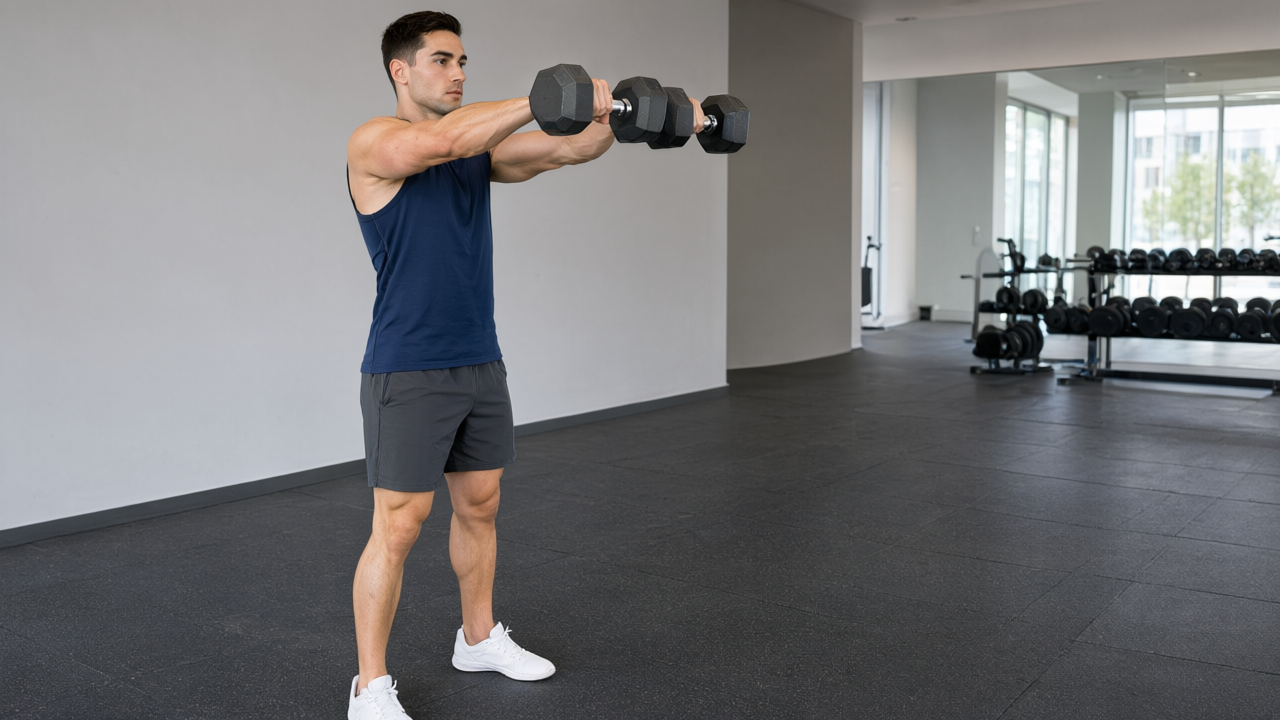
Front Raise
front-raise
ควรระวัง
- avoid · Rotator cuff tear — The long lever arm places high shear stress on the anterior rotator cuff during the lift. Instead, use isometric shoulder holds or light band external rotations to build stability without tearing.
- avoid · Shoulder impingement — Raising the arms forward under load compresses the subacromial space and aggravates impinged tissues. Instead, perform scaption raises at a thirty-degree angle to clear the joint safely.
I want you to feel a clean, focused burn across the front of your shoulders without letting momentum steal the tension. You’ll hold a light-to-moderate pair of weights and drive the movement from your shoulder joints, keeping your torso completely still. Good reps feel controlled and deliberate, with a smooth arc that stops just shy of eye level. Breathe steadily, protect your neck, and let the anterior delts do all the lifting.
หากคุณเพิ่งเริ่มต้น
As a beginner, focus entirely on strict form over heavy weight. Your front delts are small muscles, and they fatigue quickly when isolated correctly. If you feel the burn shift into your lower back, neck, or upper traps, pause immediately. That sensation usually means you are leaning backward, swinging the weights, or shrugging your shoulders to generate momentum. Keep your chest up, ribs down, and shoulder blades gently packed. When you reach true muscular failure, the weights will simply stop moving upward despite your effort—do not jerk or swing to finish the rep. Drop the load, reset your posture, and finish your set. Consistency with lighter loads builds the mind-muscle connection far faster than struggling through sloppy reps. Trust the process, prioritize a full range of motion, and let your shoulders adapt safely over time.
ก้าวต่อไป
To increase time under tension, extend the lowering phase to three or four seconds and add a distinct two-second pause at shoulder height. This removes any elastic rebound from the bottom position and forces the anterior deltoid to initiate every rep from a dead stop. The eight-to-twelve rep range suits this movement well for hypertrophy, but sets of fifteen to twenty with lighter dumbbells build local muscular endurance without compromising joint integrity. Add 2.5 lbs per dumbbell only when you complete twelve strict reps across all three sets; if your form breaks down earlier, earn those reps first. Once you can handle heavier loads cleanly for high repetitions, progress to alternating front raises, which demand greater core stability as you resist rotational forces. You might also try the seated dumbbell version to eliminate any residual lower-body momentum entirely, isolating the shoulders further.
ข้อผิดพลาดที่พบบ่อย
The most frequent error is swinging the torso backward to generate momentum, which immediately shifts tension away from the target muscles and strains the lumbar spine. Lifters also tend to shrug their shoulders toward their ears at the top of the arc, accidentally recruiting the upper traps instead of the anterior delts. Another common flaw is using excessive weight, which forces the elbows to bend deeply and turns the exercise into a hybrid curl. Finally, many drop the weights quickly on the descent instead of fighting gravity, robbing themselves of crucial eccentric tension. Keep the weight light, maintain a neutral spine, and move with deliberate control to maximize shoulder development while protecting your joints.
ตารางฝึก
- Sets
- 3
- Reps
- 8-12
- Rest
- 90s
- Tempo
- 2-0-2-0
- RPE
- 7
- Per set
- ~90s
- ความถี่
- 2-3x/week
Add 2.5 lbs per dumbbell or increase reps by two once you hit the top of your target range with perfect form.
Cues
กล้ามเนื้อ
- Shoulders
- Traps
- Chest
อุปกรณ์
- Dumbbells
- 1
Stand tall with your feet hip-width apart, knees softly bent, and core braced.
- 2
Hold a dumbbell in each hand with your palms facing your thighs and arms hanging at your sides.
- 3
Keep a slight bend in your elbows throughout the entire movement.
- 4
Exhale as you slowly raise the weights forward and upward, leading with your elbows.
- 5
Stop lifting once your hands reach shoulder height, keeping the dumbbells parallel to the floor.
- 6
Pause briefly at the top, squeezing the front of your shoulders without shrugging.
- 7
Inhale as you lower the weights with strict control, resisting gravity on the descent.
- 8
Return to the starting position with a soft tap at your sides before beginning the next repetition.