
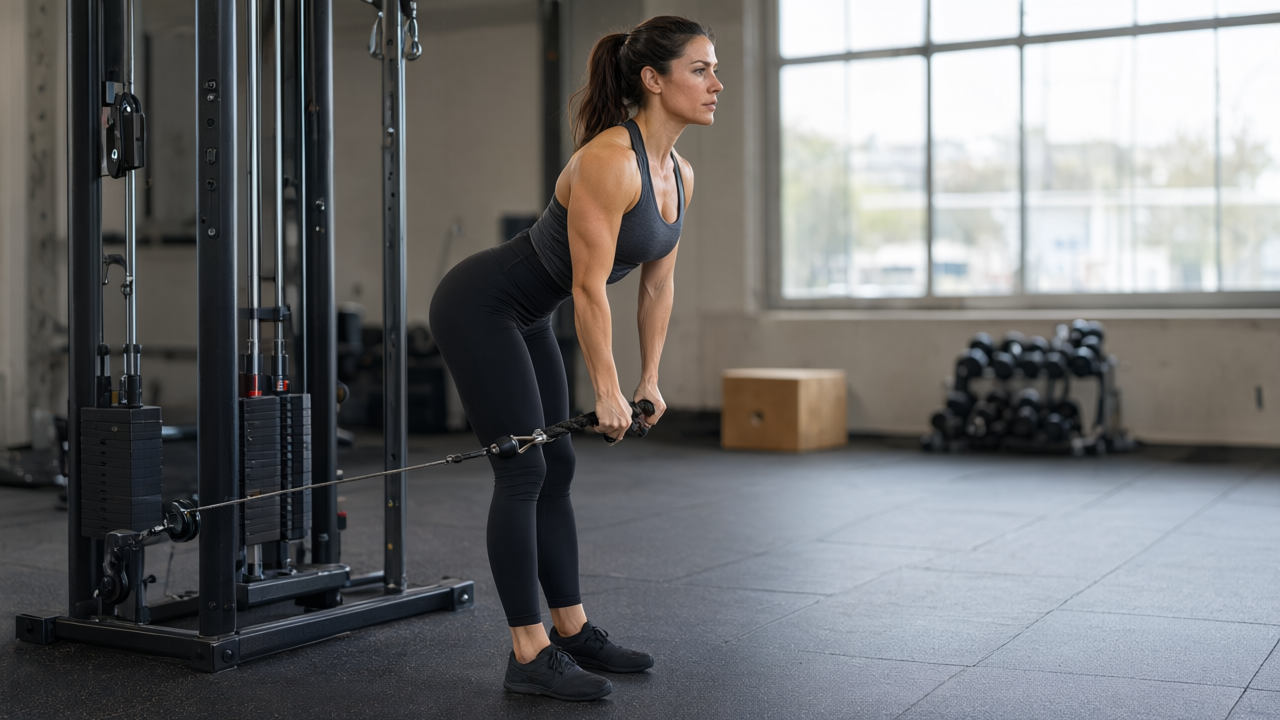
Cable Pull-Through
cable-pull-through
ควรระวัง
- avoid · Vertigo / balance disorder — You hinge with your head below heart height and stand back up with a loaded rope in both hands and the anchor behind you. If the room moves on the way up you cannot let go to catch yourself without the handle snapping back to the pulley, and there is no handhold within reach. Train the pattern at the wall with Wall Hip Hinge, where one hand is free, and take the glute work from Glute Bridge.
- avoid · Osteoporosis — Bone of reduced density fails in flexion under load, and this movement combines the two: you bend forward over a cable that keeps pulling you deeper, and the entry's own most-cited error is the back rounding at the bottom. The part that makes it worse here is that a cable cannot be dumped — with a barbell or dumbbell you let go, and here the pulley keeps loading you while you are hinged. Avoid the loaded version unless someone qualified is watching you lift. Glute Bridge trains the hip extension spine-neutral and unloaded, and Wall Hip Hinge teaches the pattern against a wall with no load at all. Anyone already diagnosed with osteoporosis should have resistance training laid out in person before adding any hinge under tension.
- avoid · Herniated disc — The hip hinge under horizontal cable pull creates shear stress that can aggravate a compromised disc, and unlike a dumbbell the rope cannot be dropped — the pulley keeps pulling you back into the hinge while you are bent over. Substitute Bird Dog for stability and Glute Bridge for the hip work, both spine-neutral and unloaded. Anything with nerve signs down a leg — numbness, tingling, weakness — is a clinician's question before it is anyone's training decision.
- caution · Uncontrolled hypertension — The method says to exhale forcefully, and against a constant horizontal cable pull most people turn that into bearing down while the head dips below heart height. Keep the breath moving on every rep and take the load down. Stop the session on any headache, flushing or spots in vision rather than pushing through the set, and if you have been told your blood pressure is uncontrolled, clear new exercise with your clinician first. Bodyweight Squat or Glute Bridge at conversational effort gives the same training effect without the strain.
- caution · Acute lower back injury — The cable pulls you back into the hinge all the way down and never relents at the bottom, so a tired back has no point in the rep where the load comes off you — and unlike a dumbbell, this cannot be dropped. Rounding under that constant tension is where the shear lands on the lumbar discs. Shorten the range to where you still feel the hamstrings and stop there, keep the torso higher, and cut the stack until the brace holds without effort. Take the hip work from Glute Bridge and the pattern from Wall Hip Hinge, both spine-neutral, until the core holds a hinge unaided. Sharp pain, or anything running down a leg, stops the session.
- caution · Pregnancy — Reaching between the legs and bracing against horizontal cable tension raises intra-abdominal pressure at the same time as the rope pulls you back over an upright base of support you can no longer trust. Keep the torso tall and the load light, and substitute Wall Hip Hinge to drill the pattern unloaded against a wall, then Glute Bridge for the hip work. After birth, return via those two first; doming along the belly, pelvic heaviness or leaking during a set is a question for whoever does your postnatal check, not something to programme around.
- modify · Acute knee injury — This entry's most common error is turning the hinge into a shallow squat, and a squat under a constant horizontal pull loads the knee on the way down instead of putting the work on the hamstrings. Keep the knees softly bent and fixed from start to finish — if the shins drift forward and the knees travel past the toes, the hips have stopped moving back. Shorten the range to where the hamstrings still take the load and drop the stack until the hinge holds without the knee collapsing inward. Take the hip work from Glute Bridge and the unloaded pattern from Wall Hip Hinge, both with a near-vertical shin. Pain that is still there the morning after a session is a physiotherapist's question, not a range-of-motion problem.
A hip hinge loaded by a low cable pulling horizontally from behind you, so the hamstrings and glutes stay under tension through the whole range and the hip drive — not the arms — finishes the rep. Because that pull never lets up, the movement rewards a braced back and a slow descent more than a barbell does, and it teaches the hinge pattern without a bar's absolute load on the spine. Reach for the rope attachment if your machine has one — its two ends let your hands finish apart so the hips can fully extend — though any handle on the lowest pulley will work. Accessory posterior-chain work, not a main lift.
หากคุณเพิ่งเริ่มต้น
Start with a light weight to master the hip hinge pattern before adding load. Keep your knees slightly bent but locked in position; they should not travel forward as you push your hips back. Imagine closing a car door with your rear end to maintain that backward travel. You will know you are failing correctly when your glutes burn and your hamstrings tremble, not when your lower back rounds or your shoulders ache. Stop immediately if you feel pinching in your spine or if you start using momentum to swing the weight forward. Beginners often compensate by squatting down instead of hinging back, or by yanking the cable with their arms. Keep your elbows straight and let your shoulders stay relaxed. If your lower back begins to fatigue, reduce the range of motion slightly until your core and posterior chain adapt. Trust the movement, move deliberately, and let your hips do the heavy lifting. Consistent, controlled reps will build a resilient foundation for every future hinge you perform.
ก้าวต่อไป
Lengthen the eccentric to four or five seconds, pausing for a full beat at maximum hamstring stretch before driving the hips forward. That pause eliminates momentum and forces your posterior chain to initiate every rep. Sets of eight to twelve build muscle; dropping to six to eight with a heavier cable stack shifts the emphasis towards strength. Add weight only when you can complete all prescribed reps without your lower back rounding or your knees drifting forward. If you want more from this movement without touching the stack, step further from the machine to increase tension at the bottom, or slow the entire tempo to accumulate time under tension. Once you own strict sets of twelve with a challenging load, progress to the barbell Romanian deadlift, which demands greater spinal stability under heavier absolute loads. For variety, try the single-leg cable pull-through using one hand on the rope, which exposes left-to-right imbalances and challenges your balance considerably.
ข้อผิดพลาดที่พบบ่อย
Most trainees turn this hip hinge into a shallow squat by bending the knees too deeply, which steals tension from the hamstrings and glutes. Others actively pull with their arms and shoulders, turning a posterior chain exercise into a misguided row that strains the neck and traps. Letting the spine round at the bottom of the movement places dangerous shear forces on the lumbar discs, so always maintain a proud chest and engaged core. Rushing the eccentric phase or bouncing out of the stretch eliminates time under tension and invites lower back compensation. Finally, overextending at the top by leaning too far backward shifts the load into the spine rather than keeping it anchored in the glutes.
ตารางฝึก
- Sets
- 3
- Reps
- 8-12
- Rest
- 90s
- Tempo
- 3-0-1-0
- RPE
- 7
- Per set
- ~120s
- ความถี่
- 2-3x/week
Increase the cable stack weight once you can complete 12 strict reps across all sets, prioritizing a full hip stretch and controlled hinge mechanics.
Cues
กล้ามเนื้อ
- Glutes
- Hamstrings
- Lower back
- Abs
อุปกรณ์
- Cable machine
- 1
Attach a handle to the lowest pulley setting on the cable machine.
- 2
Stand facing away from the machine with feet shoulder-width apart.
- 3
Step forward to create light tension in the cable.
- 4
Hinge at the hips and reach between the legs to grasp the handle with both hands.
- 5
Brace the core and maintain a neutral spine while exhaling to set the starting posture.
- 6
Drive the hips forward and squeeze the glutes to stand completely upright.
- 7
Inhale steadily as you push the hips back and lower the torso until the hamstrings stretch.
- 8
Keep the back flat and guide the handle toward the pulley without rounding the shoulders.
- 9
Exhale forcefully to drive through the heels and return to the upright starting position.
- 10
Release the handle carefully after completing the final repetition.
- 11
Step sideways to clear the cable path and reset for the next set.