
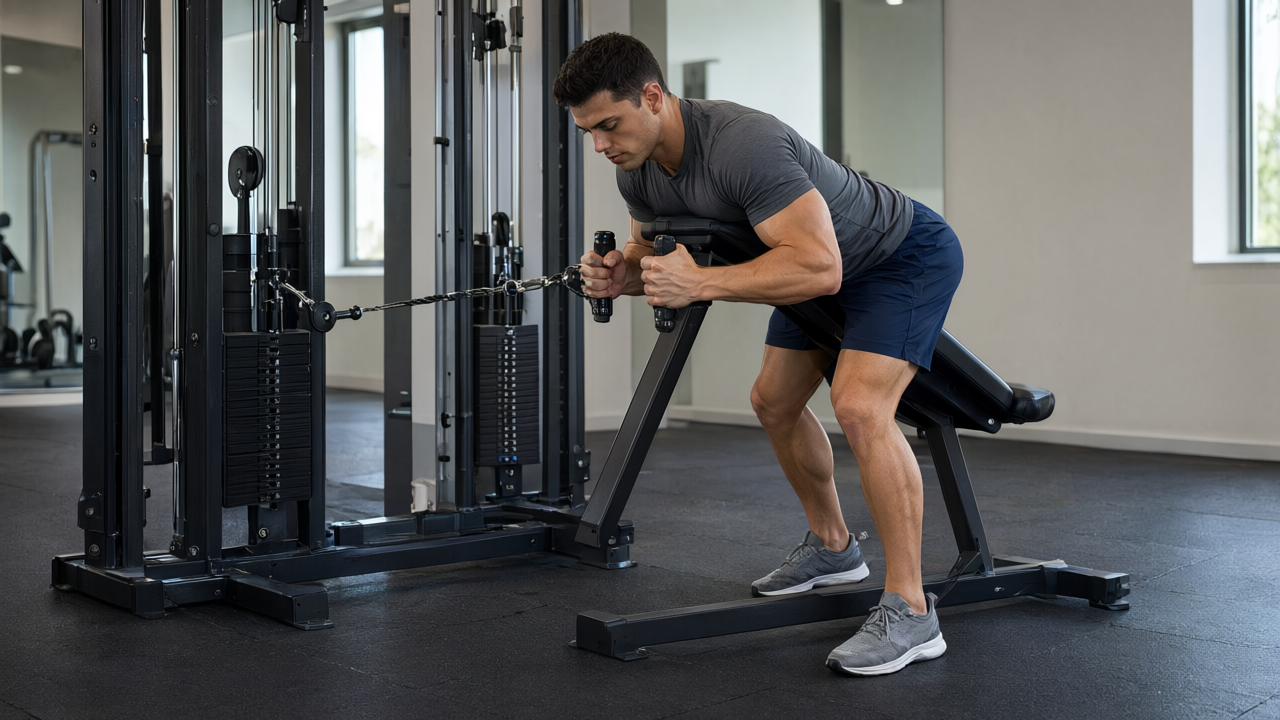
Chest-Supported Row
chest-supported-row
Будьте осторожны с
- caution · Rotator cuff tear — Flared elbows during horizontal pulling place excessive stress on compromised rotator cuff tendons. Instead, perform a cable face pull with light resistance and strict elbow alignment to train the upper back safely.
- caution · Shoulder impingement — Wide elbow flare during the row compresses the subacromial space and aggravates impinged tissues. Instead, use a neutral-grip cable row with elbows kept tight to the torso to reduce shoulder compression.
- caution · Acute lower back injury — Overextending the lower back to gain range of motion introduces spinal shear that can irritate injured lumbar structures. Instead, ensure the chest pad fully supports your torso or swap to a seated cable row with strict upright posture.
A horizontal pull done chest-down against a pad, so the torso is fully supported and the back can work without the lower spine holding a hinge. The lats and upper back do the pulling, biceps and forearms assist, and the pad removes the momentum that a free-standing row lets you borrow. The reliable choice when the lower back is already tired from squats or deadlifts, or when it cannot be loaded into flexion at all.
Если вы новичок в этом
As you step into this movement, prioritize precision over heavy loading. Your chest pad is your anchor; use it to eliminate momentum and force your back muscles to do the actual work. If you feel your lower back arching excessively or your shoulders creeping up toward your neck, reduce the weight immediately. True muscular failure on this exercise arrives as a deep, localized fatigue between your shoulder blades, not as a sudden strain in your elbows or grip. Stop your set the moment your form breaks or your torso begins to swing off the pad. Beginners often rush the eccentric phase, so count to three on every descent to build tendon resilience and control. Keep your elbows tucked at roughly a forty-five degree angle to your torso to maximize back engagement while sparing your shoulders. Trust the process of lighter, cleaner repetitions, because consistency will build the foundational strength you need for heavier compound lifts later.
Дальше
Extend the lowering phase to three or four seconds while keeping the pull brisk, and hold the peak contraction for a full second to maximise time under tension without chasing heavier loads. Sets of eight to twelve remain the primary range for building tissue; dropping to six to eight with a longer eccentric shifts the emphasis towards strength. Add weight only when you complete every prescribed rep with your chest still on the pad. Progress first within the machine — a thicker attachment, a pause rep, single-arm pulls that let you brace harder and expose a side-to-side difference. Beyond that, a barbell or dumbbell chest-supported row face-down on an incline bench demands far more upper-back stabilisation, but needs a barbell or dumbbells and a bench set to thirty to forty-five degrees, so treat it as a separate movement, not this one made harder. Grip choice carries the rest of the variation: a neutral grip allows slightly more lat involvement, an overhand grip biases the rear deltoids and mid-traps.
Распространённые ошибки
Lifters frequently sabotage their progress by yanking the weight with their biceps instead of initiating the pull from the scapulae. This usually happens when the elbows flare outward too widely, shifting tension away from the back and placing unnecessary stress on the rotator cuffs. Another frequent error involves overextending the lower back to gain extra range of motion, which defeats the entire purpose of the chest pad and introduces spinal shear. Many also cut the eccentric short by dropping the weight abruptly rather than controlling it back to full extension, robbing themselves of crucial time under tension. Finally, gripping the handles too tightly creates forearm fatigue long before the back reaches meaningful stimulation, so maintain a relaxed hook grip and let your posterior chain carry the load.
Программа
- Sets
- 3
- Reps
- 8-12
- Rest
- 90s
- Tempo
- 2-1-2-0
- RPE
- 8
- Per set
- ~120s
- Частота
- 2-3x/week
Increase the load incrementally once you can complete 12 controlled reps across all sets.
Cues
Мышцы
- Upper back
- Lats
- Biceps
- Forearms
Оборудование
- Bench
- Cable machine
- 1
Adjust the seat until the top edge of the chest pad sits just below your collarbones and your feet plant flat on the floor; if they fall short, lower the seat until they reach it.
- 2
Sit flush against the pad with your chest pressed into it and both knees bent out to the sides of the bench.
- 3
Grasp the machine handles with a neutral or overhand grip, wrists straight.
- 4
Exhale, brace your abdominal muscles and keep pressing your chest into the pad.
- 5
Inhale and pull the handles toward your lower ribcage by driving your elbows backward, elbows about forty-five degrees from your torso.
- 6
Squeeze the shoulder blades together at the peak and pause for one second.
- 7
Exhale and slowly extend the arms until they are fully stretched and you feel the load across the lats.
- 8
Release the handles, sit upright, and step away from the machine after the set.