
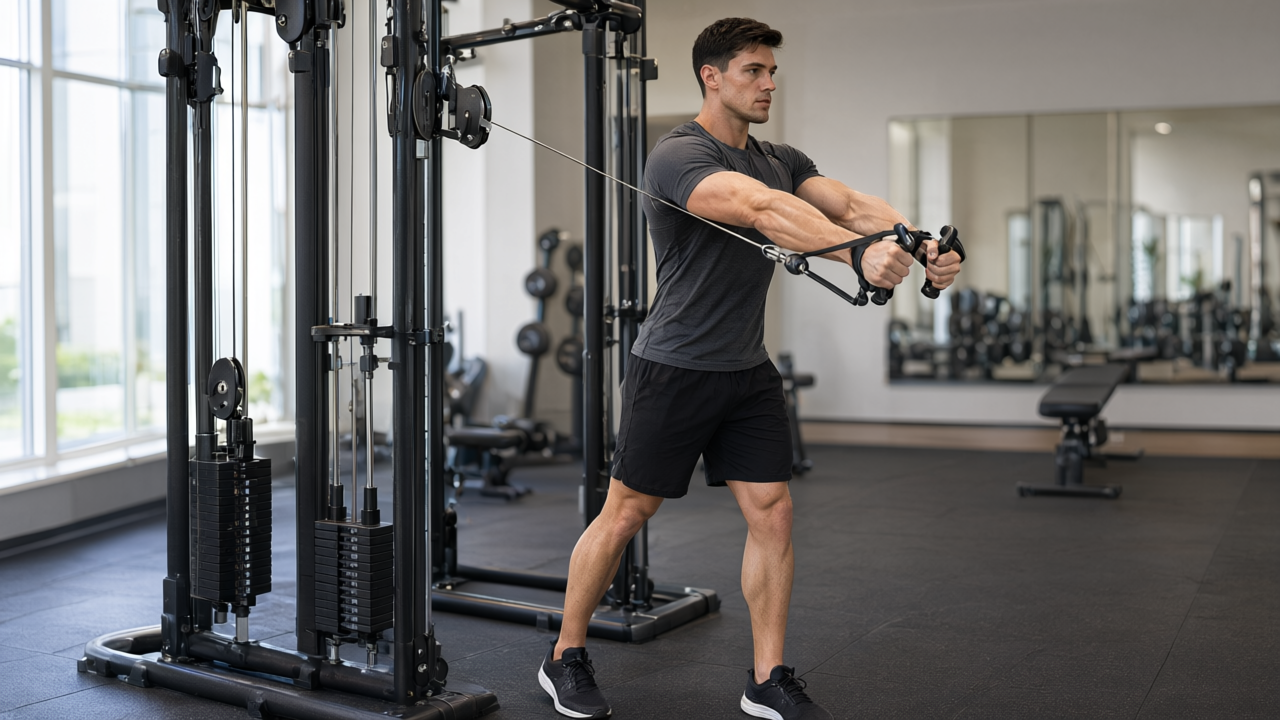
Cable Chest Fly
cable-chest-fly
Будьте осторожны с
- avoid · Rotator cuff tear — The wide open position loads the arm far behind the body with the cuff tasked for stabilising it there, and the cable keeps pulling you past whatever your own tissue would allow. Instead, take the chest with Dumbbell Floor Press — the floor stops the descent at the point the fly starts straining the front of the capsule, and the dumbbells let each arm find its own safe arc. A tear is diagnosed and progressed with a clinician; this note only keeps training safe while that happens.
- caution · Shoulder impingement — Rolling the shoulders forward at peak contraction narrows the subacromial space, and a fly invites exactly that rounding. Keep the shoulders packed down and back as step 6 says, stop the sweep before the hands cross, and set the pulleys no higher than mid-chest. Substitute Dumbbell Bench Press, where the hands can sit neutral and the bar or dumbbells stay under the shoulders instead of out in front of them. If the catch arrives every set at the same angle, the movement is wrong for the shoulder you have today, not under-warmed.
I want you to feel a deep, unbroken tension sweeping across your entire chest. The cables maintain steady resistance through every degree of the arc, making each rep feel like a smooth, controlled squeeze. I always tell my lifters to forget heavy loads and chase that intense, localized burn instead. Let the stretch pull you wide, then drive your hands inward with deliberate control to truly awaken those pecs.
Если вы новичок в этом
Start with a weight that allows you to complete ten clean repetitions without your shoulders creeping toward your ears. Keep your elbows slightly bent and locked in that position; if you find yourself straightening your arms or bending your wrists, the weight is too heavy. As you approach the final reps, you will notice a steady, warming fatigue deep in your chest rather than sharp joint pain. That is your cue to finish the set. Stop immediately if you feel your lower back arching or your torso rocking forward to compensate for the load. Instead, reduce the weight, engage your core, and focus on the smooth, sweeping motion of the handles. Remember that isolation work rewards patience over ego. Breathe steadily, keep your shoulders packed down and back, and let the cables do the work. You will quickly learn to distinguish between muscular exhaustion and structural strain. Trust the process, stay within your comfortable range of motion, and the strength will follow naturally.
Дальше
To extract more from the cable chest fly, lengthen the eccentric to three or four seconds and add a deliberate two-second pause at full stretch, where the cables pull hardest against your pecs. The concentric sweep can remain smooth but slightly quicker. This movement suits sets of ten to fifteen; chasing heavier loads rarely improves chest isolation and usually just recruits the shoulders. When fifteen controlled reps feel manageable across all sets, increase the weight by one pin rather than adding further reps. For a different stimulus, shift the pulleys to their highest setting to bias the lower fibres, or drop them low to target the upper chest. Once you can sustain deep tension through fifteen reps with a two-second stretch pause without your torso shifting, you have likely maximised what this variation offers and might consider moving to single-arm cable flies to challenge rotational stability under load.
Распространённые ошибки
The most frequent error involves bending the elbows too much, which inadvertently shifts the exercise into a cable press and recruits the triceps instead of isolating the chest. Many lifters also allow their shoulders to roll forward at the peak contraction, creating unnecessary impingement risk and robbing the pectorals of tension. Overextending on the eccentric phase is another common pitfall, where the arms travel too far behind the torso and place dangerous stress on the anterior shoulder capsule. Finally, selecting a weight that forces the hips to thrust forward or the lower back to hyperextend breaks the isolation completely. Correcting these habits requires lowering the load, maintaining a rigid torso, and treating the movement as a controlled arc rather than a heavy lift.
Программа
- Sets
- 3
- Reps
- 8-12
- Rest
- 90s
- Tempo
- 2-1-2-0
- RPE
- 7
- Per set
- ~90s
- Частота
- 2-3x/week
Increase the cable weight slightly when you can complete 12 reps across all sets with controlled form.
Cues
Мышцы
- Chest
- Shoulders
- Abs
Оборудование
- Cable machine
- 1
Set both cable pulleys to mid-chest height and attach single D-handles.
- 2
Stand in the center of the station, grip a handle in each hand, and step forward to create initial tension.
- 3
Plant feet shoulder-width apart, soften the knees, and brace the abdominal muscles.
- 4
Extend arms outward to the sides with a slight elbow bend, keep palms facing forward, and inhale deeply.
- 5
Exhale steadily while sweeping the handles forward in a wide arc until they align at chest midline.
- 6
Hold the peak contraction for one second, focusing on squeezing the chest while keeping shoulders depressed.
- 7
Inhale slowly while controlling the handles back to the starting position, maintaining a constant elbow angle.
- 8
Reset shoulder posture, verify cable tension remains steady, and begin the next repetition.