
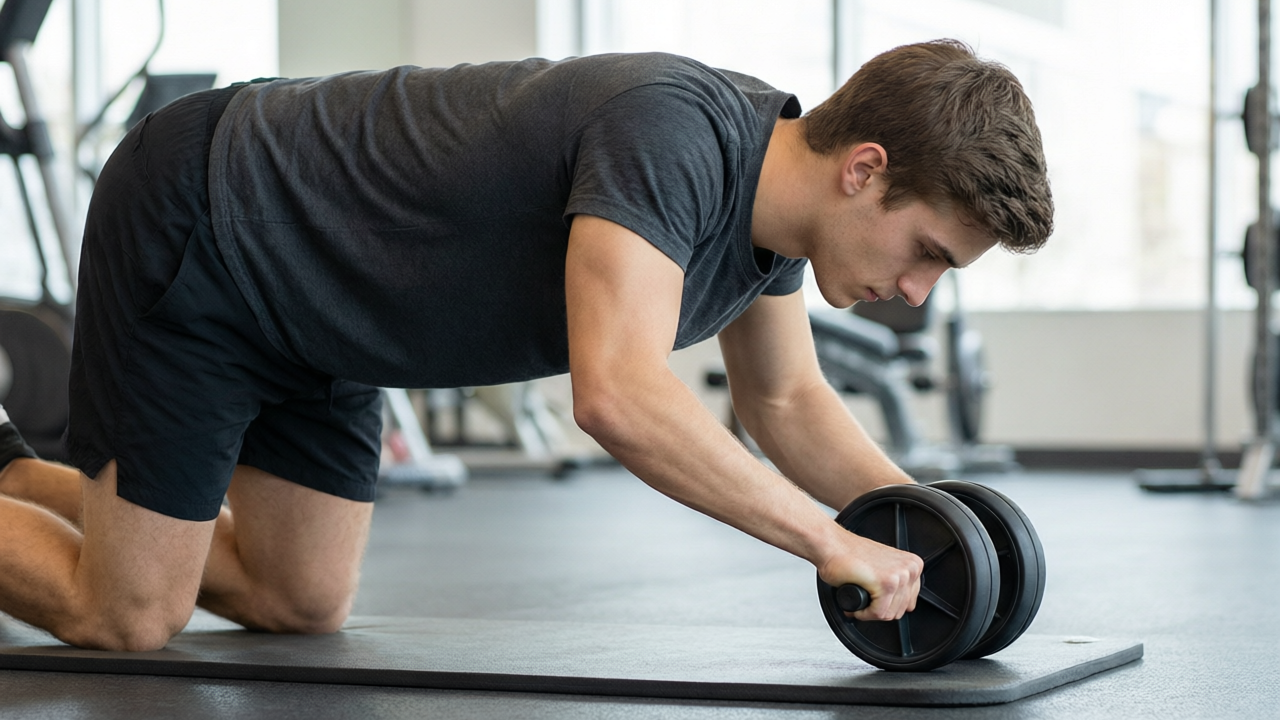
Ab Wheel Rollout
ab-wheel-rollout
Будьте осторожны с
- avoid · Acute lower back injury — Step 5 exists because the wheel keeps rolling after the abdomen gives up, and at that point the load arrives on an extending, unbraced lumbar spine on a long lever — a hard thing to ask of an acute back, and it happens silently mid-rep. Avoid it until the back settles. Rebuild the same brace from standing: press the wheel out against a wall, where gravity is not involved and the range is self-limiting. In this library, Dead Bug or Bird Dog train the identical anti-extension demand with the spine supported and the failure mode harmless. Difficulty 4 is honest here — this is not a beginner core move whatever it looks like.
- avoid · Herniated disc — Most disc problems tolerate this better than a curl-up, but the failure pattern is the problem: when the abs exhaust, the pelvis tucks under and the lumbar spine rounds into loaded flexion at the moment of no control — which is precisely the position a disc dislikes. There is also no way to bail out of a rep partway through. Avoid it while the disc is symptomatic. Substitute Wall Hip Hinge to relearn hips-back movement with a flat back, and Suitcase Carry for the brace. Numbness, tingling or weakness down a leg is a clinician's question, not a range adjustment.
- avoid · Pregnancy — The rollout takes the abdominal wall to its longest possible length under load, which is the opposite of what a midline already separating needs, and it is performed kneeling with weight forward — a position that gets awkward quickly. Avoid it. Instead, use Bird Dog, which keeps the brace trained with the trunk supported, or a single-arm Suitcase Carry, which loads anti-rotation without lengthening the front of the trunk. Stop and raise it with your midwife or obstetric team if you feel coning or doming along the midline, pelvic heaviness, or any leaking.
- caution · Rotator cuff tear — The arms are fixed overhead in flexion while the body's weight hangs off them and the shoulder has to stabilise a joint that is also moving, which is a demanding job for a cuff that cannot. Keep the range short and the wheel near the shoulders so the arms stay more vertical under the hips, and stop if the front of the shoulder strains. Instead, use Suitcase Carry, which trains the same anti-lateral-flexion brace with the arm simply hanging at the side.
When I nail a rollout, my entire midsection locks into a rigid, humming line. You’ll feel a deep, steady burn radiating from your lower abs and obliques as the wheel glides forward, but your spine stays completely neutral. The return should feel controlled and deliberate, never a collapse. Good reps leave you breathing hard but proud, knowing your core held the tension perfectly from start to finish.
Если вы новичок в этом
Start your journey with partial rollouts, stopping the moment your lower back even hints at arching. Keep your glutes squeezed and your ribs knitted down throughout the movement to protect your spine. If you feel a sharp pinch in your lower back, a sudden loss of core tension, or your hips begin to sag, stop immediately and shorten your range. Beginners often compensate by bending their elbows or rolling too fast, which shifts the work away from the midsection and onto the shoulders. Focus on a slow, deliberate tempo where you control the descent and pull yourself back using your abs, not your arms. It is completely normal to only roll out a few inches at first. Consistent, short-range reps will build the necessary stability long before you attempt a full extension. Trust the process, prioritize form over distance, and let your midline dictate your limits. You will notice your control improving week by week.
Дальше
Once you can complete twelve controlled kneeling rollouts without your pelvis shifting, start manipulating tempo to increase difficulty rather than simply adding reps. A three-second lowering phase with a distinct one-second pause at full extension forces your midsection to resist gravity under maximum leverage before you pull back. Keep the return deliberate but slightly faster than the descent. For load, stick to sets of six to ten; if you can hold perfect alignment for more, the movement is no longer challenging enough in its current form. Your progression path is straightforward: extend your range until your chest nearly grazes the mat from your knees, then begin practising standing rollouts, starting with partial range and building towards the floor over weeks. To alter the stimulus, try rolling slightly off-centre to demand more anti-rotation work from your obliques, or use a narrower hand position on the wheel handles to reduce your base of support.
Распространённые ошибки
The most frequent error is allowing the lumbar spine to hyperextend as you roll out, which transforms a core builder into a lower back strain. Many lifters also rush the movement, relying on momentum to bounce back to the start instead of maintaining constant tension through the entire range. Another common flaw is shrugging the shoulders or bending the elbows, which inadvertently shifts the load onto the anterior deltoids and triceps while letting the midline collapse. Finally, rolling too far without the requisite stability forces a loss of pelvic control, causing the hips to drop and the abdominals to disengage completely. Correcting these patterns requires respecting your current range of motion and moving with deliberate, measured control.
Программа
- Sets
- 3
- Reps
- 8-12
- Rest
- 60s
- Tempo
- 2-0-2-0
- RPE
- 8
- Per set
- ~90s
- Частота
- 2-3x/week
Gradually increase range of motion, then transition from kneeling to standing rollouts.
Cues
Мышцы
- Abs
- Lats
- Shoulders
- Hip flexors
Оборудование
- Ab wheel
- Mat
- 1
Kneel on a padded surface with knees hip-width apart and grip the ab wheel handles firmly.
- 2
Position the wheel directly under your shoulders while flattening your back and tucking your pelvis.
- 3
Brace your core by drawing your navel toward your spine and keeping your gaze fixed on the floor.
- 4
Inhale steadily as you roll the wheel forward along the floor, extending your body into a straight line.
- 5
Halt forward movement immediately if your lower back begins to sag or your abdominal tension drops.
- 6
Exhale forcefully while squeezing your abs to pull the wheel back toward your starting position.
- 7
Complete the return by bringing your shoulders back over your knees without rounding your spine.
- 8
Reset your posture, re-tighten your midsection, and verify your alignment before the next repetition.