
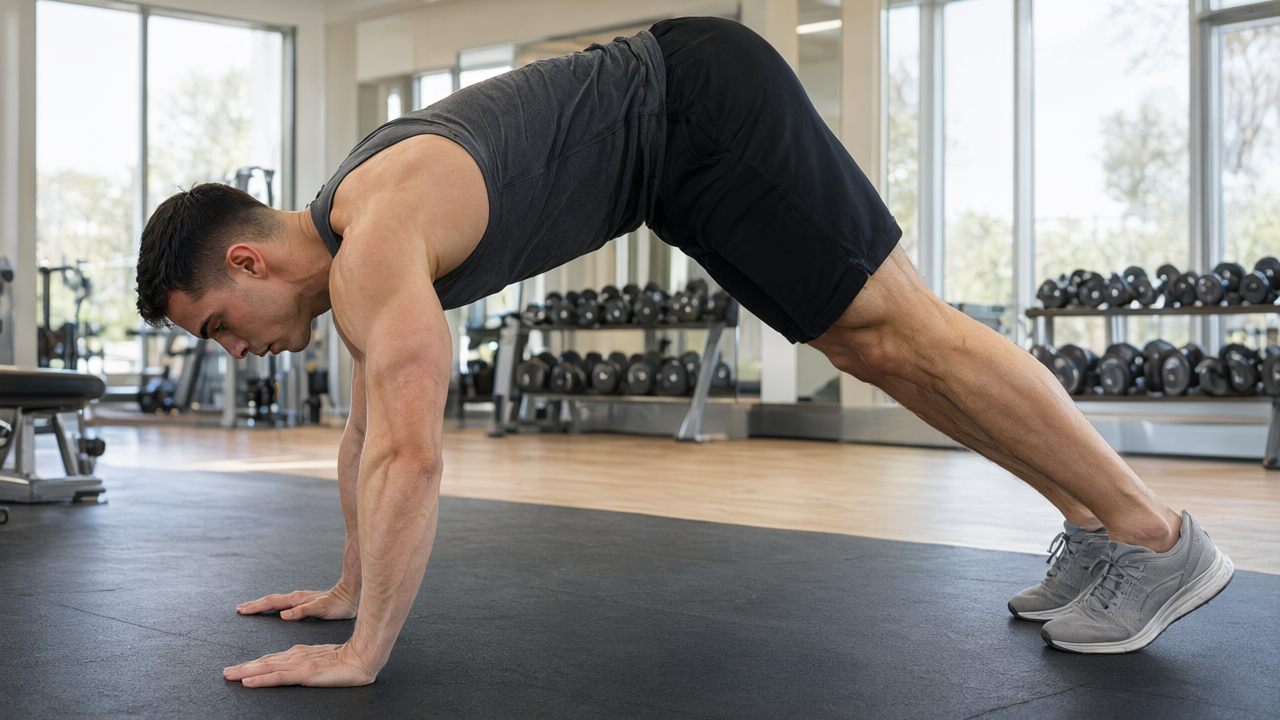
Pike Push-Up
pike-push-up
Let op bij
- avoid · Vertigo / balance disorder — Holding an inverted V position with the head below the heart can trigger dizziness and disorientation. Instead, perform kneeling overhead presses to build shoulder strength without inversion.
- avoid · Rotator cuff tear — Driving through the palms in a vertical plane places heavy tensile demand on the rotator cuff stabilizers. Instead, use landmine presses with light loads to train the shoulders safely.
- avoid · Shoulder impingement — The inverted vertical pressing angle compresses the subacromial space under bodyweight load. Instead, perform incline push-ups to build horizontal pushing strength without impinging the shoulder joint.
- caution · Uncontrolled hypertension — The inverted head-down position combined with breath-holding during the press can spike blood pressure significantly. Instead, perform seated dumbbell overhead presses to train vertical pushing while keeping the head above the heart.
When I nail these, I feel a deep, steady burn across my shoulders and upper chest, like I’m pressing the floor away with controlled precision. My core stays locked, my hips stay high, and each descent feels smooth and deliberate rather than rushed. Good reps leave my delts humming with focused fatigue, not joint strain, giving me that clean, vertical push momentum that builds real overhead strength. I stay light on my feet and heavy in my shoulders.
Als je hiermee begint
If this is your first time building vertical pushing strength, prioritize range of motion over depth. Elevate your hands on a sturdy block or step to reduce the load while you learn the hip-hinge positioning. Keep a slight bend in your elbows at the top to maintain constant tension, and never let your lower back arch or your hips collapse toward the floor. When your shoulders start to shake or your form breaks into a compromised arch, it is time to end the set. Stop immediately if you feel sharp pain in the front of your shoulder or wrist; mild muscular fatigue is your target, joint discomfort is not. Beginners often compensate by flaring their elbows out to the sides, which shifts stress away from the shoulders and into the rotator cuff. Instead, keep your elbows tracking at a forty-five-degree angle relative to your torso. Trust the process, scale the incline as needed, and build your foundation with deliberate, controlled repetitions.
Verder gaan
Slow the lowering phase to three or four seconds and add a distinct one-second pause with your head just above the floor. This removes any elastic rebound and forces your anterior deltoids and triceps to generate the press from a dead stop. Drive up at a controlled but deliberate pace. Sets of six to eight build pressing strength, while ten to twelve favour muscular endurance; once you complete three sets of twelve cleanly at an RPE of 8, it is time to progress. Elevate your feet on a box or bench to shift more bodyweight onto your shoulders and increase the range of motion. The higher the surface, the closer the movement mimics a freestanding handstand push-up, which is your eventual destination. For variation, place your hands slightly wider to emphasise the lateral deltoid, or bring them closer together to bias the triceps. Both demand strict hip height throughout.
Veelgemaakte fouten
Most lifters fail by allowing their hips to sag, which instantly converts the movement into a standard horizontal push-up and removes the vertical loading from the shoulders. Another frequent error is flaring the elbows wide to the sides, placing unnecessary strain on the anterior capsule instead of driving force through the triceps and deltoids. Many also rush the eccentric phase, dropping too quickly and relying on momentum rather than muscular control to rebound out of the bottom position. Finally, failing to actively engage the core leads to a hollow or arched spine, destabilizing the entire kinetic chain and making consistent repetitions nearly impossible.
Routine
- Sets
- 3
- Reps
- 8-12
- Rest
- 90s
- Tempo
- 2-0-2-0
- RPE
- 8
- Per set
- ~120s
- Frequentie
- 2-3x/week
Elevate your feet on a box or bench to increase shoulder loading and range of motion.
Cues
Spieren
- Shoulders
- Triceps
- Abs
- Upper back
Keukengerei
- Bodyweight
- 1
Place hands flat on the floor shoulder-width apart with fingers spread wide.
- 2
Walk feet forward while lifting hips high to form a stable inverted V shape.
- 3
Align shoulders directly over wrists and press firmly through the palms.
- 4
Inhale deeply while bending elbows to lower the crown of the head toward the floor.
- 5
Keep elbows angled slightly back and maintain a tight core throughout the descent.
- 6
Stop lowering when the head reaches just above the ground or a comfortable depth.
- 7
Exhale steadily while driving through the palms to extend the arms fully.
- 8
Push the hips slightly higher to return to the starting inverted V position.
- 9
Reset shoulder alignment and stabilize the core before beginning the next repetition.