
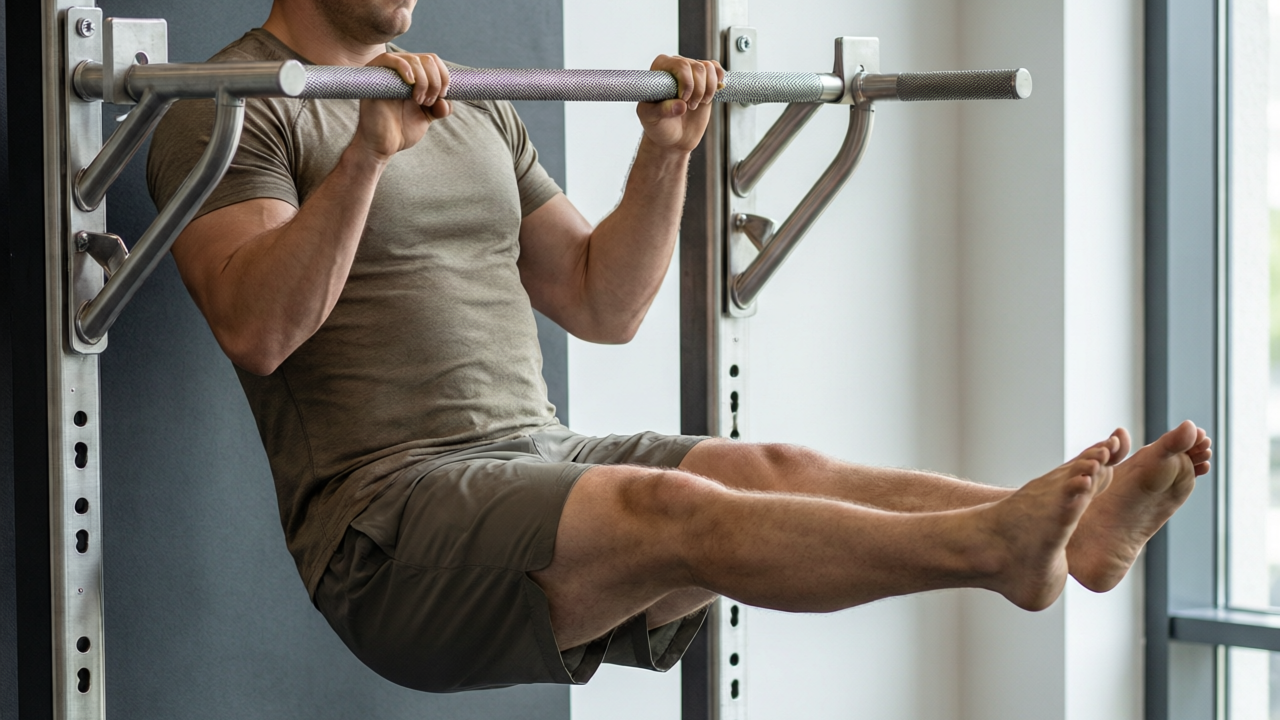
Hanging Leg Raise
hanging-leg-raise
Let op bij
- avoid · Rotator cuff tear — Hanging under full bodyweight with the arm fixed overhead asks the cuff to centre the joint for the entire set, and the moment grip or cuff control fails the shoulder is dumped into end-range flexion. Avoid it while the cuff is healing. Substitute Dead Bug or Suitcase Carry, which train the same brace with the arms doing nothing at all.
- avoid · Herniated disc — Lifting both legs to parallel rounds the pelvis under and puts the lumbar spine into flexion while a heavy load hangs off it, and the hamstrings and hip flexors are usually what finish the rep rather than the abdominals. This is the direction a symptomatic disc dislikes most. Avoid it. Substitute Dead Bug, which trains the same brace one limb at a time with the spine supported on the floor, or Wall Hip Hinge to relearn pelvic movement with a flat back. Numbness, tingling or weakness down a leg is a clinician's question, not a range adjustment.
- avoid · Pregnancy — Hanging stretches the already-lengthened abdominal wall under the load of both legs, and the midline control this exercise depends on is exactly what changes through pregnancy. Avoid the full range. Instead, use Bird Dog, which trains the same anti-extension brace on all fours, or a Suitcase Carry for the brace with the arm simply at the side. Stop and raise it with your midwife or obstetric team if you feel coning along the midline, pelvic heaviness, or any leaking.
- caution · Uncontrolled hypertension — This pulls hard on a grip while the head sits below the shoulders and the legs come up, and the natural instinct is to hold the breath on the way up, which spikes pressure. Avoid it until your pressure is controlled and cleared. Instead, use Bodyweight Squat or a Glute Bridge at moderate effort with the head level and the breath moving continuously. Stop the set on headache, spots in your vision, or unusual breathlessness.
- caution · Shoulder impingement — This is a full hanging shoulder with the arm in overhead flexion, and a shoulder that catches at end range often catches here — especially when people shrug up into the joint instead of packing the blades down as step 2 says. Do not drop into a dead hang at the bottom of each rep; keep a light bend in the elbows and stay in a range where the shoulder stays settled. Instead, use Table Inverted Row or Cable Row, which train the same core brace with the arms in front of the chest rather than locked overhead. Stop if the shoulder goes weak or pain runs down the arm.
- modify · Acute lower back injury — The moment the abdominals fatigue, the pelvis tips and the lower back arches hard to hold the legs up — which is the pattern that aggravates a reactive back, and it happens in the last few reps of every set. Stop the set while you can still keep the ribs stacked and the pelvis controlled. Take the legs only as high as you can hold without swinging, and bend the knees rather than keeping them straight. If the arch appears every set, substitute Dead Bug on the floor, where a loss of control costs nothing.
When I hang from the bar and lift my legs, good reps feel like a deep, steady burn radiating through my entire midsection. There’s no frantic momentum, just a smooth, deliberate pull that engages my core from the very first repetition. I notice a satisfying stretch at the bottom, followed by a controlled, tension-filled ascent that leaves my lower abs trembling with purpose and focus.
Als je hiermee begint
If you are new to this movement, I highly recommend starting with bent-knee raises or even hanging knee lifts to build foundational tension. Focus on keeping your ribcage down and your spine long throughout the entire range of motion. You should feel the work primarily in your stomach, not your lower back or shoulders. When your grip begins to slip or your legs start swinging uncontrollably, that is your signal to stop the set. Pushing past this point usually means you are compensating by arching your back or using momentum, which shifts the load away from your core and increases injury risk. I want you to celebrate small victories, like holding a solid dead hang for thirty seconds or completing three perfectly controlled reps. Remember that your hip flexors will naturally want to take over, so consciously think about tucking your tailbone and pulling your belly button inward. Consistent, mindful practice will steadily increase your capacity, and soon you will find yourself moving with fluid, controlled strength.
Verder gaan
Slow the lowering phase to three or four seconds; that extended eccentric is where your lower abdominals work hardest. Add a distinct two-second pause at the top to eliminate any residual hip-flexor momentum and force your core to stabilise under full load. Sets of eight to twelve build strength, while pushing towards fifteen develops endurance. When fifteen strict reps feel manageable, add light ankle weights rather than chasing higher numbers, as excessive volume often invites swinging. Alternatively, keep the weight off but insist on perfectly straight legs throughout the entire range. Once you own weighted or straight-leg repetitions with absolute control, progress to toes-to-bar, which demands greater hamstring length and deeper pelvic rotation. For variation, try hanging windscreen wipers by rotating your raised legs side to side at the top, shifting emphasis onto the obliques, or perform the movement using gymnastic rings hung from your pull-up bar, which forces your grip and stabilisers to work considerably harder.
Veelgemaakte fouten
Most lifters compromise this exercise by turning it into a swinging pendulum, using momentum to bypass true muscular engagement. I frequently see athletes shrug their shoulders upward during the ascent, which destabilizes the upper back and robs the core of its anchoring point. Another widespread error is allowing the lower back to hyperextend at the bottom of the rep, creating unnecessary spinal compression instead of maintaining a neutral, braced midline. Finally, many rush the descent, dropping their legs too quickly to reset for another repetition, which eliminates the crucial eccentric phase where significant strength is built.
Routine
- Sets
- 3
- Reps
- 8-12
- Rest
- 90s
- Tempo
- 2-0-2-0
- RPE
- 8
- Per set
- ~90s
- Frequentie
- 2-3x/week
Increase reps toward 15, then add ankle weights or transition to straight-leg raises with a controlled eccentric.
Cues
Spieren
- Abs
- Hip flexors
- Lats
- Forearms
Keukengerei
- Pull-up bar
- 1
Grip a pull-up bar with palms facing forward and hands slightly wider than shoulder-width.
- 2
Hang with straight arms, pull your shoulder blades down, and inhale deeply to brace your midsection.
- 3
Keep your legs straight or slightly bent, point your toes forward, and eliminate all body swing.
- 4
Exhale forcefully while contracting your lower abs and lifting your knees toward your chest.
- 5
Raise your legs until your thighs reach parallel to the floor, maintaining a rigid torso.
- 6
Pause for one second at the top while continuing to exhale and verifying zero momentum.
- 7
Inhale slowly as you lower your legs back down with strict muscular control.
- 8
Return to a complete dead hang, reset your shoulder position, and prepare for the next repetition.