
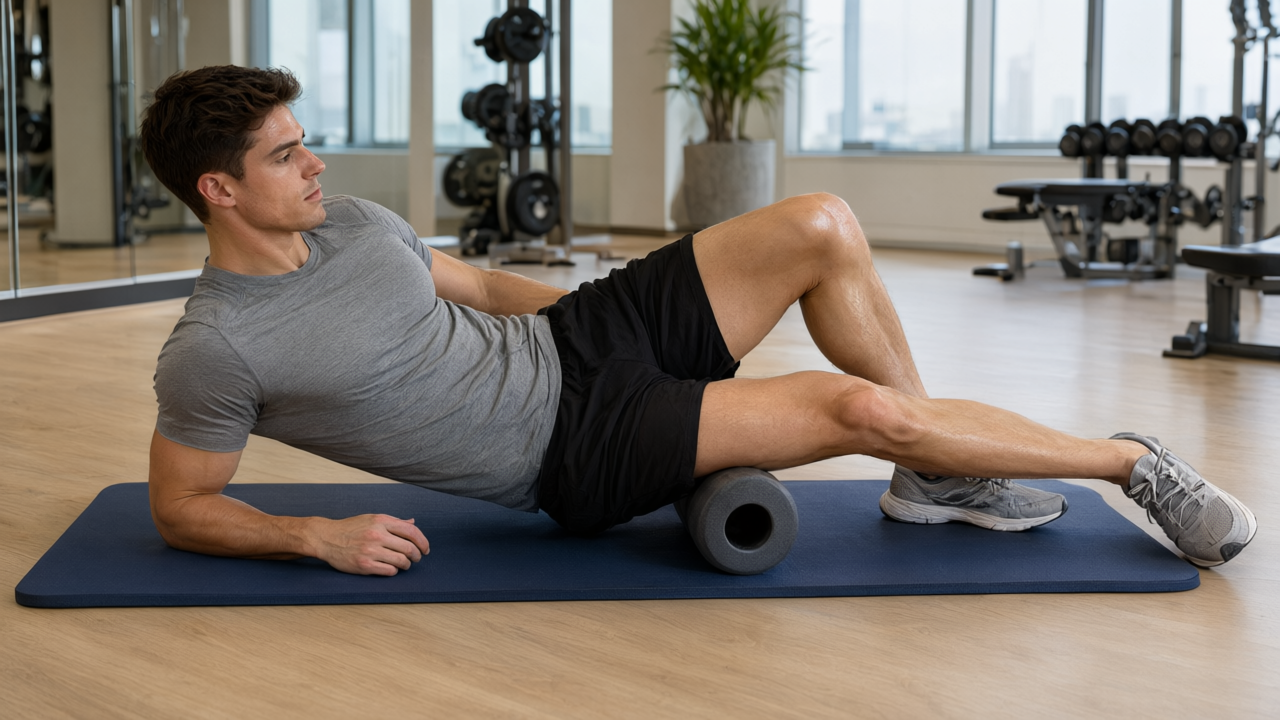
Foam Roll Lateral Thigh
foam-roll-lateral-thigh
Let op bij
- caution · Acute knee injury — Rolling close to a compromised lateral knee ligament or meniscus can aggravate inflammation. Instead, stop the roller at least ten centimetres above the kneecap.
- caution · Hip replacement (post-op) — Direct pressure over a replaced lateral hip joint may irritate surrounding tissues or the surgical site. Instead, roll only the distal half of the thigh well below the joint line.
When I cue you into this lateral thigh roll, I want you to manage the pressure carefully. You will lie on your side with a foam roller beneath your outer thigh, using your top foot to control how much body weight presses into the tissue. This releases tension along the iliotibial band and outer quadriceps after running or cycling. Keep it slow and deliberate.
Als je hiermee begint
The first time you try this, you will likely press too hard into the roller because the outer thigh is notoriously sensitive. Beginners often drop their hips toward the floor, which increases pressure dramatically and causes them to tense up rather than relax into the movement. To fix this, use your planted top foot like a brake; press it firmly into the mat to lift your hips and take weight off the roller until the sensation is tolerable. It should feel like a deep, dull ache that eases as you breathe, never a sharp or shooting pain. If you feel tingling down your leg, you are pressing directly on a nerve—shift the roller slightly forward or backward. Your bottom forearm stays flat to stabilise your upper body, and your spine remains neutral throughout. Limit your first session to thirty seconds per side. Stop immediately if the discomfort becomes sharp or if you cannot maintain steady breathing.
Verder gaan
Once you can tolerate full body weight without bracing heavily through the top foot, progress by stacking both legs together, removing the top foot's support entirely. Use a firmer foam roller to increase tissue density feedback. Maintain a tempo of roughly two centimetres per second; rushing defeats the purpose. Spend forty-five to sixty seconds per side, dedicating extra pauses to adhesions near the greater trochanter. For variation, perform small oscillatory rolls over a single tender point rather than long sweeps, keeping the range under five centimetres. Another option is to cross the top ankle behind the bottom knee, which subtly changes the fascial tension along the lateral thigh. Progress frequency to daily during heavy running blocks, but avoid rolling the same area multiple times within one session to prevent tissue irritation.
Veelgemaakte fouten
Rolling directly over the bony prominence of the hip joint or the outside of the knee causes sharp pain and risks irritating the bursa or joint capsule instead of releasing muscle tissue; always stop an inch short of these landmarks. Letting the hips sag toward the floor removes your ability to control pressure, turning a therapeutic release into an endurance test that makes you brace and hold your breath. Moving too quickly turns the exercise into a superficial massage that fails to affect deeper fascial layers; slow down to roughly two centimetres per second. Finally, collapsing the chest toward the mat rounds the thoracic spine and shifts the load unevenly across the roller, missing the target tissue entirely. Keep your ribs stacked directly above your pelvis throughout.
Routine
- Sets
- 1
- Reps
- 45–60 seconds per side
- Rest
- 0s
- Tempo
- slow, 2 cm per second
- RPE
- 4
- Per set
- ~60s
- Frequentie
- 3
increase duration to 90 seconds per side or use a firmer roller
Cues
Spieren
- Quadriceps
- Glutes
- Abductors
Keukengerei
- Foam roller
- Mat
- 1
Place the mat on the floor and position the foam roller horizontally across it.
- 2
Lie on your right side, resting your right forearm flat on the mat for support.
- 3
Position the foam roller under your right outer thigh, midway between hip and knee.
- 4
Bend your left knee and plant your left foot on the mat in front of your right knee.
- 5
Lift your hips slightly so your spine forms a straight line from head to feet.
- 6
Press through your left foot to shift weight off the roller as needed.
- 7
Roll slowly from just above the right knee towards the right hip, pausing on tender spots.
- 8
Hold any tight spot for five seconds while breathing steadily, then continue rolling.
- 9
Switch sides by repositioning the foam roller under your left outer thigh and repeating.