
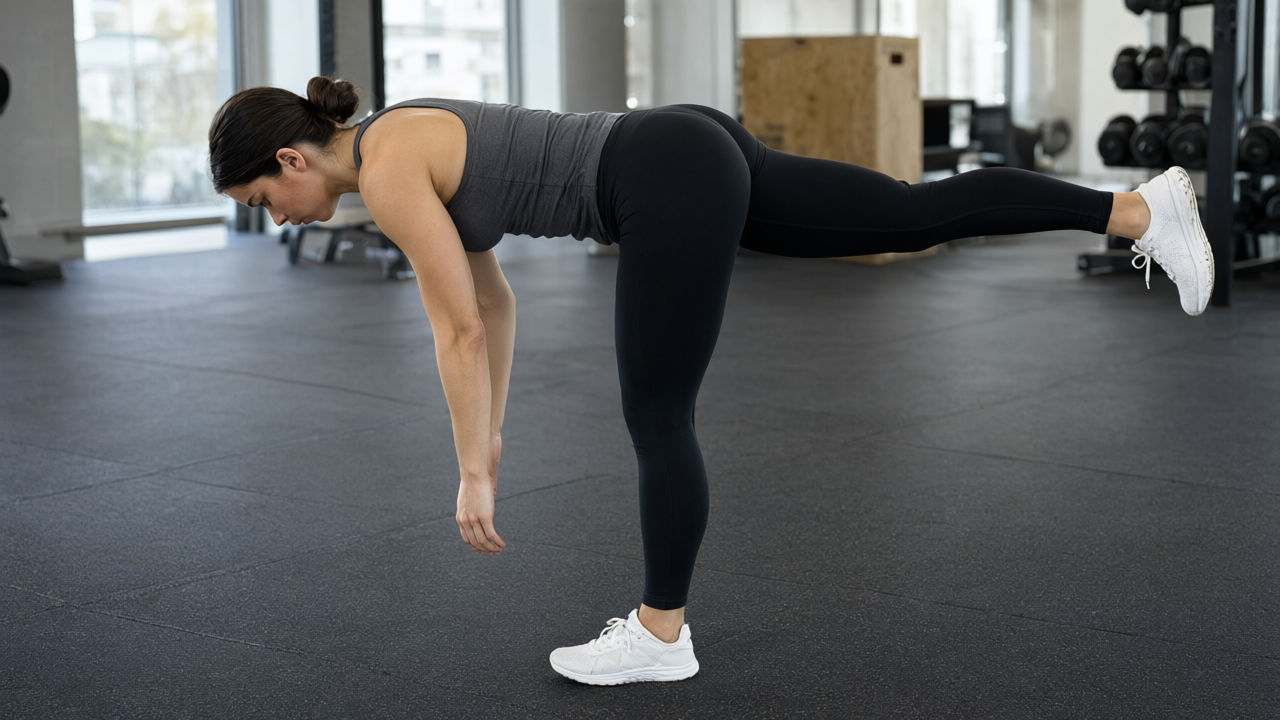
Bodyweight Single-Leg Romanian Deadlift
bodyweight-single-leg-romanian-deadlift
Let op bij
- caution · Acute knee injury — Single-leg stance demands stabilisation that may irritate an unstable or painful knee joint. Instead, perform bilateral bodyweight Romanian deadlifts to distribute load evenly across both legs.
- caution · Acute lower back injury — Hinging under poor motor control places shear force on the lumbar spine. Instead, perform a supported hip hinge against a wall to limit range and spinal load.
When I cue you into this single-leg hinge, I am asking you to control your hip and hamstring without any external load. You stand on one leg, push your hips back, and let your torso tip forward whilst the free leg extends behind you. This builds balance, teaches a proper hinge pattern, and develops hamstring length. It is a quiet, deliberate movement for hip control.
Als je hiermee begint
The first time you try this, you will likely wobble or twist your hips open to the side. That happens because your brain searches for balance by rotating rather than hinging. To fix it, imagine headlights on your hip bones; keep them pointing straight down throughout the descent. If balancing freely feels impossible, stand near a wall and lightly touch it with one fingertip for feedback. You should feel a gentle stretch in the hamstring of your standing leg and tension through your glute as you return upright. Your lower back must stay flat, not rounded. Stop the set if your standing knee locks out completely, if your spine rounds, or if the wobble becomes uncontrollable. A few controlled repetitions per side are far more useful than many sloppy ones. Practise this barefoot initially so you can feel the floor beneath your standing foot and learn to grip with your toes.
Verder gaan
Control the tempo strictly: three seconds lowering, a one-second pause at the bottom where the hamstring is longest, and two seconds rising. Because there is no external load, time under tension drives adaptation. Aim for three sets of eight to twelve slow repetitions per leg. Progress by closing your eyes during the descent to challenge proprioception, or by holding a light dumbbell in the hand opposite your standing leg once bodyweight feels effortless. Another variation is the reaching single-leg hinge, where you sweep both arms overhead as you descend, increasing the lever length and demanding greater core stability. Use this movement as an activation drill before heavy bilateral deadlifts, performing one set of six per side to prime the hamstrings and glutes. Do not rush the return phase; the concentric drive is where hip power is built.
Veelgemaakte fouten
The most frequent error is rotating the hips open as you hinge, which turns a sagittal-plane movement into a twisted balance act. This loads the lower back unevenly and removes tension from the hamstring. Keep both hip bones facing the floor. Another mistake is rounding the spine instead of hinging at the hips. This shifts stress to the lumbar discs rather than the posterior chain. Think about pushing your tailbone towards the wall behind you. Locking the standing knee is also common; a rigid joint cannot absorb force or maintain balance. Maintain a slight bend throughout. Finally, swinging the free leg wildly for momentum defeats the purpose. The trailing leg should move as a fixed extension of your torso, not as a counterweight.
Routine
- Sets
- 3
- Reps
- 8–12 per side
- Rest
- 45s
- Tempo
- 3-1-2-0
- RPE
- 6
- Frequentie
- 3
Add a light dumbbell once bodyweight is stable for 12 reps per side
Cues
Spieren
- Hamstrings
- Glutes
- Lower back
- Abs
Keukengerei
- Bodyweight
- 1
Stand tall on your right leg with a soft knee, arms hanging at your sides, spine neutral.
- 2
Shift your weight fully onto your right foot, keeping your hips square to the floor.
- 3
Push your hips back and hinge forward, letting your torso tip towards the floor.
- 4
Extend your left leg straight behind you as your torso lowers, keeping both hips level.
- 5
Lower until your torso and left leg are roughly parallel to the floor or your hamstring pulls.
- 6
Hold briefly at the bottom with your spine neutral and your standing knee softly bent.
- 7
Drive your right hip forward to return to standing, exhaling as you rise.
- 8
Repeat all repetitions on the right leg before switching to the left.