
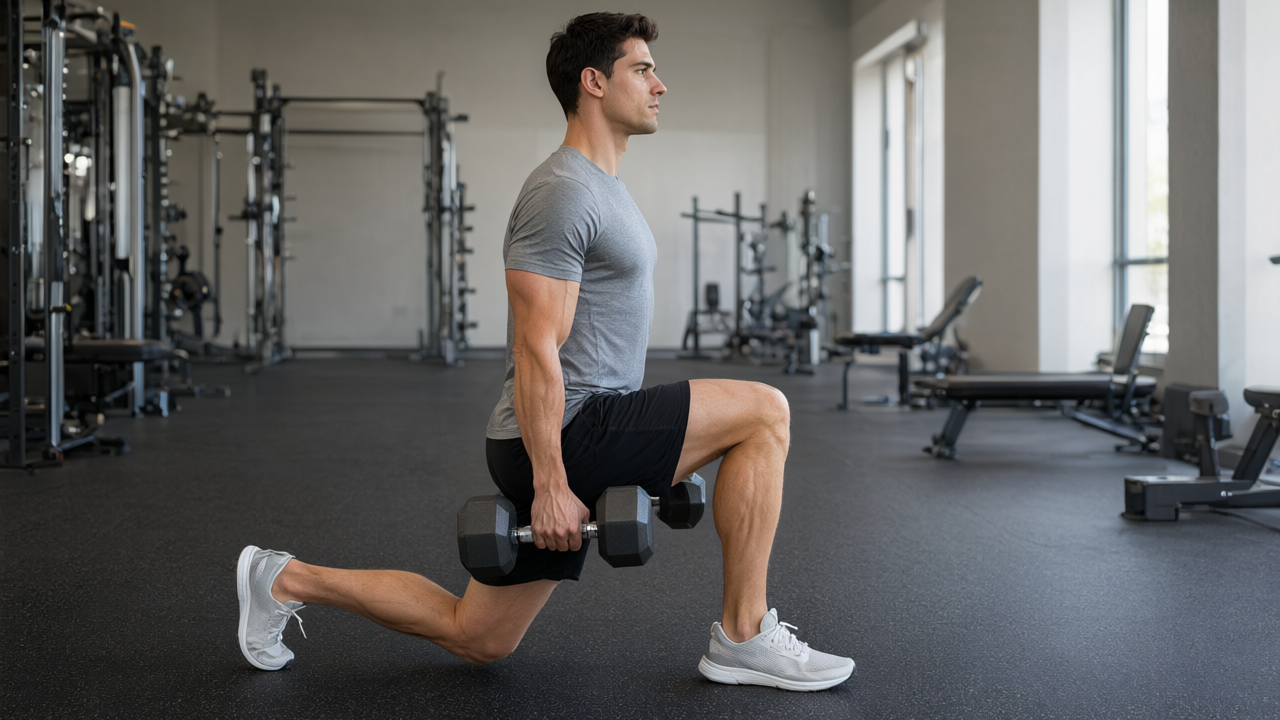
Forward Lunge
forward-lunge
Fai attenzione con
- avoid · Hip replacement (post-op) — Deep hip flexion combined with single-leg balance risks exceeding safe range-of-motion limits for a replaced joint. Instead, perform shallow step-ups to build unilateral leg strength within a controlled, limited range.
- caution · Acute knee injury — Stepping forward and decelerating places high shear force on the patellofemoral joint. Instead, perform reverse lunges or split squats to reduce forward knee translation while still training unilateral leg strength.
- caution · Acute lower back injury — Leaning forward or losing core tension forces the lumbar spine into hyperextension under load. Instead, perform supported split squats holding a wall to keep the torso perfectly upright without spinal stress.
When I step forward into a clean lunge, I feel a smooth, controlled descent where my front thigh burns just enough while my back leg stays engaged but relaxed. My core stays locked, keeping my torso tall as I drive back up with steady power. It’s a rhythmic, grounded movement that builds unilateral strength without jarring my knees, leaving me feeling balanced and strong with every rep.
Se sei nuovo in questo
As you begin, prioritize stability over depth. Keep your steps moderate so your center of gravity stays directly over your base of support, preventing that wobbly feeling. Your front knee should track in line with your second toe throughout the entire movement. If you feel sharp pain in the knee or your lower back begins to arch excessively, shorten your stride and stop the set immediately. Beginners often compensate by leaning too far forward or letting the front knee collapse inward; actively press your big toe into the floor to keep the knee aligned and your spine neutral. When fatigue sets in, you will notice your balance slipping or your trailing leg dragging; that is your signal to rest. Quality always outweighs quantity, so reset your posture between every single rep. With consistent practice, your proprioception will sharpen, and the movement will feel increasingly grounded and controlled.
Andare oltre
Once bodyweight sets of twelve per leg feel steady, hold dumbbells to increase the demand. The eight-to-twelve rep range builds muscle; dropping to six to eight with heavier dumbbells shifts the emphasis towards strength. Add load when you finish your target reps with two left in reserve. Slowing the descent to three or four seconds increases time under tension and forces the front quad and glute to work harder without extra weight. A deliberate one-second pause hovering above the floor removes momentum entirely and exposes any lingering instability. Drive up briskly from that pause. When loaded forward lunges become routine, progress to walking lunges, which remove the reset between reps and challenge your balance continuously. Alternatively, try the deficit forward lunge by stepping off a low plate to deepen hip flexion. For a variation that biases the glutes further, lengthen your stride slightly and lean your torso forward just a few degrees while keeping your spine neutral.
Errori comuni
Most lifters undermine the forward lunge by taking steps that are either too long or too short, which disrupts balance and shifts excessive stress to the front knee or trailing hip. Another frequent error is allowing the front knee to collapse inward toward the midline, which places unnecessary torque on the joint and reduces glute engagement. Many people also rush the descent, using momentum instead of muscular control, which turns a strength builder into a joint-pounding impact drill. Finally, failing to keep the torso upright forces the lower back into hyperextension and robs the quads and glutes of their intended workload.
Routine
- Sets
- 3
- Reps
- 8-12
- Rest
- 90s
- Tempo
- 2-0-2-0
- RPE
- 8
- Per set
- ~120s
- Frequenza
- 2-3x/week
Add dumbbells once you can complete 12 controlled reps per leg, then incrementally increase the load.
Cues
Muscoli
- Quadriceps
- Glutes
- Hamstrings
- Abs
- Hip flexors
Attrezzatura
- Bodyweight
- Dumbbells
- 1
Stand tall with feet hip-width apart, inhale deeply, and brace your core.
- 2
Keep your chest lifted and gaze fixed straight ahead to establish a neutral spine.
- 3
Step your right foot forward about two feet, planting the heel firmly as you exhale.
- 4
Lower your hips until both knees bend to roughly ninety degrees, keeping your front knee aligned over your toes.
- 5
Maintain an upright torso and hover your back knee just above the floor without letting it touch.
- 6
Drive through your right heel to stand back up, inhaling smoothly as you return to the starting position.
- 7
Step your left foot forward and repeat the descent, exhaling steadily while lowering your center of gravity.
- 8
Align your front shin vertically and distribute your weight evenly across both feet.
- 9
Push off your left heel to return to standing, inhaling as you straighten both legs completely.
- 10
Bring your feet back to hip-width alignment, exhale fully, and reset your posture before continuing.