
Treadmill Walk-Run Intervals
treadmill-walk-run-intervals
Perhatikan
- caution · Acute knee injury — The repetitive impact of running intervals loads the patellofemoral joint and tibial plateau. Instead, use the treadmill for incline walking only until cleared for impact.
- caution · Cardiac condition (un-cleared) — Rapid transitions between walking and running cause sudden heart rate spikes that may exceed safe thresholds. Instead, perform steady-state low-intensity walking on the treadmill with medical clearance.
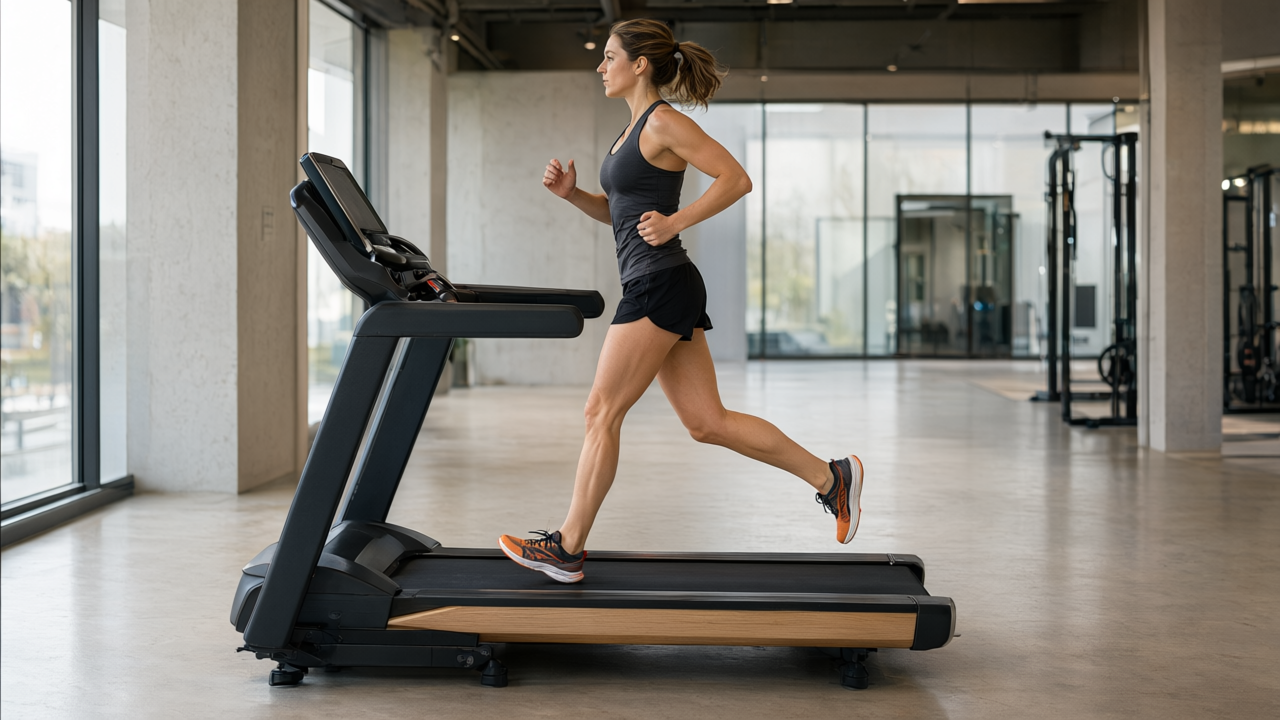
When I cue you into treadmill walk-run intervals, I am asking you to alternate short bouts of easy jogging with brisk walking on the treadmill. This builds your aerobic base without overloading joints or lungs too quickly. You will keep your torso upright, land softly under your hips, and let your arms swing freely. It is the most reliable way I know to transition safely from walking to continuous running.
Jika Anda Pemula
The first mistake I see beginners make is grabbing the treadmill handrails during the running portions. Holding on pulls your shoulders forward, collapses your chest, and completely changes your natural gait pattern. Keep your hands relaxed by your waist and let your arms drive the rhythm. Another common error is overstriding, meaning your foot lands far ahead of your hips. This acts as a brake and jars your knees. Instead, think about quick, light steps where your foot touches down directly underneath you. The running intervals should feel conversational; if you are gasping, reduce the treadmill speed slightly. You should feel your heart rate rise during the jog and settle comfortably during the walk. Stop immediately if you feel sharp pain in your shins, knees, or Achilles tendons. Mild muscle fatigue is expected, but joint pain means your pace is too fast or your session is too long. Build gradually over weeks.
Melangkah Lebih Jauh
Once sixty-second runs feel effortless, progress by lengthening the work intervals to two or three minutes while shortening the walks to sixty seconds. Maintain a conversational pace rather than chasing higher speeds on the treadmill. Aim for a cadence of roughly one hundred and seventy steps per minute during the running phases to improve efficiency. When you can complete thirty minutes of continuous running, transition to steady-state sessions. For variety, introduce a one-to-two percent incline on the treadmill during the running intervals to simulate outdoor wind resistance and increase glute recruitment. Alternatively, turn this into a fartlek-style session by varying the treadmill speed unpredictably within safe limits. Keep the total interval volume between twenty and forty minutes, excluding your warm-up and cool-down. Monitor your resting heart rate weekly; a downward trend confirms your aerobic base is adapting well to the increased load.
Kesalahan Umum
Holding the treadmill handrails is the most frequent error, and it ruins your posture by rounding your upper back and reducing core engagement. Let your arms swing naturally to counterbalance your legs. Overstriding is another issue; landing with your foot far ahead of your body creates a braking force that stresses the knees and shins. Focus on landing softly directly beneath your hips with a slight knee bend. Many people also stare down at their feet or the console, which flexes the cervical spine and restricts breathing. Keep your gaze level and your chin parallel to the floor. Finally, starting the running intervals too fast spikes your heart rate prematurely, forcing you to cut the session short. Begin each run phase at a pace where you could still speak in full sentences, and only increase the treadmill speed once your form feels settled and rhythmic.
Rutinitas
- Sets
- 1
- Reps
- 8–10 intervals of 60 seconds running and 90 seconds walking
- Rest
- 0s
- Tempo
- conversational pace
- RPE
- 5
- Per set
- ~1800s
- Frekuensi
- 3
increase run duration by 15–30 seconds weekly, decrease walk duration
Cues
Kardio
- Style
- interval
- Durasi
- 30 min
- Zone
- 2
- Work
- 60s
- Rest
- 90s
- Rounds
- 10
Otot
- Cardiovascular
- Quadriceps
- Glutes
- Calves
- Hamstrings
Peralatan
- Treadmill
- 1
Step onto the treadmill belt, clip the safety key to your clothing, and stand tall with feet hip-width apart.
- 2
Start the treadmill at a brisk walking pace, around five to six kilometres per hour, for five minutes to warm up.
- 3
Swing your arms naturally, keep your spine neutral, and look straight ahead rather than down at the console.
- 4
Increase the treadmill speed to an easy jog, roughly eight to nine kilometres per hour, and run for sixty seconds.
- 5
Exhale steadily as you run, landing each foot softly directly beneath your hips without reaching forward.
- 6
Reduce the treadmill speed back to your brisk walking pace and recover for ninety seconds, keeping your posture upright.
- 7
Repeat this alternating run-and-walk cycle eight to ten times, never gripping the handrails for support.
- 8
Finish with a five-minute brisk walk on the treadmill to cool down before stepping off carefully.